Key Takeaways
- The Philippine SEC warned against dYdX, Aevo, gTrade, Pacifica, Orderly, Deriv, and Ostium for operating without local authorization or licenses.
- The SEC said these platforms fall outside the CASP framework and are not legally allowed to offer or promote crypto investment services locally.
- CASP rules require crypto firms to register, maintain a local office, and meet at least ₱100 million capital before serving Philippine users.
The Philippine Securities and Exchange Commission (SEC) has released a public warning against several cryptocurrency platforms, including dYdX, Aevo, gTrade, Pacifica, Orderly, Deriv, and Ostium. The regulator said these platforms are not licensed to operate or offer investment services in the Philippines.
The advisory is part of the SEC’s ongoing enforcement of its Crypto-Asset Service Provider (CASP) rules, which require all crypto service providers targeting Filipino investors to register and secure proper authorization. The Philippine SEC pointed out that the mentioned platforms fall outside this regulatory framework and are considered unregistered and unauthorized.
Platforms Included in the Warning
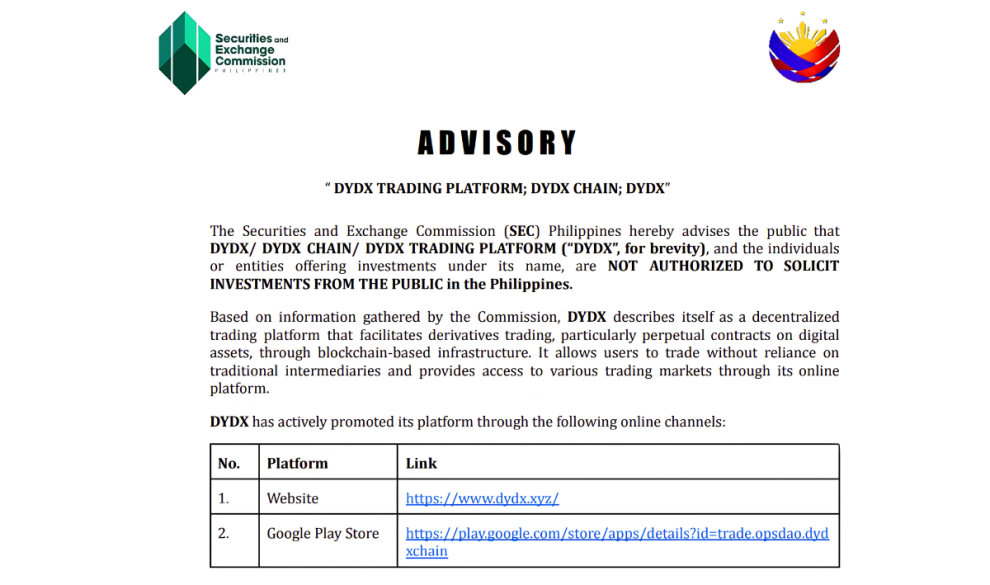
The SEC listed the following platforms in its advisory:
- dYdX
- Aevo
- gTrade
- Pacifica
- Orderly
- Deriv
- Ostium
The regulator noted that these platforms may be offering investment-related services or products without the required authorization, which could expose investors to potential risks.
No Local Registration or CASP Approval
Based on SEC records, none of the listed platforms are registered as companies or partnerships in the Philippines. The Commission also confirmed that none of them have the required Crypto-Asset Service Provider (CASP) license to legally operate in the country.
Under the SEC’s CASP rules, both local and foreign firms offering crypto services to people in the Philippines must be registered and licensed before they can offer or promote investments or trading.
The rules also require companies to follow strict conditions, including having a physical office in the Philippines and a minimum paid-up capital of ₱100 million. These requirements are meant to improve accountability, financial stability, and protect investors.
SEC Concerns on Unauthorized Solicitation
The SEC warned that some of these platforms may be offering or promoting investments that promise possible returns. However, without proper approval, these activities are not covered by regulated financial services in the country.
The Commission said that investors who use unregistered platforms are not protected under Philippine securities laws. This may leave them more exposed to financial losses, fraud, or false claims.
Investor Advisory and Risks
The SEC advised the public to exercise caution when using online trading platforms, especially those that promote high or guaranteed returns. It noted that some unlicensed operators may still be accessible to users in the Philippines despite not being authorized to operate locally.
The Commission recommended that investors check whether a platform is registered with the country’s SEC before investing. It also advised avoiding platforms that are not officially recognized, as they may not be subject to local regulations and investor protections.
Check a Platform’s SEC Registration First
The SEC’s advisory highlights the importance of regulation in the crypto space to make sure platforms operating in the Philippines follow legal and financial standards. Registration and licensing help ensure accountability and compliance with local rules. It also shows why it matters for investors to take a closer look at whether a platform is regulated by the country’s SEC before investing. When a platform is properly registered, there is clearer oversight and stronger investor protection. Without that, users may be taking on risks without the same level of safeguards in place.
Frequently Asked Questions
Why did the Philippine SEC issue a warning against these crypto platforms?
The SEC warned investors because dYdX, Aevo, gTrade, Pacifica, Orderly, Deriv, and Ostium are not licensed to operate or offer investment services in the Philippines.
Are these platforms registered in the Philippines?
No. According to the SEC, none of the listed platforms is registered as a company or partnership in the Philippines.
Do these platforms have CASP approval?
No. The SEC confirmed that none of the platforms hold Crypto-Asset Service Provider (CASP) authorization required to legally operate in the country.
What are the requirements under CASP rules?
Crypto firms must be registered with the SEC, establish a physical office in the Philippines, and maintain at least ₱100 million in paid-up capital.