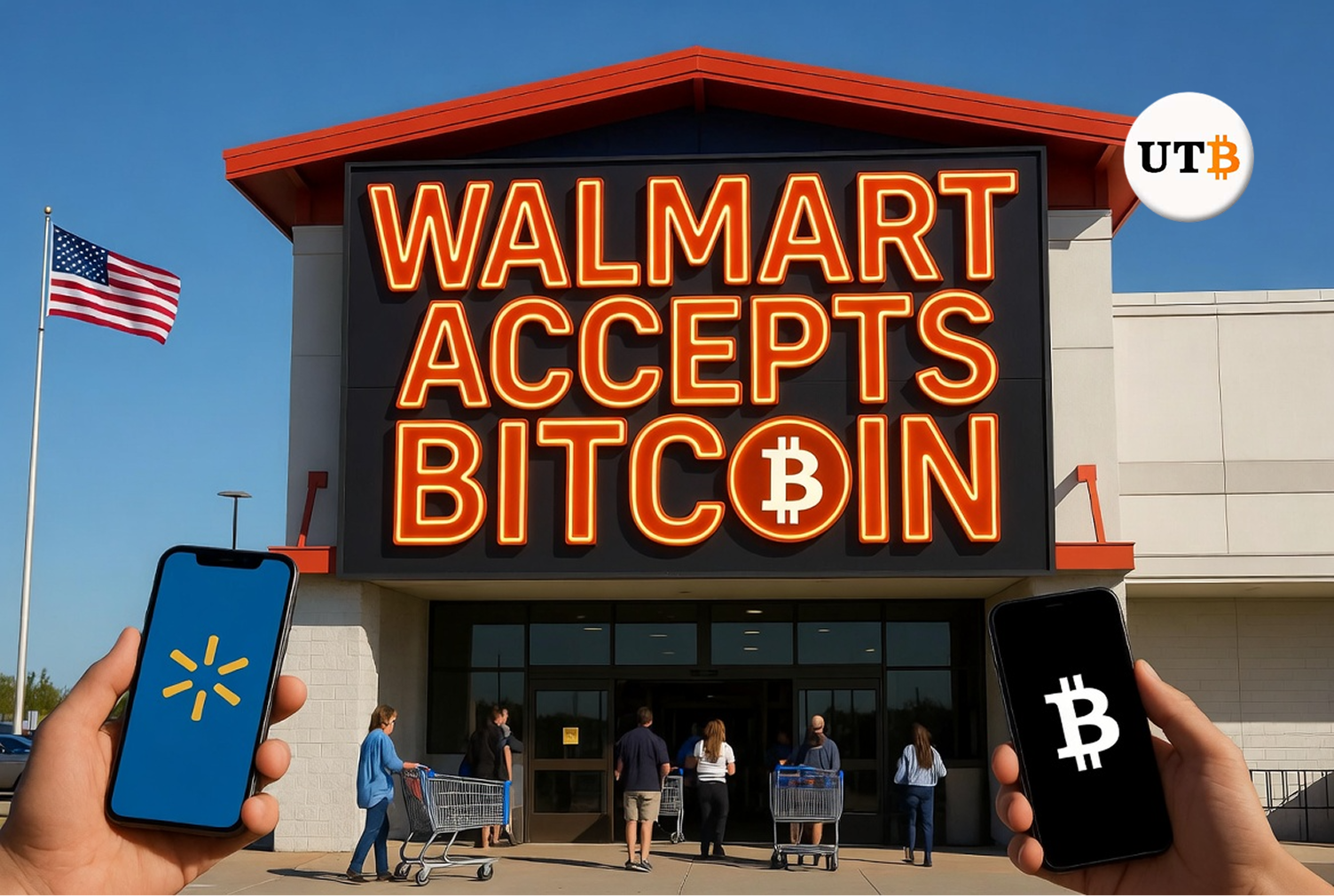
Walmart has quietly made one of the most significant moves in crypto adoption history – and most people do not fully understand what it actually means. Walmart-backed OnePay went live with Bitcoin, Ethereum, and XRP integration in January 2026, potentially reaching over 150 million weekly US shoppers.
The announcement triggered a wave of “Walmart accepts Bitcoin” headlines across crypto media. But fintech analyst Simon Taylor, who broke down the mechanics in detail, pointed out that the reality is more nuanced – and actually more interesting – than the headline suggests. This is not your standard crypto payment story. Here is what is actually happening, why it matters more than it appears, and what it means for Bitcoin’s future as everyday money.
Key Takeaways
- It works, but it is indirect. You sell your Bitcoin in the OnePay app and spend the USD balance at Walmart – the register never processes crypto directly. This is the same model Starbucks has used since 2021.
- The real play is the financial super-app. Walmart is using crypto as a hook to bring 150 million shoppers into a full mobile banking ecosystem – not just to enable BTC payments. Zero Hash, the infrastructure provider, is already trusted by Morgan Stanley and E-Trade.
- The unbanked opportunity is real. Walmart shoppers without traditional bank accounts can now use crypto holdings as a functional payment method – a genuine financial inclusion development that most coverage overlooked.
What Walmart OnePay actually is – and why it is Smarter than it Looks
OnePay is Walmart’s financial super-app. It combines mobile banking, debit rewards, a digital wallet, and now crypto – all in one application used by Walmart’s existing 150 million weekly shoppers. OnePay lets users buy, sell, hold, and convert Bitcoin and crypto, then use the fiat proceeds at checkout by converting them into USD at the point of payment. The crypto integration is powered by Zero Hash – a crypto infrastructure company that raised $104 million at a $1 billion valuation and already powers crypto features for E-Trade, Morgan Stanley, Apollo, and Interactive Brokers.
Simon Taylor’s analysis captured the real strategy: “They’re not trying to make crypto a payment rail. They’re using crypto as an engagement feature to own the banking relationship. That’s the real story.” OnePay is already the number five finance app on the Apple App Store – ahead of Chase and Robinhood, despite having barely scratched its potential customer base of 150 million weekly Walmart shoppers. The crypto feature is designed to pull those shoppers into a full financial ecosystem, not just to enable BTC transactions.
How to use Bitcoin at Walmart – Step-by-step
How to pay at Walmart using Bitcoin via OnePay:
- Download the OnePay app (available on iOS and Android) and create an account using your Walmart account credentials.
- Navigate to the crypto section inside OnePay and connect your existing crypto holdings or purchase Bitcoin, Ethereum, or XRP directly within the app via Zero Hash.
- Sell your crypto inside the app. The proceeds are instantly credited to your OnePay Cash balance in USD – no waiting, no external transfer needed.
- At Walmart checkout – in-store or online – scan the barcode in the OnePay app or select OnePay at the online checkout to pay with your Cash balance.
- Walmart still processes a standard USD payment. No crypto rails, no conversion delays at the register.
Why this Matters for Bitcoin Adoption – the Real Story
1. The scale argument – 150 million people is not a number to dismiss
Walmart serves approximately 150 million unique US shoppers every week. That is nearly half the entire US population interacting with one retail platform. Every one of those shoppers now has one-click access to buy, hold, and spend Bitcoin through an app they already use for banking. The accessibility barrier, the primary reason most people have never touched crypto, has been removed for the largest retail audience in America. This is crypto’s mainstream moment, even if the mechanism is indirect.
2. The unbanked argument – crypto as a financial bridge
Brian Spinelli, Co-CIO at Halbert Hargrove, highlighted a critical angle most coverage missed: “There are numerous people, even in the US, who are unbanked. They don’t use traditional banks, and this is going to make it easier for them to convert crypto holdings into a payment form. If you don’t have a bank account, but you own crypto on your phone, this is bridging that gap.” Walmart is disproportionately used by lower-income Americans. This integration gives that demographic a pathway to participate in retail commerce through crypto without needing a traditional bank account.
3. The tax warning – selling crypto is a taxable event in the US
Every time you sell Bitcoin or ETH inside OnePay to fund a Walmart purchase, that conversion is a taxable event under US law — just like selling crypto on Coinbase or Binance. If your Bitcoin has appreciated since you bought it, you owe capital gains tax on the difference. This is not a flaw in the OnePay system — it applies to all crypto-to-fiat conversions — but it is a critical detail that every user needs to understand before spending their holdings on groceries.
4. The volatility risk – what returns mean for crypto spenders
CK Zheng, co-founder and CIO of ZX Squared Capital, offered a cautionary note: spending Bitcoin on everyday purchases is only financially neutral if BTC’s price appreciation is lower than your cost of living needs. If Bitcoin continues to appreciate — as most bulls expect — spending BTC on groceries today could mean missing significantly larger purchasing power tomorrow. “Bitcoin should be viewed as an investment against the depreciation of the fiat currency.” Use crypto to pay off high-interest debt before using it to buy groceries.
What Comes Next? Retailers Watching Walmart
Walmart’s OnePay integration has already been cited by industry analysts as a potential inflection point for retail crypto adoption. If Bitcoin payments prove efficient and user-friendly at Walmart’s scale, other major retailers may follow, accelerating crypto acceptance across retail, e-commerce, and financial services. Amazon, Target, and Costco all have comparable fintech infrastructure, and the same incentive – locking shoppers into a financial super-app reduces dependence on third-party payment processors and generates data on consumer spending behaviour.
Starbucks has accepted Bitcoin and Ethereum since 2021 through a similar model via the SPEDN app; proof that the convert-to-fiat mechanism works at scale with minimal friction. Walmart’s move normalises the approach for every major US retailer still on the sidelines.
Frequently Asked Questions
Can you pay with Bitcoin directly at Walmart checkout?
Not directly. You sell your Bitcoin inside the OnePay app, and the converted USD balance is used to pay at checkout — either by scanning a barcode in-store or selecting OnePay online. The Walmart point-of-sale terminal processes a USD payment. The conversion from crypto to cash happens inside the app before the transaction, powered by Zero Hash.
Which cryptocurrencies does Walmart OnePay accept?
As of April 2026, OnePay supports Bitcoin (BTC), Ethereum (ETH), and XRP for buying, selling, and holding. Walmart is reportedly considering adding Dogecoin and stablecoins to expand payment options. Users can also access Bitcoin ATMs (Coinstar and CoinMe machines) inside many Walmart stores for cash-to-crypto conversions.
Is it a good idea to spend Bitcoin at Walmart?
It depends on your financial situation. Every crypto-to-USD conversion inside OnePay is a taxable event — you owe capital gains tax on any appreciation since purchase. If Bitcoin continues to rise in value, spending it on everyday items means giving up future purchasing power. Most financial advisors suggest spending crypto to pay off high-interest debt before using it for routine purchases. If you need to spend and Bitcoin is your most liquid asset, OnePay is a convenient and legitimate option.
What is Zero Hash and why does it matter?
Zero Hash is the crypto infrastructure company powering OnePay’s Bitcoin integration. It raised $104 million at a $1 billion valuation from Morgan Stanley, Apollo, and Interactive Brokers. Zero Hash also powers crypto features for E-Trade and several other major financial institutions. Its involvement gives OnePay institutional-grade security and compliance infrastructure — the same layer of trust that Wall Street uses for crypto exposure.
Will other retailers follow Walmart’s lead on Bitcoin?
Industry analysts widely expect that Walmart’s OnePay model will be studied and replicated by major retailers. Amazon, Target, and Costco all have comparable fintech capabilities. Starbucks has already used a similar convert-and-spend model since 2021. If OnePay’s crypto feature drives meaningful user engagement, the retail industry will accelerate crypto integration — making Walmart’s move a bellwether, not an outlier.
Does Walmart have Bitcoin ATMs?
Yes. Walmart stores across the US host Coinstar and CoinMe Bitcoin ATM kiosks that allow customers to convert cash into Bitcoin. These are separate from the OnePay app integration — they are physical machines for cash-to-crypto transactions, not crypto-to-fiat spending. Both options together make Walmart one of the most crypto-accessible retail destinations in the United States.
Related Read
$0 to $22,000: Crypto Airdrops that Created Overnight Millionaires