Key Takeaways
- Blockchain is changing banking, making transactions faster, safer, and more transparent, moving far beyond just cryptocurrency.
- Sending money across borders is now quicker, cheaper, and easier to track thanks to blockchain, with fewer banks and middlemen involved.
- Banks can verify customer identities faster, cut compliance costs, and keep personal data more secure with blockchain-based digital IDs.
Not long ago, blockchain was just the obscure technology powering Bitcoin, something most bankers dismissed or didn’t fully understand. Today, that same technology is quietly reshaping how money moves around the world. Every time you send a wire transfer or tap your card at checkout, a surprisingly complex chain of events unfolds behind the scenes, involving multiple banks, separate databases, and intermediaries at every step. It gets the job done, but in a world where speed and transparency matter more than ever, that is no longer enough, and blockchain is stepping in to fill the gap.
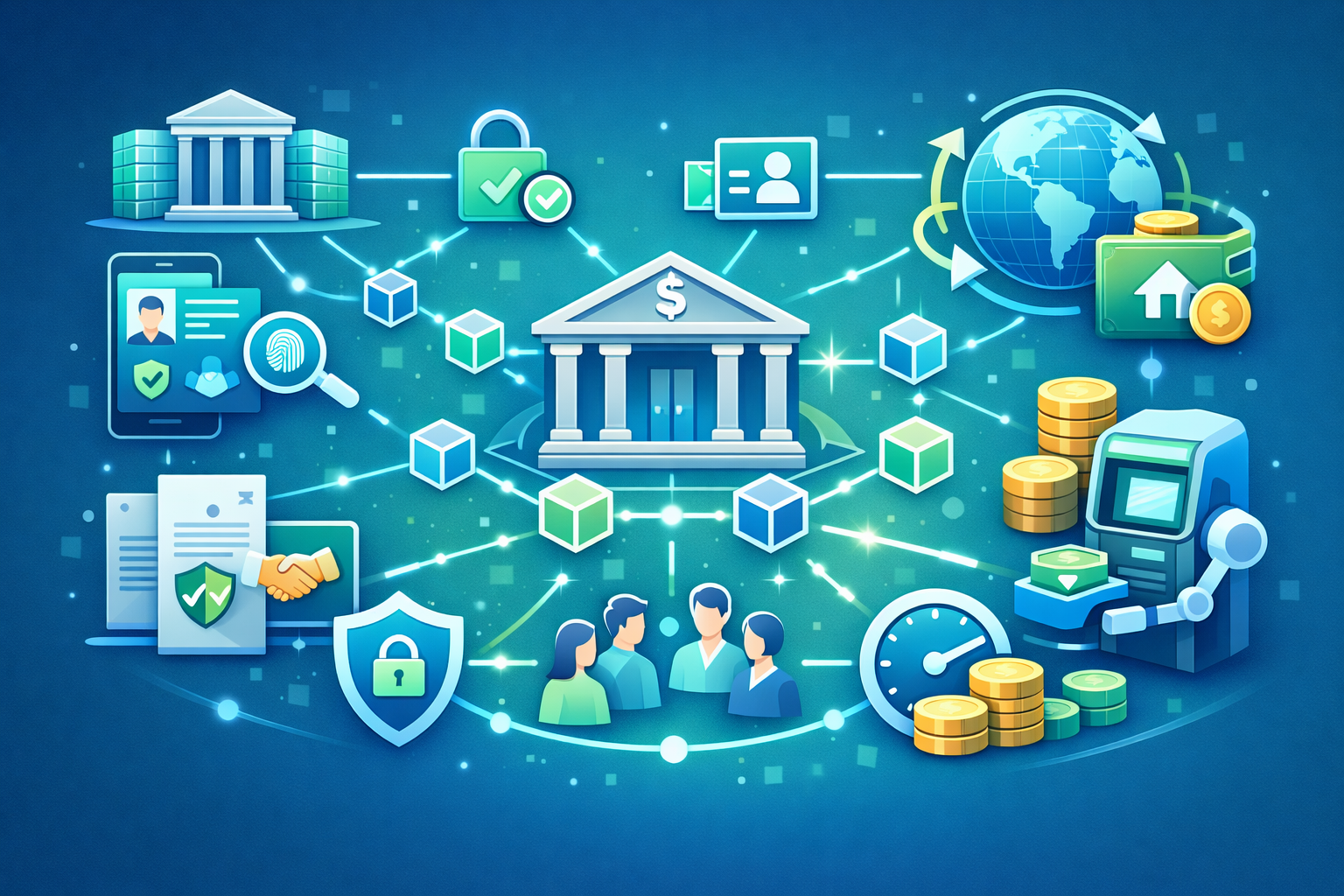
As a shared digital ledger that records transactions transparently and verifies them in real time, it removes the need for costly middlemen and cuts through the inefficiencies that traditional banking still relies on. Banks worldwide are already deploying it across payments, compliance, settlements, and digital asset management. In this article, we explore seven compelling ways blockchain is transforming modern banking.
1. Cross-Border Payments
Sending money across borders has always been slow and expensive. Traditional international transfers often pass through multiple banks, involve lots of paperwork, and take days to complete. Blockchain is changing that by allowing direct transfers between banks on a secure, shared digital ledger. This means money can move quickly, safely, and with fewer middlemen.
Here’s how banks benefit:
- Faster international settlements – payments that used to take days can now happen in minutes.
- Lower costs – fewer banks involved means smaller fees.
- Clear tracking – every transaction can be monitored in real time.
- Simpler process – less paperwork, fewer intermediaries, and reduced risk.
Some banks are already using blockchain to offer instant transfers to their clients, showing how this technology can truly modernize global payments.
2. Faster, Smarter Transaction Settlements
Settling financial transactions has traditionally been slow, complicated, and error-prone. Banks often have to reconcile multiple records across institutions, which can create delays, increase costs, and even lead to mistakes. Blockchain changes this by providing a shared, secure ledger that everyone involved can access. With all parties seeing the same information in real time, transactions can be confirmed much faster and with greater accuracy.
This brings several benefits: transactions reach finality almost instantly, operational costs drop due to fewer manual checks and intermediaries, settlement risk is reduced thanks to real-time transparency, and reconciliation becomes much simpler since there’s no need for repeated cross-checking. Banks and central banks around the world are already testing blockchain-based settlement systems, showing how this technology can modernize the backbone of financial transactions and make clearing and settlement faster, safer, and more efficient than ever before.
3. Making Global Trade Faster and Safer
Managing trade finance can be a real headache for banks and businesses. Letters of credit, invoices, shipping documents, and coordination between banks, exporters, importers, and logistics providers often create delays and increase costs. Fraud and errors can also creep in when information is handled manually across multiple parties.
Blockchain offers a smarter way by recording all trade documents on a secure, shared digital ledger. Everyone involved can access verified information instantly, which speeds up approvals and reduces mistakes. The main benefits include:
- Faster document verification – approvals and checks can happen almost immediately
- Reduced fraud risk – secure records make it much harder to manipulate documents
- Greater transparency across supply chains – all parties can track shipments and payments in real time
- Lower administrative costs – fewer manual processes and middlemen make operations more efficient.
By digitizing documentation and tracking transactions in real time, blockchain is helping banks and businesses simplify trade finance, lower risks, and make global supply chains far more efficient.
4. Identity Verification and KYC Compliance
Verifying customer identities is a vital part of banking, but it can be slow, repetitive, and expensive. Banks must follow strict Know Your Customer (KYC) regulations to prevent fraud, money laundering, and other financial crimes. Traditional processes often require customers to submit the same documents multiple times, and banks must manually verify them across different systems, which delays onboarding and increases operational costs.
Blockchain provides a smarter solution by creating secure digital identity systems. Verified customer information can be stored in a tamper-proof ledger and shared with permission across institutions, reducing duplication and improving accuracy. This approach allows banks to onboard customers faster, lower compliance costs, improve privacy and data security, and reduce the risk of identity theft.
By using blockchain-based identity systems, banks can simplify KYC processes while maintaining strong security standards and full regulatory compliance.
5. Smart Contracts for Automated Banking Services
Smart contracts are self-executing digital agreements stored on a blockchain that automatically carry out specific actions when certain conditions are met. In banking, these contracts can automate a wide range of processes that traditionally require manual verification and intervention. For example, smart contracts can handle loan approvals, insurance claims, vendor financing, and payment settlements without waiting for paperwork or human approval.
The advantages go beyond speed. By automating agreements, smart contracts reduce the chance of human error, cut operational costs, and ensure complete transparency, since all parties can see and verify the contract terms on the blockchain. This means banks can process transactions faster, provide more reliable services, and improve trust with customers and partners. Over time, the use of smart contracts can transform banking operations by making routine processes more efficient, secure, and predictable.
6. Fraud Prevention and Security
Fraud and cybercrime are major concerns for banks and financial institutions. Traditional systems can struggle to prevent sophisticated attacks, but blockchain helps avoid these risks through its secure and immutable ledger. Every transaction is time-stamped, encrypted, and permanently stored, making it extremely difficult to alter or delete. This creates a verifiable audit trail, improves traceability, and reduces opportunities for fraudulent activity.
Key benefits for banks include:
- Stronger data integrity – records are permanent, accurate, and tamper-proof
- Easier detection of suspicious transactions – real-time monitoring helps identify anomalies quickly
- Greater transparency in financial records – every activity is recorded on a verifiable ledger
- Improved security for customer data – sensitive information is encrypted and better protected
7. Asset Tokenization
Asset tokenization is quickly becoming one of the most exciting uses of blockchain in banking. It lets real-world assets like stocks, bonds, real estate, or commodities be turned into digital tokens that can be easily traded and tracked on a blockchain. This also makes it possible for investors to own a fraction of an asset instead of the whole thing, which not only increases liquidity but also opens up opportunities for more people to participate in markets that were once hard to access.
For banks, tokenization opens up a world of possibilities. It lets them offer new types of digital investments, speed up trading, and make financial assets more accessible to a wider range of investors. Many leading financial institutions are already experimenting with tokenized securities and blockchain-based investment products, looking for ways to modernize markets and give clients easier, smarter ways to invest and grow their wealth.
Final Thoughts
Blockchain is no longer just the technology behind cryptocurrencies. It is transforming the way banks work by making transactions faster, safer, and more transparent. From speeding up cross-border payments and simplifying trade finance to improving identity verification, automating processes with smart contracts, preventing fraud, and enabling asset tokenization, blockchain is helping banks reduce costs, lower risks, and provide better experiences for their customers. As more financial institutions adopt these solutions, blockchain is becoming the foundation for a smarter, more efficient, and innovative future in banking.
You Might Also Like: