Key Takeaways:
- TRON processes majority of global USDT transfers making it the remittance leader
- Solana offers instant 400ms settlement versus TRON’s 1-minute confirmation
- Fee structures favor Solana at sub-cent costs but TRON enables free transactions through staking
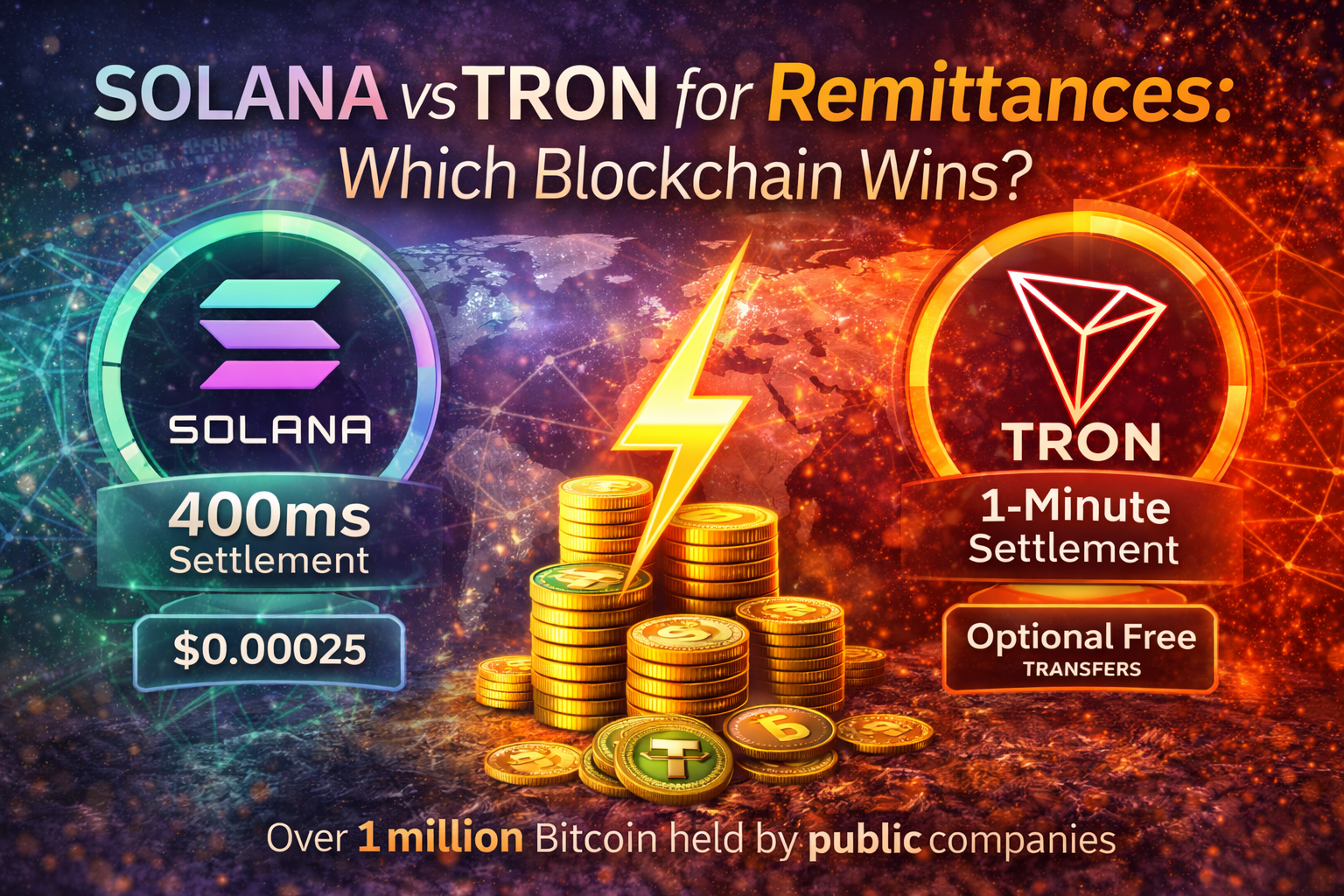
Solana vs TRON for remittances presents different strengths for cross-border payments. TRON dominates stablecoin transfers with over 50% of all USDT circulating on its network. Solana offers faster settlement at 400ms compared to TRON’s 1-minute finality. Transaction costs differ significantly: Solana charges $0.00025 while TRON ranges from $0.02 to $1.00 depending on energy availability.
How Do Transaction Speeds Compare for Remittances?
Solana vs TRON for remittances shows stark differences in settlement times. Solana finalizes transactions in approximately 400 milliseconds. This near-instant confirmation means recipients access funds almost immediately after senders initiate transfers.
TRON requires roughly 1 minute for transaction finality. While slower than Solana, this still beats traditional remittance services. Banks and money transfer operators take 1-5 business days for international transfers. TRON’s 1-minute window provides significant improvement over legacy systems.
The Firedancer upgrade deployed in 2026 enhanced Solana’s reliability. Historical network outages plagued earlier versions. Current infrastructure maintains consistent uptime while processing 700-1,200+ transactions per second.
TRON achieves 110-240 TPS with 99.9% uptime reliability. The network rarely experiences congestion spikes that occasionally affect Solana. Exchanges and institutions prefer TRON’s stability for large-value transfers.
Settlement speed matters differently depending on use case. Emergency remittances benefit from Solana’s 400ms finality. Regular monthly transfers work fine with TRON’s 1-minute confirmation. Both significantly outperform traditional banking rails.
What Are the Real Costs for Sending Money?
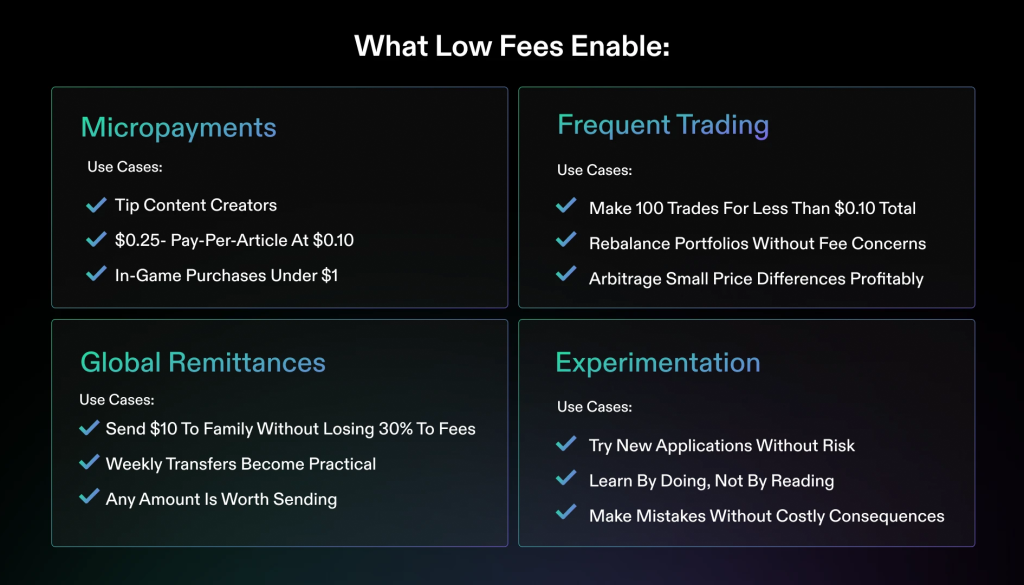
Solana vs TRON for remittances reveals complex fee structures beyond headline numbers. Solana charges approximately $0.00025 per transaction. This sub-cent cost remains consistent regardless of transfer amount. Sending $10 or $10,000 costs the same negligible fee.
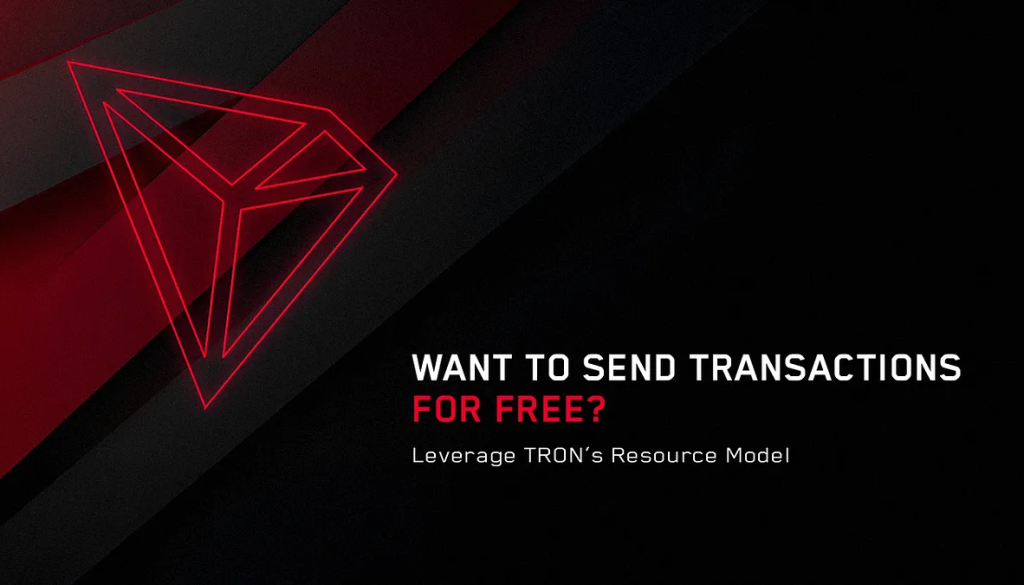
TRON’s fee structure operates differently through its energy and bandwidth model. Users who stake TRX tokens receive free transaction bandwidth. Staking 8,100 TRX provides enough bandwidth for one free daily transaction.
Without staked TRX, TRON transactions cost $0.02 to $1.00 depending on network congestion. Complex smart contract interactions require more energy and higher fees. Simple USDT transfers typically cost $0.02-0.05 when paying directly.
The staking model benefits frequent users significantly. Sending stablecoins regularly makes TRX staking economically viable. One-time senders pay per transaction without staking requirements.
Solana offers fee abstraction allowing sponsors to cover transaction costs. Remittance platforms can absorb the sub-cent fees entirely. Users pay only the stablecoin amount without worrying about SOL tokens for gas.
TRON requires users to hold TRX for either staking or paying fees directly. This adds friction for recipients unfamiliar with cryptocurrency. Platforms must provide TRX or absorb costs for smooth user experience.
Batch transactions improve efficiency on both networks. Solana supports bundling multiple payments into single transactions. This further reduces per-payment costs for businesses processing many transfers.
Which Network Handles More Stablecoin Volume?
TRON dominates stablecoin circulation with over 50% of all USDT supply. Tether issued approximately $60 billion USDT on TRON as of 2026. This makes TRON the primary banking layer for global stablecoin transfers.
Exchanges integrate TRON USDT as their primary deposit and withdrawal option. Binance, Kraken, and other major platforms default to TRON for USDT movements. Users recognize TRC-20 USDT as the standard for crypto-to-crypto transfers.
Solana processed over $1 trillion in stablecoin volume during 2025. This includes USDC, USDT, and other dollar-pegged tokens. The volume demonstrates significant adoption but doesn’t translate to circulation dominance.
Emerging markets rely heavily on TRON USDT for remittances. Countries with capital controls use crypto as alternative payment rails. TRON’s stability and exchange integration make it accessible globally.
Solana attracts DeFi and trading activity driving its volume numbers. High-frequency traders move stablecoins between protocols rapidly. This creates volume without corresponding long-term circulation.
The network effect matters tremendously for remittances. Recipients need easy ways to convert received stablecoins to local currency. TRON’s ubiquity across exchanges simplifies this final mile problem.
How Does Decentralization Affect Remittance Reliability?
Solana operates with approximately 3,200+ validators securing the network. This distributed validator set provides strong censorship resistance. No single entity controls enough stake to manipulate transactions.
TRON relies on 27 Super Representatives controlling network consensus. This centralized structure enables rapid decision-making and efficiency. However, it concentrates power among a small group of entities.
Decentralization implications for Solana vs TRON for remittances include:
- Censorship resistance: Solana’s distributed validators make transaction blocking difficult
- Regulatory risk: TRON’s centralization creates potential regulatory pressure points
- Uptime reliability: TRON’s coordination enables consistent 99.9% uptime
- Network governance: Solana requires broader consensus for protocol changes
The centralization trade-off provides TRON with operational advantages. The 27 Super Representatives coordinate upgrades efficiently. This prevents the governance gridlock affecting more decentralized networks.
Solana’s decentralization requires expensive hardware for validator operation. High-end servers cost $10,000+ annually to run. This creates barriers to validator participation despite theoretical openness.
TRON’s Delegated Proof of Stake allows token holders to vote for Super Representatives. The voting mechanism provides some democratic oversight. However, large token holders wield disproportionate influence.
Remittance users care more about reliability than ideological decentralization. Both networks maintain sufficient decentralization for payment processing. Neither faces imminent shutdown risks affecting user funds.
What Role Do Tokenomics Play in Long-Term Viability?
Solana follows an inflationary model issuing approximately 4% new SOL annually. This inflation rewards validators securing the network. The issuance rate gradually decreases over time but never reaches zero.
TRON operates deflationary tokenomics burning more TRX than it issues. Transaction fees paid in TRX get burned permanently. High stablecoin transfer volume creates significant burn pressure.
The deflationary mechanics make TRX attractive to holders seeking asset appreciation. Reduced supply combined with steady demand pushes prices upward. This appeals to users staking TRX for free transactions.
Solana’s inflation dilutes existing SOL holders unless they stake. Unstaked SOL loses approximately 4% annual value to inflation. This incentivizes participation in network security through staking.
TRON burns excess fees beyond what validators require. The protocol generates significant revenue from USDT transfers. This creates a profitable blockchain with value accruing to TRX token holders.
Solana prioritizes network growth over current profitability. The inflationary rewards attract validators securing high-performance infrastructure. This trade-off sacrifices immediate token value for long-term network quality.
Remittance platforms considering Solana vs TRON for remittances should evaluate token economics. TRON’s deflationary model provides better long-term holding incentives. Solana offers superior technical performance at cost of inflation.
Which Ecosystem Better Supports Remittance Applications?
Solana dominates DeFi, NFTs, and high-frequency trading applications. January 2026 data showed Solana dApps leading industry revenue. Platforms like Jupiter and Pump.fun drive massive transaction volumes.
This DeFi ecosystem creates complementary services for remittances. Users can earn yield on stablecoin balances between transfers. Lending protocols provide additional utility beyond simple payments.
TRON focuses specifically on payments and stablecoin infrastructure. The network optimized for this use case rather than broader Web3 applications. Limited DeFi ecosystem means fewer complementary services.
Developer tooling on Solana supports complex payment applications. Native fee abstraction allows sponsors to cover gas costs. Embedded memos enable transaction reconciliation for businesses.
TRON’s resource model through energy and bandwidth staking suits frequent users. The free transaction capability appeals to remittance corridors with tight margins. Cost predictability helps businesses model operational expenses.
Solana’s parallel execution processes transactions simultaneously. This increases throughput for platforms handling many concurrent payments. Local fee markets prevent network congestion from affecting payment flows.
TRON’s simplicity reduces technical complexity for basic remittance applications. Developers don’t need sophisticated blockchain knowledge. The straightforward model suits traditional money transfer operators exploring blockchain.
Integration with exchanges matters critically for remittance recipients. TRON’s universal support across platforms simplifies cash-out processes. Solana integration continues growing but hasn’t achieved TRON’s ubiquity.
Frequently Asked Questions
Which is faster for remittances, Solana or TRON?
Solana finalizes transactions in 400 milliseconds compared to TRON’s 1-minute settlement. Both significantly outperform traditional 1-5 day bank transfers for cross-border payments.
How much do transactions cost on each network?
Solana charges approximately $0.00025 per transaction. TRON costs $0.02-$1.00 unless users stake TRX for free bandwidth. Frequent senders benefit from TRON staking model.
Which network processes more stablecoin transfers?
TRON dominates with over 50% of all USDT circulation. The network serves as primary infrastructure for global stablecoin movements and exchange integrations.
Is Solana or TRON better for small remittances?
Solana’s sub-cent fees work better for very small transfers. TRON’s minimum $0.02 fee represents higher percentage cost for micro-remittances below $10.
Which blockchain is more reliable for payments?
TRON maintains 99.9% uptime with rare congestion issues. Solana improved significantly after Firedancer upgrade but historically experienced more network disruptions.