Ripple’s RLUSD stablecoin has grown to roughly $1.58 billion in market capitalization and is now expanding onto Ethereum layer-2 networks including Optimism, Base, Ink, and Unichain, using Wormhole’s Native Token Transfers standard, according to CoinMarketCap. The expansion matters because RLUSD no longer needs the XRP Ledger, or XRP itself, to move value, a shift that touches the bridge-currency role XRP was originally built to fill.
What Happened
Ripple has been stacking up institutional wins for RLUSD on a track separate from XRP. CoinMarketCap reported that Mastercard partnered with Ripple, Gemini, and WebBank to pilot RLUSD settlements for credit card transactions on the XRP Ledger, one of the first times a regulated U.S. bank has settled card payments using a regulated stablecoin on a public blockchain.
In December 2025, Ripple also cleared a bigger regulatory step. CoinDesk reported that the OCC granted the company conditional approval to become a federally chartered national trust bank, with CEO Brad Garlinghouse calling it a “massive step” for RLUSD.
XRP, meanwhile, is tracking its own storyline in Washington. CoinDesk reported that the Senate Banking Committee advanced the CLARITY Act in a 15-9 vote in May 2026, a bill that would classify XRP as a federally recognized digital commodity, though the full Senate hadn’t voted on it as of early July 2026.
What This Means for XRP Holders
Not every RLUSD headline is bullish for XRP. The token still earns demand through Ripple’s On-Demand Liquidity corridors like USD-MXN and USD-PHP, per Yahoo Finance Crypto, and stands to gain legal clarity if the CLARITY Act passes.
But CoinGecko notes that RLUSD’s network fees are paid in XRP only on the XRP Ledger, and in ETH on Ethereum, so RLUSD activity shifting onto Ethereum and its layer-2s generates no XRP demand at all. Readers newer to these mechanics can find the basics in our crypto guides section, and our breakdown of how Ripple’s XRP valuation actually works covers the same ODL-versus-RLUSD split in more depth.
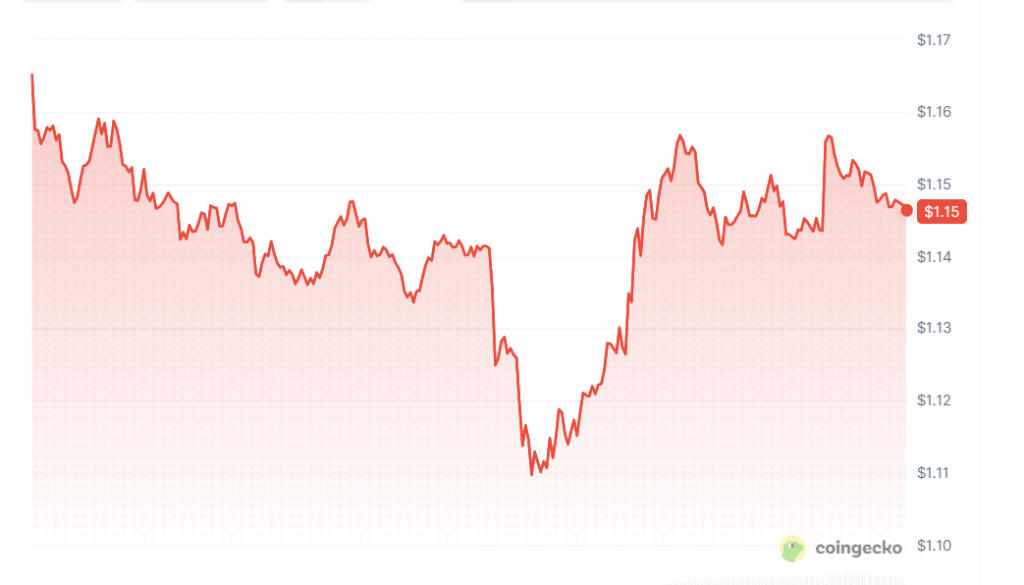
XRP itself trades near $1.15, with a market capitalization around $71.75 billion, according to CoinGecko.
The Catalyst to Watch: A Full Senate Vote on CLARITY
The next concrete marker is the Senate’s floor vote on the CLARITY Act, expected before the August 2026 recess. A passed bill locks in XRP’s federal commodity status, but it won’t slow RLUSD’s expansion onto Ethereum and its layer-2s, which sits on a separate regulatory track entirely.
This article is for informational purposes only and does not constitute financial advice. Do your own research before making any investment decisions.
What this means for you: RLUSD’s growth is not a proxy for XRP’s growth, so track each asset’s own catalysts separately rather than assuming one lifts the other.