
Key Takeaways
- The Ethereum Foundation has staked around $46.2M in ETH, putting a substantial portion of its reserves to work in Ethereum’s proof-of-stake system instead of keeping them idle.
- By staking ETH, the Foundation helps strengthen network security, as validators use staked assets to confirm transactions and maintain blockchain integrity.
- Locking up this amount of ETH also reduces liquid supply, reflecting a longer-term commitment and limiting immediate selling pressure from its holdings.
The Ethereum Foundation just made one of its biggest moves yet, staking around $46.2 million worth of ETH. Instead of letting that money sit idle in reserve, the Foundation is now putting it directly into Ethereum’s proof-of-stake system, where participants lock up ETH to help verify transactions and keep the network secure. It is a notable change in how the Foundation has handled its funds, and given how much is on the table, it is a move that is hard to overlook.
The timing matters too. Ethereum has been under pressure lately, with rival blockchains gaining ground and questions swirling about the network’s long-term direction. Staking this much capital is the Foundation’s way of saying it is not just watching from the sidelines but is fully invested in where Ethereum is going. For anyone following the crypto space, it is a big statement from the group that helped build Ethereum from the ground up.
Why Staking Matters for Ethereum?
Staking is essentially how Ethereum keeps itself secure and running. When participants lock up their ETH, they become validators, confirming transactions and defending the blockchain from bad actors. The more people that stake, the harder it becomes to attack the network, making the whole system more reliable over time. It also takes ETH out of active circulation, which can help support its value while keeping everyone involved with a real stake in seeing the network succeed.
As Ethereum grows and handles more users and activity, staking is one of the core things keeping it all together. It supports decentralization, builds trust in the system, and helps the network scale without falling apart. Simply put, staking is not just a feature of how Ethereum works. It is a big part of why it works.
A Major Vote of Confidence in Ethereum
The Ethereum Foundation’s decision to stake such a large amount of ETH is being seen as a strong vote of confidence in Ethereum. By committing these funds, the foundation is actively putting part of its treasury to work in the network’s validation process, helping confirm transactions and strengthen overall blockchain security.
Unlike holding ETH in liquid form, staking requires locking tokens for a period of time, limiting immediate selling. This signals a longer-term outlook and may help reduce short-term sell pressure.
Source: Arkham
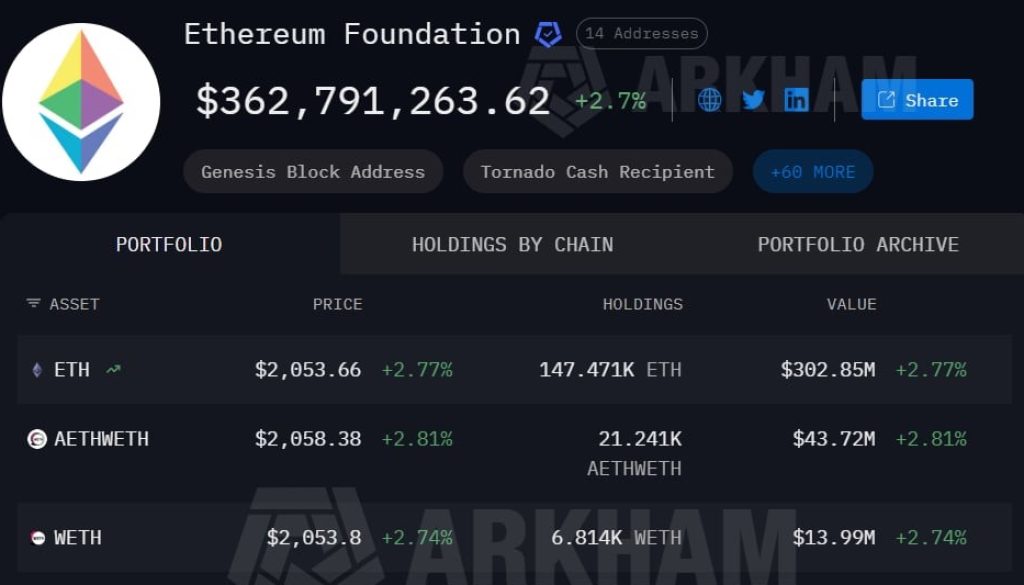
At the time of writing, the foundation holds around 147,471 ETH, valued at roughly $302 million, meaning a large portion of its reserves is now contributing directly to the network. The move also aligns its treasury strategy more closely with the broader Ethereum ecosystem, where staking plays a key role in both security and yield generation.
Treasury Strategy Shift: From Holding to Earning
The move toward staking brings several key benefits for the Ethereum Foundation in how it manages its Ethereum treasury:
- Creates a source of ongoing staking rewards, adding yield to existing holdings.
- Puts idle ETH to work by actively participating in network validation.
- Strengthens Ethereum’s security by helping support the proof-of-stake mechanism.
- Improves treasury efficiency by generating returns from assets already held.
- Reduces reliance on selling ETH, helping preserve long-term exposure to the asset.
- Aligns the foundation’s financial strategy with the operational model of Ethereum’s proof-of-stake system.
Market and Ecosystem Implications
This staking move has real ripple effects for both the crypto market and the broader Ethereum ecosystem, and a few things are worth paying attention to.
Reduced Circulating Supply
Staking ETH pulls it out of active circulation. When a chunk that size is locked up, it tightens supply, and over time that kind of constraint can start to influence how the market prices ETH.
Institutional Signal
The Ethereum Foundation is one of the most closely watched organizations in crypto, and a staking commitment this size does not go unnoticed. For investors and developers, it reads as a direct vote of confidence in Ethereum’s security model and where the network is heading long term.
Reinforcing PoS Adoption
Ethereum’s transition from mining was one of the biggest changes in blockchain history, and having a major player like the Ethereum Foundation actively participating sends a message that the model is working and worth backing. That kind of validation can encourage others across the ecosystem to follow suit.
What This Means Going Forward
The Ethereum Foundation’s $46.2 million staking move shows a stronger connection between how institutions manage their treasuries and how they actively participate in Ethereum’s network.
Looking ahead, this could lead to a few key developments:
- More ETH being staked as participation continues to grow.
- Increased involvement from institutions in network validation.
- Greater focus on treasury strategies that generate yield instead of just holding assets.
- A stronger perception of Ethereum as a secure, stable, and more mature blockchain.
Why the Foundation Is Staking Its Own ETH
The Ethereum Foundation’s decision to stake $46.2 million worth of ETH is more than just a treasury move. It reflects real confidence in Ethereum’s proof-of-stake system and the direction the network is heading. By putting a significant portion of its holdings to work, the Foundation is backing network security while aligning its financial strategy with how Ethereum actually operates today. At a bigger picture, this reflects a major transition in how major players are engaging with Ethereum. Instead of just holding ETH, key organizations are now actively putting it to work, and that kind of participation is what makes the network stronger over time. For the market, it is also a telling sign that those closest to Ethereum still believe in where it is going, even as rival blockchains continue to push for their own share of the space.
Frequently Asked Questions
What did the Ethereum Foundation do with its ETH holdings?
The Ethereum Foundation allocated around $46.2 million worth of Ethereum into staking, putting a portion of its treasury to work within the network’s proof-of-stake system.
Why is staking important in Ethereum?
Staking is a core part of how Ethereum maintains security and validates transactions through its proof-of-stake mechanism, helping protect the network from attacks while keeping it operational.
Does staking affect Ethereum’s circulating supply?
Yes. When ETH is staked, it is locked and removed from active circulation, which can reduce available supply in the market over time.
How does this impact Ethereum’s security?
More staked ETH increases the number of validators securing the network, making it more difficult for malicious actors to attack or manipulate the blockchain.
Could this lead to more institutional participation in staking?
Yes. Actions by the Ethereum Foundation may encourage other institutions to consider staking as part of their treasury and asset management strategies.