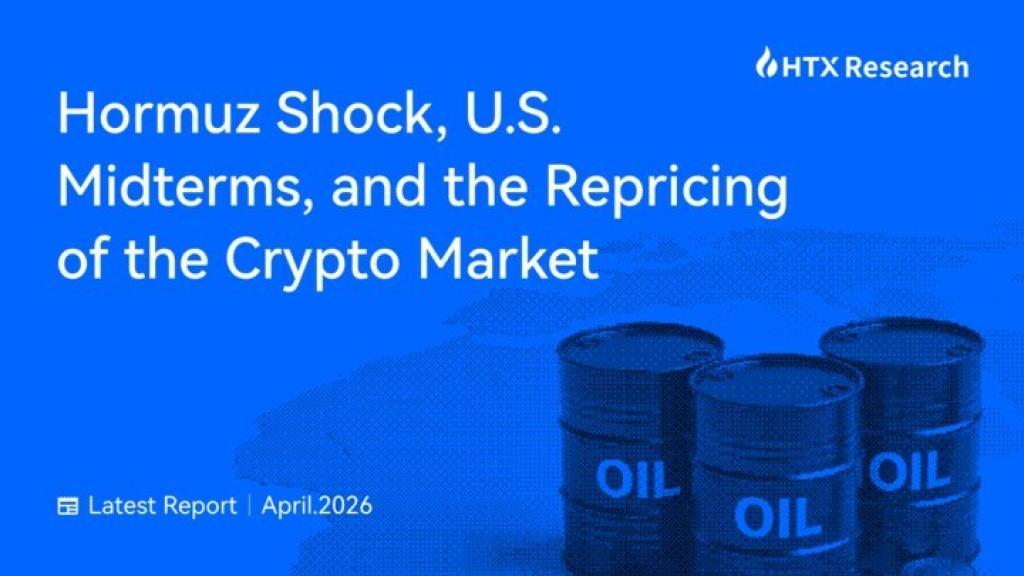
PANAMA CITY, April 14, 2026 /PRNewswire/ — HTX Research, the dedicated research arm of HTX Group, has released a new report titled Hormuz Shock, U.S. Midterms, and the Repricing of the Crypto Market. HTX Research concludes that the macro framework has shifted from “easing-driven risk recovery” to a more restrictive regime defined by geopolitical energy shock, higher-for-longer rates, and rising policy uncertainty. The crypto market’s near-term trajectory has moved toward defense, stratification, and repricing. This assessment, detailed in the new report Hormuz Shock, U.S. Midterms, and the Repricing of the Crypto Market, echoes HTX’s recently published 2026 Digital Asset Trends White Paper, which noted that digital asset volatility is now increasingly driven by funding costs, yield curves, and dollar index movements.
HTX Research concludes that the macro framework has shifted from “easing-driven risk recovery” to a more restrictive regime defined by geopolitical energy shock, higher-for-longer rates, and rising policy uncertainty. The crypto market’s near-term trajectory has moved toward defense, stratification, and repricing. This assessment echoes HTX’s recently published 2026 Digital Asset Trends White Paper, which noted that digital asset volatility is now increasingly driven by funding costs, yield curves, and dollar index movements. The current report shows how that transmission played out in real time within 72 hours of a single geopolitical event.
Market Reactions That Broke Conventional Assumptions
The cross-asset response provides the essential context. Brent crude surged over 7% to above $108. The 10-year Treasury yield rose to roughly 4.37%. Bitcoin fell to the $66,000–$67,000 range. So far, a standard wartime risk-off. But gold and silver also dropped — breaking the near-universal assumption that war benefits precious metals.
The actual chain: oil spike → higher inflation expectations → compressed Fed easing room → stronger dollar and real yields → forced contraction of global risk budgets. This was a liquidity-contraction shock, not a classic flight to safety. In a traditional safe-haven episode, BTC could lean on a “digital gold” narrative. In a liquidity squeeze, nearly every asset dependent on marginal inflows comes under first-stage pressure. The 2026 White Paper anticipated this in its systemic risk analysis: during extreme geopolitical stress, BTC remains subject to macro clearing pressure and correlates with traditional risk assets. April 2 validated that framework.
Why a Strait Thousands of Miles Away Matters for Crypto
The report identifies a core asymmetry in how global energy chokepoints impact crypto liquidity. Historical data shows that disruptions to major transit corridors—such as the Strait of Hormuz—disproportionately impact Asian and European importers. This creates a specific macro result: localized energy shocks often strengthen the U.S. Dollar, as the U.S. leverages domestic energy capacity while other major economies face rising costs.
A stronger dollar effectively compresses non-U.S. liquidity. As global institutions manage currency depreciation and rising energy overheads, risk budgets for volatile allocations are reduced. HTX Research notes that this capital contraction follows a specific hierarchy: capital exits the “outermost ring” of the risk curve first. While BTC retains relative resilience due to deeper institutional ownership and liquidity, most altcoins—positioned at the outer edge of global dollar liquidity—face the most immediate and pronounced clearing pressure.
Stablecoins and RWA: Structural Resilience Under Stress
Not every crypto vertical weakens equally. Rising macro uncertainty and stronger dollar demand make USD stablecoin settlement more relevant, particularly for users in Asia and emerging markets facing simultaneous currency depreciation and energy cost pressure. RWA assets backed by real yield — on-chain Treasuries, private credit — display defensive characteristics when risk appetite retreats from narrative-driven tokens. The White Paper provides structural context: stablecoins now constitute a $300 billion-plus on-chain dollar system, while the RWA market has grown at roughly 30% CAGR over three years.
Four High-Frequency Signals to Watch
HTX Research identifies four indicator clusters for the next six to ten weeks: oil and shipping (whether Brent sustains a decline below $100); rates and the dollar (whether the 10-year yield and DXY have peaked); crypto internals (BTC ETF flows, stablecoin net issuance, altcoin volume share); and policy (CLARITY Act progress and how crypto issues interact with inflation narratives in swing districts). Improvement in two or more clusters would signal a potential recovery phase. Otherwise, deleveraging and repricing remain the dominant theme.
About HTX Research
HTX Research is the dedicated research arm of HTX Group, responsible for conducting in-depth analyses, producing comprehensive reports, and delivering expert evaluations across a broad spectrum of topics, including cryptocurrency, blockchain technology, and emerging market trends. Committed to providing data-driven insights and strategic foresight, HTX Research plays a pivotal role in shaping industry perspectives and supporting informed decision-making within the digital asset space. Through rigorous research methodologies and cutting-edge analytics, HTX Research remains at the forefront of innovation, driving thought leadership and fostering a deeper understanding of evolving market dynamics. Visit us.