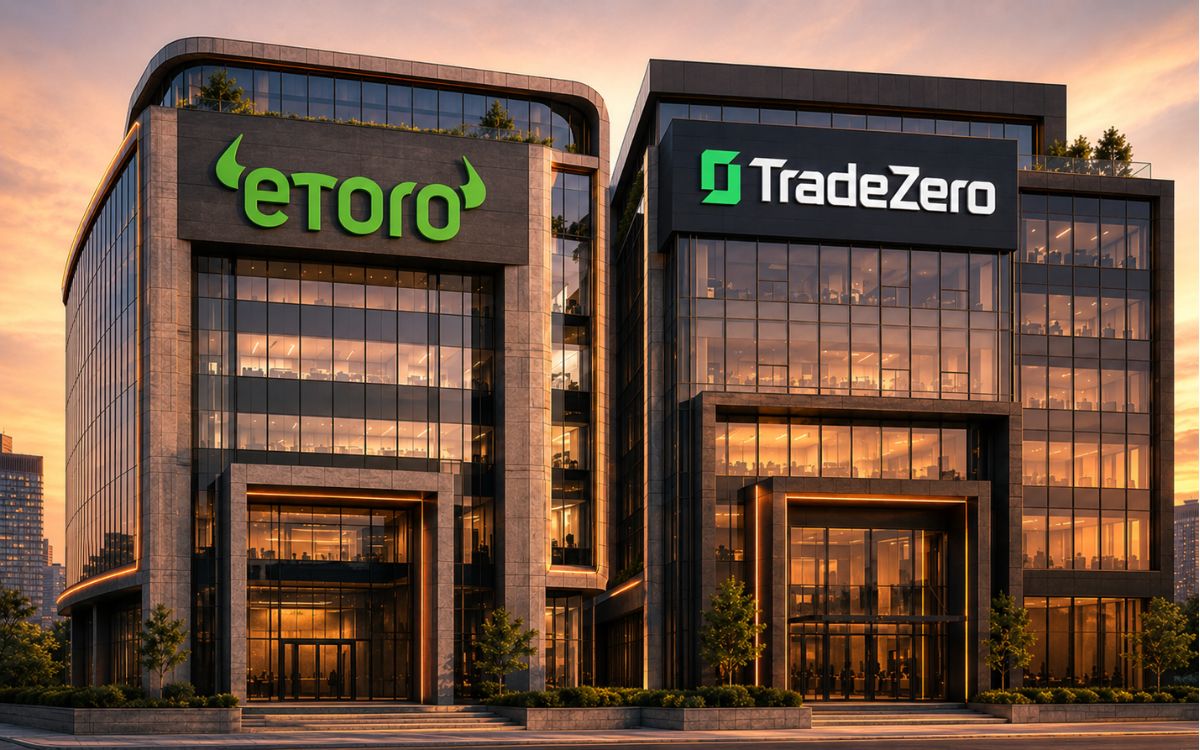
The eToro TradeZero acquisition arrived on August 11, 2026, the same day eToro Group Ltd. (NASDAQ: ETOR) disclosed that crypto trades on its platform fell 73% year-over-year in July, to 1.4 million trades, even as the company agreed to pay up to $231 million for the US stock brokerage.
eToro also reported crypto revenue of $1.35 billion for the second quarter, down from $1.91 billion a year earlier. The two announcements point the same direction: a platform built on crypto trading is now putting more money into stock brokerage and crypto infrastructure than crypto volume itself.
The $231 Million Deal Structure
Under the terms disclosed in eToro’s press release, the purchase price consists of cash plus up to 2.5 million newly issued eToro Class A common shares, subject to customary adjustments. eToro expects the deal to add to adjusted earnings per share in its first year, once it closes in the first half of 2027 pending regulatory approval.
TradeZero, founded in 2015, brought in roughly $80 million in revenue with an 81% gross margin and is known for commission-free stock trading and a proprietary short locator tool for short-sellers. “TradeZero was built by active traders, for active traders,” said Daniel Pipitone, Co-Founder and CEO of TradeZero, on August 11, 2026.
eToro’s Crypto Pullback by the Numbers
Crypto trading on eToro is shrinking even as the rest of the business grows. Invested amount per crypto trade dropped 50% year-over-year to $182 in July, and eToro’s own cryptoasset holdings fell to roughly $50 million as of June 30, 2026, down from $62.6 million at the end of 2025.
Rather than chase trading volume, eToro built crypto infrastructure instead, closing acquisitions of self-custody firms Zengo and Bit2C, investing in on-chain perpetual futures platform Extended, and becoming a founding partner of the Open USD stablecoin project. Yoni Assia, Co-Founder and CEO of eToro, said in the second-quarter 2026 results release that “AI and on-chain finance represent the next chapter” in eToro’s evolution.
The Regulatory Clock Now Running to 2027
The TradeZero deal still needs regulatory sign-off before eToro and TradeZero can operate as one company. eToro CFO Meron Shani called the deal financially accretive and evidence of disciplined capital allocation.
Kraken parent Payward took a similar route into the US market this year, paying up to $550 million for derivatives platform Bitnomial to secure federal clearing and brokerage licenses instead of building them independently, a comparison that shows what trading platforms will spend for a regulatory shortcut even as their crypto desks cool off.
What this means for you: If you trade crypto on eToro, nothing about your account or fees changes because of the TradeZero deal, since that brokerage handles US stocks and options, not digital assets. What is shifting is where eToro puts its crypto resources, away from trading volume and toward self-custody and on-chain infrastructure, a pivot that sits alongside a broader run of trading-platform acquisitions reshaping exchange business models this year.
This article is for informational purposes only and does not constitute financial advice. Do your own research before making any investment decisions.