Key Takeaways
- Ethereum has processed its first demonstrated atomic L1-to-L2 transaction through the Ethereum Economic Zone, moving 0.001 ETH alongside a rollup state update.
- The EEZ lets compatible rollups work with Ethereum mainnet in one transaction, reducing the need for bridges and helping avoid split liquidity across L2s.
- The system is still in development and needs more rollup support, better proving infrastructure, and more testing before wider use.
Ethereum has completed its first demonstrated atomic transaction between Ethereum mainnet and a Layer 2, using the Ethereum Economic Zone to coordinate a 0.001 ETH transfer with a rollup state update in a single transaction.
The transaction was shared by Ethereum Economic Zone core contributor Eduardo Antuña Díez on X. The demonstration shows that synchronous composability between Ethereum mainnet and a compatible L2 can work on live Ethereum infrastructure.
Gnosis and Zisk are developing the Ethereum Economic Zone, or EEZ, with support from the Ethereum Foundation. Its goal is to make Ethereum and compatible rollups behave more like a single execution environment rather than separate networks connected through asynchronous bridges.
Ethereum Demonstrates Atomic L1-to-L2 Execution
The test involved 0.001 ETH and a connected update to the rollup state. The key feature was that the actions were linked together so they could either complete as intended or fail as a whole.
That is what makes the transaction atomic. Today, moving assets or information between Ethereum and an L2 often involves separate transactions and asynchronous messaging. Users may also need bridges when moving assets between networks.
EEZ is designed to change that model. A compatible rollup can call an Ethereum mainnet contract within the same transaction, receive a response, and use that result during execution.
This creates a closer connection between the two environments without requiring a traditional bridge transaction for the cross-layer interaction.
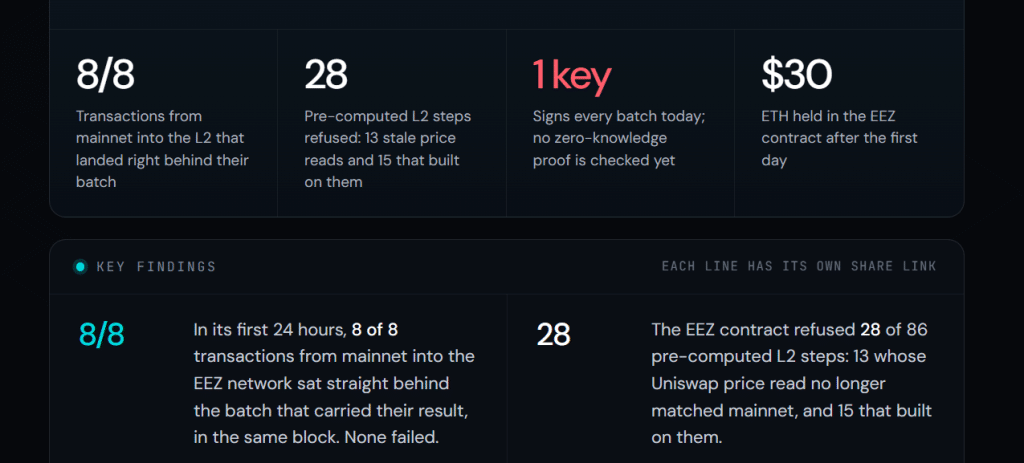
Bitquery’s independent on-chain analysis found that eight out of eight mainnet-to-L2 calls during the first 24 hours landed directly behind the batch containing their results. The analysis also found that a test loan moved to the L2 and back within a single Ethereum transaction.
Source: Bitquery – Ethereum L1-L2 Atomic Transactions Analysis
EEZ Targets Ethereum’s L2 Fragmentation
The technology is designed to address a problem created by Ethereum’s own scaling strategy. Layer 2 networks have increased transaction capacity and lowered costs, but they have also divided liquidity and applications across multiple execution environments.
A decentralized exchange, lending protocol or other application may need separate deployments on several L2s. Users can also face additional steps when moving assets between those networks.
Gnosis described the problem as Ethereum scaling into separate “islands,” with liquidity, applications and infrastructure distributed across different networks. EEZ is intended to let compatible rollups access Ethereum’s mainnet liquidity and contracts without relying on wrapped assets or asynchronous bridge messages.
The potential benefit is not simply faster transfers. Atomic composability could allow applications on an EEZ-compatible rollup to use Ethereum mainnet liquidity as part of the same transaction.
Gnosis and Zisk Are Building the EEZ Framework
Gnosis and Zisk are developing the Ethereum Economic Zone, with funding from the Ethereum Foundation.
Gnosis has been working on the framework throughout 2026. Its Q2 report said developers had added stronger protections for rollup registration, static cross-chain calls, and destination validation.
Developers also introduced a deferred-revert mechanism designed to allow failures in cross-chain execution to propagate without leaving connected actions in an inconsistent state. The project is therefore further along than a simple proof-of-concept, but it is still under development.
Gnosis plans to use EEZ on Gnosis Chain, with the network’s current materials targeting an EEZ upgrade in 2027.
The Test Does Not Mean All Ethereum L2s Are Connected
The mainnet demonstration should not be interpreted as Ethereum having already solved L2 fragmentation across the entire ecosystem.
The atomic transaction involved the EEZ framework and a compatible rollup environment. Wider adoption would require other rollups and applications to integrate with the system.
There are also technical issues that need to be addressed before the model can operate at a larger scale.
Bitquery’s analysis found that the first-day implementation relied on a single key to validate batches. The project plans to replace that mechanism with zero-knowledge proofs during 2027.
That means the successful transaction demonstrates that the execution model works, but it does not yet establish how the system will perform with many rollups, high transaction volumes, or a fully decentralized proving setup.
What Atomic L1-to-L2 Transactions Could Change
If the technology expands to more rollups, users could eventually interact with applications across participating Ethereum networks without manually managing every cross-chain step.
For example, an application running on an L2 could potentially interact with liquidity held on Ethereum mainnet during the same transaction. A trade, collateral operation, or other DeFi action could therefore combine activity across networks without requiring a separate bridge transfer.
This could also reduce the need for applications to maintain duplicated liquidity and infrastructure across multiple L2s.
However, the actual benefits will depend on adoption. A technically successful system does not automatically eliminate fragmentation if only a small number of networks support it.
What Comes Next
The next stage for EEZ is broader testing, performance benchmarking, and integration with additional rollups and applications. Gnosis has previously said the project would publish technical specifications, benchmarks and developer tools as development continues.
The first Ethereum mainnet demonstration provides evidence that atomic L1-to-L2 execution is possible through the EEZ framework. The bigger test will be whether the system can scale beyond controlled demonstrations while maintaining secure validation and attracting enough rollups to make cross-layer composability useful across the Ethereum ecosystem.
What This Means for You: This is not a new feature that lets every Ethereum user instantly move between L1 and L2 in one transaction. For now, the milestone shows that EEZ can coordinate activity between Ethereum mainnet and a compatible L2 atomically. Wider user benefits will depend on additional rollups adopting the framework.
More on Ethereum: Ethereum hub · Ethereum price today · Ethereum price prediction · How to buy Ethereum