
Key Takeaways
- Bitcoin is not backed by gold, government reserves, or a promise to redeem it for another asset. Its market value depends on demand, scarcity, security, and adoption.
- Proof-of-work mining uses electricity and computing power to make transaction history expensive to alter, helping secure the Bitcoin network.
- Bitcoin’s protocol limits its supply to approximately 21 million BTC, with new issuance declining through scheduled halvings.
- Independent full nodes verify transactions and enforce consensus rules, preventing miners from creating invalid bitcoins or unilaterally changing the protocol.
- Bitcoin’s value is not guaranteed. Its price can fall sharply, and its long-term usefulness depends on continued demand, security, and network adoption.
Bitcoin and gold are often compared because both are viewed by some investors as alternatives to traditional money. Gold has a long history as a monetary asset, supported by its physical properties, scarcity, and demand across jewelry, industry, and investment.
Bitcoin takes a different approach: it exists digitally and relies on cryptography, a predictable supply schedule, and a decentralized network to operate. This raises a common question: if Bitcoin is not backed by gold or a government, what gives it value?
The answer involves several factors. Bitcoin’s code establishes rules for issuing and transferring coins, mining uses real-world resources to secure its transaction history, and independent network participants verify that the rules are followed. User and investor demand then determines what people are willing to pay.
Understanding these factors helps explain why Bitcoin can have a market value without a physical reserve behind it, while also making clear why that value is not guaranteed.
Deconstructing the “Backed By” Fallacy
When people ask what backs an asset, they may mean different things. They might be asking whether the asset can be exchanged for something else, whether it has practical uses, or why other people are willing to accept it as payment.
These questions are related, but they are not interchangeable. An asset can have value without being redeemable for a physical commodity, and an asset backed by collateral can still lose value if confidence in the issuer or the collateral breaks down.
The Real History of Fiat Money (The End of the Gold Standard in 1971)
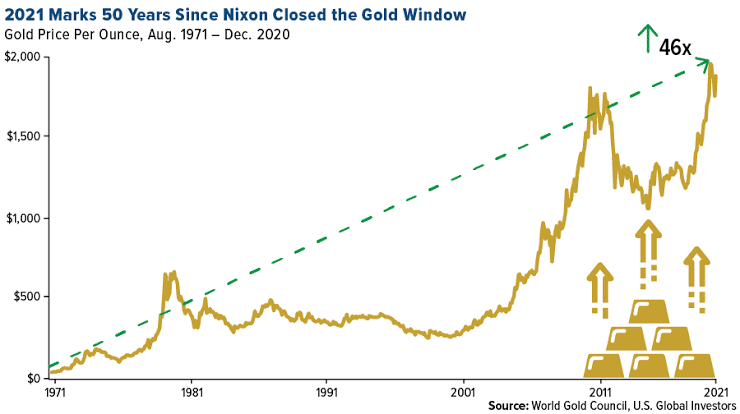
Source – US Funds Gold Price Growth From 1971 to 2020
For much of modern history, governments linked currencies to gold, allowing eligible holders to exchange currency for a fixed amount of the metal.
After World War II, the Bretton Woods system pegged participating currencies to the US dollar, which foreign official holders could convert into gold at $35 per ounce. As overseas dollar balances grew relative to US gold reserves, confidence weakened.
On August 15, 1971, President Richard Nixon suspended gold convertibility, and the system eventually gave way to floating exchange rates. The historical details are documented by Federal Reserve History.
Today, the US dollar is a fiat currency, backed not by gold redemption but by institutions, economic output, monetary policy, financial markets, and public confidence.
Bitcoin follows a different model. It offers no redemption for gold or other assets. Its protocol governs issuance and transfers, while market participants determine its value.
What Backs the US Dollar? Legal Tender, Taxation, and Sovereign Debt
The US dollar’s value is supported by a combination of legal, economic, and institutional arrangements rather than a physical reserve that every dollar can be exchanged for.
Three factors help explain this system.
- Legal and institutional framework: US law establishes the dollar as the country’s monetary unit and gives it a central role in financial and commercial transactions. Legal-tender rules are part of this framework, although they do not mean every private seller must accept dollars for every transaction.
- Taxation: The US government assesses and collects taxes in dollars. This creates an ongoing need for dollars among households and businesses that owe taxes and supports the currency’s role in the domestic economy.
- Government debt and financial markets: US Treasury securities are dollar-denominated obligations of the federal government. They provide widely used assets for savings, collateral, banking, and investment. Their market value depends on factors such as interest rates, inflation expectations, liquidity, and confidence in the government’s ability to meet its obligations.
The dollar’s established role in global trade and finance supports its widespread use, though inflation and changes in purchasing power still affect its value. By contrast, Bitcoin has no government collecting taxes in BTC or a sovereign treasury backing its obligations; its monetary model relies on protocol rules, network security, and voluntary demand.
Why Traditional Investors Confuse “Intrinsically Backed” With “Valuable”
The idea of intrinsic value can make it hard to compare Bitcoin, gold, and fiat money.
Gold has physical properties that people value independently of its monetary role. It is durable, divisible with suitable processing, relatively scarce, and useful in jewelry, electronics, and other applications. Its established history and large market also contribute to its appeal as an investment and reserve asset.
Bitcoin does not have these physical uses. Its utility is digital: it allows participants to transfer a scarce asset across a network without requiring a central issuer to approve each transaction. Users can verify the public transaction history and control their holdings through private keys.
Some investors argue that this combination of scarcity and transferability makes Bitcoin valuable. Others consider its price too dependent on speculative demand. Both positions recognize that Bitcoin’s value is not guaranteed by a physical reserve.
It is also important to distinguish intrinsic usefulness from market value. Gold’s physical uses do not establish a fixed price for it, just as Bitcoin’s digital properties do not establish a minimum price. Both assets can trade at different prices as demand and market conditions change.
The Physical Anchor: Proof-of-Work and Thermodynamic Cost
Bitcoin’s digital records are supported by physical infrastructure. Mining computers consume electricity to compete for the right to add new blocks to the blockchain. This process, called proof-of-work, makes it costly to produce valid blocks and helps protect the transaction history from being rewritten.
However, the electricity used by miners does not sit in a reserve account backing BTC. Energy is an input to the security system, not a redemption guarantee for holders.
How Energy and Capital Convert Into Unforgeable Digital Scarcity
Bitcoin miners use specialized computers to repeatedly calculate cryptographic hashes of block headers. A miner succeeds when it finds a hash that meets the network’s current difficulty target.
The process involves trial and error. Miners cannot predict which attempt will succeed, so finding a valid result generally requires many calculations. The network adjusts mining difficulty approximately every 2,016 blocks to keep block production near an average of one block every ten minutes, according to Bitcoin Developer.
Mining requires real resources, including hardware, electricity, cooling, and maintenance. These costs help create an economic barrier to producing blocks and attempting to rewrite recent transaction history.
This creates a useful distinction: Bitcoin’s scarcity is enforced by protocol rules, while proof-of-work helps secure the records that track ownership and issuance. Mining energy alone does not determine the number of bitcoins that can exist.
The Cost of Production Theory: Why Miners Cannot Arbitrage Free Coins
Bitcoin’s cost of production is sometimes presented as a floor beneath its market price. The reasoning is that miners must pay for equipment and electricity, so BTC should not trade below the cost of producing it. That conclusion is too strong.
Mining costs influence the decisions of miners. When revenue falls relative to operating expenses, less efficient operations may shut down, sell equipment, or delay investment. If enough hashrate leaves the network, mining difficulty can eventually adjust downward, making it easier for the remaining miners to find blocks at the target rate.
However, no rule requires the market price of BTC to cover miners’ costs. Bitcoin can trade below some miners’ cost of production, and unprofitable operations can continue for a period if owners expect prices to recover or have other reasons to keep mining.
Miners also cannot simply create free coins to compensate for losses. Their blocks must follow Bitcoin’s consensus rules. A block claiming an excessive reward or including invalid transactions will be rejected by validating nodes.
Production costs therefore influence mining economics and security, but they do not guarantee a minimum BTC price.
Why Stored Work Makes Network Reorganization Economically Difficult
Every Bitcoin block references the previous one, forming a chain of records. Altering an earlier transaction requires rebuilding the affected block and subsequent blocks with enough proof-of-work to overtake the network’s accepted chain.
As more blocks confirm a transaction, rewriting its history generally becomes more difficult, which is why users often wait for multiple confirmations before treating payments as final.
Reorganizations can still occur when competing blocks are found or when an attacker has sufficient computing power to rewrite recent blocks and potentially double-spend.
The effort required depends on the attacker’s resources, the network’s total hashrate, and the depth of the targeted transaction. Proof-of-work makes rewriting established history increasingly costly and risky, but does not make it impossible.
The Mathematical Anchor: Cryptography and Absolute Scarcity
Bitcoin’s monetary rules are expressed in software and enforced by network participants. Cryptography protects the authorization of transactions, while the issuance schedule limits how quickly new bitcoins enter circulation.
These features are central to Bitcoin’s design, but they do not eliminate every risk. Software can contain bugs, users can lose private keys, and the market price remains uncertain.
Bitcoin’s 21 Million Limit vs. Central Bank Money Creation
Bitcoin’s issuance schedule caps its supply at approximately 21 million BTC, with new coins issued through block rewards that decrease over time. Unlike fiat monetary systems, where central banks can influence money and credit supply, Bitcoin’s issuance rules are publicly verifiable and predictable.
The 21 million limit is a consensus rule, not a physical law. Changing it would require broad network adoption of new rules, and users enforcing the existing limit could reject the change. Its durability depends on Bitcoin’s protocol and the participants who choose to follow its rules.
Open-Source Rules: SHA-256 Math vs. Institutional Trust
Bitcoin’s software is open source, allowing developers and users to inspect its code, review changes, and verify its rules for transactions, issuance, and block validation.
Bitcoin uses SHA-256 hashing in proof-of-work, helping miners find valid blocks, while cryptographic signatures verify that transactions are authorized by the holder of the relevant private key. These tools help secure the network without relying on a central issuer to maintain a private ledger.
However, open-source code and cryptography do not guarantee bug-free software or determine Bitcoin’s market value. Security also depends on ongoing review, testing, and users verifying the rules they follow.
Halving Schedules: Programmatic Supply Declines vs. Discretionary Monetary Policy
Bitcoin’s block subsidy is cut in half every 210,000 blocks, or roughly every four years. This event is known as the halving.
The initial subsidy was 50 BTC per block. After successive halvings, it fell to 25 BTC, 12.5 BTC, 6.25 BTC, and then 3.125 BTC in April 2024. The next halving is expected around 2028, when the subsidy will fall to 1.5625 BTC per block.
The schedule slows the rate at which new bitcoins are issued. Eventually, the subsidy will fall to zero, expected around the year 2140, although the exact timing depends on block production.
Unlike discretionary monetary policy, the halving schedule does not require a committee to vote on each reduction. It follows the rules implemented by the network.
A halving does not guarantee a price increase. Market prices depend on demand as well as supply, and traders may anticipate the event before it occurs. The reduction also affects miners by lowering their BTC subsidy, increasing the importance of transaction fees and efficient operations over time.
The Social and Institutional Layer: The Global Node Consensus
Code and proof-of-work alone do not explain why Bitcoin continues to function as a shared monetary network. Bitcoin also depends on people and organizations that run software, verify transactions, hold BTC, develop tools, and accept payments.
This social layer determines whether the protocol’s rules remain widely accepted and whether Bitcoin continues to be useful.
Who Controls the Protocol? (Why Miners Cannot Change the Rules)
Bitcoin has no central company or government that can unilaterally change the rules for all participants. Developers can propose updates, but users decide whether to adopt them. Miners choose which transactions to include in blocks, while full nodes independently check that blocks follow the rules they enforce.
For example, a miner cannot create extra BTC beyond the permitted block subsidy and fees simply by producing more proof-of-work. Full nodes will reject the invalid block. Consensus changes require coordination and adoption across the network, and disagreements over certain changes can lead to separate chains.
As explained in the Bitcoin Core documentation, this system gives users a role in enforcing Bitcoin’s rules. Large miners, developers, exchanges, and businesses can influence discussions, but none has automatic authority to make everyone accept a change.
The Game Theory of Independent Node Operators Globally
A Bitcoin full node downloads and verifies blocks and transactions against the network’s consensus rules. Anyone with suitable hardware and an internet connection can run one, letting users verify payments independently rather than relying entirely on miners, exchanges, or other services.
Different participants have different incentives. Miners earn block rewards and transaction fees, users want valid payments, and businesses need reliable settlement. Node operators verify that received BTC follows the rules they accept, making it difficult for miners to impose invalid changes without having their blocks rejected.
However, decentralization depends on broad participation. When users rely heavily on a few custodians or third-party services, they lose some ability to verify Bitcoin independently. Accessible software and a distributed network of node operators help strengthen the system’s resilience.
Network Effects: How Metcalfe’s Law Relates to Bitcoin’s Global Liquidity
Bitcoin becomes more useful as more people buy, sell, transfer, hold, and accept it. This network effect can attract more exchanges, payment services, custodians, developers, and financial products, making BTC easier to access and trade globally.
Metcalfe’s Law describes how a network’s potential value may grow with the square of its connected users, but it is a simplified model, not a reliable way to predict Bitcoin’s price. Liquidity also plays a role: more buyers and sellers can help larger trades occur with less price impact, though liquidity may fall during market stress.
Growing adoption and global trading infrastructure can support Bitcoin’s usefulness, but they do not guarantee price increases. Demand can weaken, regulations can change, and investors can move their capital elsewhere.
Common Misconceptions About Bitcoin’s Value
Bitcoin’s lack of a physical issuer or redemption promise often leads to confusion about how it works. Understanding what Bitcoin is not backed by helps separate its technical design from claims about its market value.
Is Bitcoin Backed by the US Dollar or Stablecoins?
Bitcoin has no direct backing from the US dollar, US Treasury securities, or stablecoins such as USDT and USDC. Stablecoins aim to maintain a stable value against a reference asset, often the US dollar. Depending on their structure, they may use reserves or other mechanisms to support their peg.
Bitcoin has no similar redemption mechanism. Owning BTC does not give holders the right to exchange it for a fixed amount of dollars, gold, or stablecoins.
Although BTC trades against dollars and stablecoins on exchanges, these trading pairs measure its market price rather than back its supply. Bitcoin’s price depends on supply and demand, adoption, liquidity, market expectations, and broader economic conditions.
Why Bitcoin Doesn’t Need Physical Commodities to Function as Money
Money does not need to be backed by a physical commodity to serve monetary functions. Fiat currencies demonstrate that people can use money without being able to redeem it for gold.
Bitcoin takes a digital approach, allowing users to transfer and verify BTC on a public network under a predictable issuance schedule. Its usefulness depends on secure ownership, reliable transfers, and people willing to accept it.
Bitcoin’s limited supply, portability, and global accessibility may appeal to users. However, price volatility, transaction fees, and confirmation times can limit its suitability for certain payments or short-term savings.
Physical commodities are not a technical requirement for digital money. Their usefulness depends on the properties people value and their willingness to use them.
Can Other Cryptocurrencies Dilute Bitcoin’s Supply?
Creating another cryptocurrency does not change Bitcoin’s supply or issuance rules. The Bitcoin network’s protocol determines how new BTC enters circulation.
However, competing cryptocurrencies can affect Bitcoin’s market demand. Investors may direct their money toward other assets that offer different features or services, potentially putting downward pressure on BTC’s price. This is a change in demand, not a dilution of Bitcoin’s supply.
Wrapped or tokenized BTC is different from an independent cryptocurrency. These tokens represent BTC on other networks and may depend on custodians, bridge contracts, or other mechanisms. Their security depends on those arrangements, but they do not increase the native BTC supply.
Final Thoughts
Bitcoin is not backed by a physical reserve or government promise. Instead, its predictable issuance schedule, cryptographic verification, proof-of-work security, and independent consensus rules help maintain scarcity and make its transaction history costly to alter, though they do not guarantee a specific market price. For investors, understanding how Bitcoin works and why people value it is key. While its limited supply may appeal to those seeking a scarce digital asset, its price still depends on demand, liquidity, regulation, and market confidence. Bitcoin also remains volatile and carries risks that differ from gold and traditional currencies. To learn more about digital assets and their risks, visit our crypto basics hub.
Frequently Asked Questions
Still have questions about what backs Bitcoin and what gives BTC its value? Here are some answers to common questions.
What Gives Bitcoin Value If It Is Completely Digital?
Bitcoin’s value comes from scarcity, security, transferability, network adoption, and market demand. Its protocol limits issuance and allows users to verify transactions without relying on a central issuer. However, these properties don’t guarantee a price. BTC is worth what buyers are willing to pay for it in the market.
What Happens to Bitcoin’s Security After All 21 Million Coins Are Mined?
When the block subsidy eventually reaches zero, miners are expected to earn revenue primarily from transaction fees. They will still be needed to produce blocks and help secure the network. Whether fees provide enough incentive to sustain the required level of mining activity will depend on future transaction demand, fees, mining costs, and the broader economics of the network.
How Does Bitcoin’s Backing Compare to Gold’s Historical Utility?
Gold has physical properties and uses in jewelry, electronics, and other industries, as well as a long history as a monetary and reserve asset. Bitcoin has no comparable physical utility, but it offers digital transferability, verifiable ownership, and a protocol-defined supply schedule. Neither asset has a price guaranteed by these properties alone. Their market values depend on demand, confidence, liquidity, and the roles investors and users choose for them.
Can Bitcoin Lose Its Value Even With a Limited Supply?
Yes. Bitcoin’s limited supply does not guarantee its market value. If demand falls, investor confidence weakens, or market conditions change, BTC’s price can decline even though its issuance rules remain unchanged. Its scarcity is one factor that may support demand, but its market value ultimately depends on what buyers are willing to pay.