
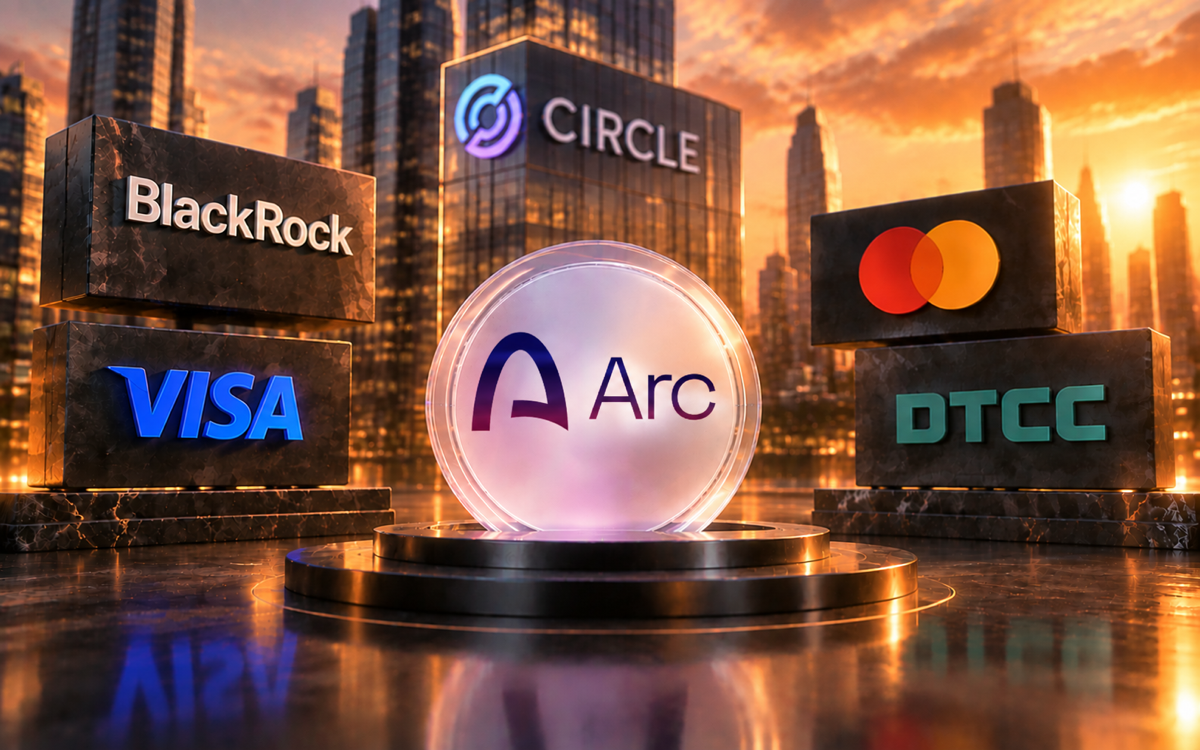
Circle launched the public mainnet of Arc on September 16, 2026, a Layer 1 blockchain built for institutional finance, with 11 founding validators drawn almost entirely from traditional finance.
According to Arc’s announcement, the cohort includes BlackRock, DTCC, ICE, Mastercard, MoneyGram, SBI Group, Standard Chartered, Sumitomo Corporation, Visa, and Worldpay, alongside Circle. Arc is designed as an “economic operating system” for internet finance, providing infrastructure for payments, capital markets, and stablecoin-based applications.
Arc announced the mainnet launch through its official X account, framing the network as a full-stack financial platform rather than simply another blockchain:
More than 100 applications went live on day one, including Aave V4, Morpho, Uniswap, and Aerodrome, supported by more than 100 institutional and ecosystem builders. Circle CEO Jeremy Allaire called it “the single most significant launch in Circle’s history since USDC itself.”
How Arc’s Validator Network Works
Arc runs on a permissioned validator set, meaning Circle selects who validates rather than opening participation to anyone, a tradeoff the company presents as a selling point for regulated institutions. It uses the Malachite consensus engine, a Tendermint-style BFT system delivering deterministic finality in roughly 350 to 500 milliseconds, since BFT protocols require a known, bounded validator set to reach agreement.
| Validator | Industry Area |
| BlackRock | Asset management |
| Visa, Mastercard | Global payments |
| DTCC, ICE | Financial market infrastructure |
| Standard Chartered, SBI Group | Global and regional banking |
Table 1. Selected founding validators announced for Arc mainnet.
Unlike most Layer 1 networks that use a volatile native token for gas, Arc charges transaction fees in USDC, a design choice explained in more depth in USDC’s no-hype breakdown. Allaire compared requiring a volatile token for gas to forcing a company to buy Amazon shares just to pay its AWS bill.
Arc Extends Circle’s Stablecoin Infrastructure Strategy
Arc represents Circle’s move beyond issuing USDC and toward building dedicated infrastructure around stablecoin-based financial activity. The network is EVM-compatible and built on Reth, so existing Solidity contracts deploy without rewriting, and Circle minted the full 10 billion ARC token supply this week as a genesis event without committing to a public token launch.
The ARC presale raised $222 million at a $3 billion valuation, led by a16z crypto with BlackRock and Apollo among the backers. Arc’s public testnet, launched October 28, 2025, has processed more than 700 million transactions since then, an infrastructure buildout that mirrors the regulatory momentum described in how the Clarity Act could affect altcoins, DeFi, and tokenized assets, with Arc launching one day after the Senate’s CLARITY Act cloture vote on September 15.
What the Validators Plan to Do With Arc
BlackRock is expected to deploy its $2.87 billion BUIDL institutional digital-liquidity fund on Arc, one of the most prominent integrations attached to the founding cohort. DTCC’s plan has a longer timetable, intending to enable tokenization of DTC-custodied assets on Arc beginning in the second half of 2027, more than a year after the mainnet’s public launch.
That gap matters for assessing Arc’s debut: the September event establishes the public network and its validators, while the BlackRock and DTCC integrations represent a separate roadmap arriving on different timelines rather than all at once.
Why the Validator Composition Itself Is the Story
The founding lineup connects several areas of traditional finance rather than crypto-native infrastructure providers. Four of the eleven names, DTCC, ICE, Mastercard, and Visa, represent systemic market infrastructure rather than typical blockchain participants, and Circle frames that composition as its core argument for what institutional settlement requires.
Validator participation alone does not determine network success. Long-term adoption will depend on developer activity, applications, transaction usage, and whether institutions follow through on integrations like BUIDL and DTCC’s tokenization plans.
What Comes Next for Arc’s Ecosystem
The next phase for Arc will depend on ecosystem development and adoption beyond the applications already live at launch. Circle has not disclosed detailed transaction volume targets or a timeline for additional institutional integrations beyond the BlackRock and DTCC commitments already announced.
What this means for you: Circle’s Arc mainnet launch shows major financial institutions moving beyond blockchain experiments and toward dedicated, permissioned infrastructure for digital payments and financial markets. The immediate impact for individual users remains unclear since Arc is built around institutional settlement, but the validator lineup signals how seriously traditional finance is now investing in stablecoin-based financial systems.
This article is for informational purposes only and does not constitute financial advice. Stablecoins, blockchain networks, and digital assets involve technical, regulatory, market, and operational risks. Network adoption and availability may change over time.