Created way back in 2014 by the crypto prodigy Dan Larimer, BitShares (BTS) is one of the oldest blockchain projects, as it used to go by the name of ProtoShares (with the adjacent PTS token).
Status (October 2026): The BitShares chain still runs, but the project is largely inactive. Blocks still arrive every 3 seconds from 17 elected witnesses. No worker proposal pays for development, and the last protocol upgrade (BitShares Core 7.0) went live in November 2023. Binance delisted BTS in December 2023, and daily trading volume was about $77,000 on October 7, 2026 (CoinGecko).
The platform’s main goal is to facilitate financial transactions and interactions in a decentralized matter via a technologically advanced exchange that supports both the creation of cryptocurrencies and trading. In short, it was designed to help all those around the globe who don’t have direct access to classic financial services.
Essentially, BitShares provides a unique opportunity for the “unbanked” to become their very own banks thanks to secure and decentralized tools backed up by blockchain technologies.

Everything about Graphene
Another interesting fact is that BitShares is based on Graphene, an open source, C++ blockchain implementation designed to act as a consensus mechanism. You can see some of Graphene’s real-world utility behind projects such as Steemit.com and PeerPlays.com.
One noteworthy fact is that Graphene can handle as much as 100.000 transactions per second and BitShares produces a block every 3 seconds. Hence, BitShares is able to handle more transactions each second than the MasterCard and Visa financial services combined. On September 13, 2017, BitShares processed around 920.000 transactions, at the time a record for a single day.
BitShare’s Decentralized Asset Exchange
The BitShares exchange was designed to ensure the protection of all its transactions, without having the typical trading and withdrawal limits. It’s one of the cheapest exchanges out there and all traders have equal rights and advantages.
On the BitShares decentralized exchange, you can swiftly and cheaply trade two types of assets: smartcoins and user-issued assets.
To put it into perspective, these crypto-based assets track real-world assets such as the US dollar, also known as bitUSD. Regarding the smartcoins, note that these coins are programmed to always be approximately the same value as their representative asset’s real-world value. They are designed to mirror their associated fiat value. For instance, one bitUSD is designed to have the same value as one US dollar.
User-issued assets are created by the platform’s users. Anyone who owns BTS can issue their own asset. These assets are custom tokens that can be registered on the platform. The best part is that users are provided with full control over how they create these assets, as they can choose their associated structure as well as their value. Whoever creates an asset must also specify the name, distribution, description, and other required information.
The exchange includes support for assets that track inflation, stocks, bonds, and even indexes. You can trade virtually anything, provided that your asset has enough interest. A few relevant examples are cryptocurrencies, fiat currencies, gold, gas, oil, and other precious materials.
Decentralized Autonomous Companies (DACs)
BitShares’ internal administration is controlled by a so-called Decentralized Autonomous Company (DAC), a framework specifically designed to help BitShares holders decide the future of BTS. BitShares itself can be considered a DAC, as it’s designed to ensure enough compensation for all the people involved in developing the platform.
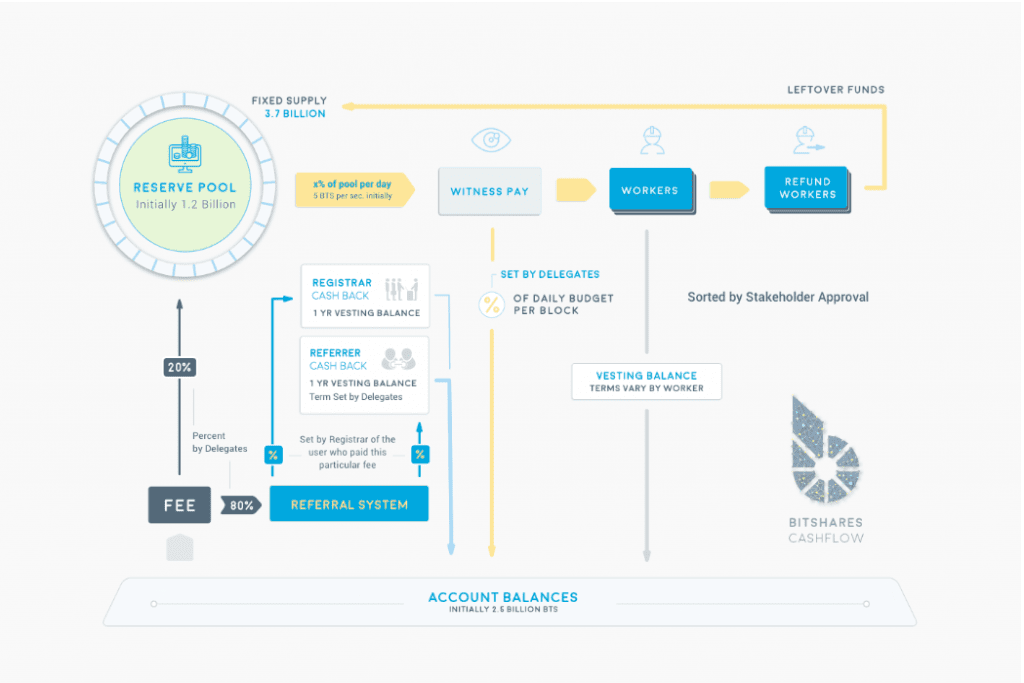
Any member can essentially become an employee, as BitShares coin holders can decide how the funds will be allocated within the platform. The more coins someone has staked, the higher their vote is going to be weighed. There are three types of workers: witnesses, committee members, and workers.
Delegated Proof of Stake (DPoS)
The first type of workers, the witnesses, are the ones getting paid to process transactions and to secure the network. The committee members, on the other hand, are unpaid. BTS holders elect them to set blockchain parameters, such as block time and witness pay, and the fee schedule. Finally, the workers are the ones who can propose projects and, if and when their projects get voted, they start getting paid to go forward with their development.
To further simplify everything: witnesses do the “heavy-lifting,” witnesses and workers are paid by the blockchain, and witnesses are held accountable.
Traditional Proof of Work (PoW) (as used by most cryptocurrencies, Bitcoin included) is already considered an outdated solution since it uses substantial computing resources. BitShares uses a Delegated Proof of Stake (DPoS) consensus model. It’s designed to improve upon the design of Proof of Stake (PoS) and to eliminate the need for a PoW model.
Scheduled Payments on BitShares
One noteworthy advantage that BitShares has over other smart contract platforms is its support for scheduled payments which allows you to set up an authorized withdrawal from your account. Better yet, the platform also boasts support for recurring payments, making monthly subscription payments seem like a walk in the park.
All you have to do in order to set up recurring payments is to grant withdrawal permissions and choose the withdrawal limit per period.
Referral Reward Program
Similar to most blockchain platforms, BitShares also offers a referral program with rewards. It’s designed to benefit the platform and anyone already on the network who manages to bring more people in, so to speak. From every fee a user pays, 20% goes to the network’s working budget and 80% to the referral program, shared between the registrar and the referrer. The committee sets the Lifetime Membership fee in BTS: about 5,791 BTS on October 7, 2026.
The Team
BitShares’ creator, Dan Larimer, worked on the project from 2013 to 2016 before moving on to Steemit and then Block.one (EOS). As previously mentioned, BitShares is a DAC, so it’s not surprising that there’s very little known about the rest of the team. BTS holders elect the witnesses and committee, and over the past year almost all changes to the core code came from a single maintainer on GitHub. In theory, practically any user actively engaging with the platform through creation, voting, staking, and development is a member.
How to buy BitShares BTS
You can purchase BTS on the BitShares Asset Exchange itself by trading any other cryptocurrency for it, or on a centralized exchange. On October 7, 2026, CoinGecko listed BTS/USDT markets on MEXC, Gate.io, LATOKEN and Poloniex (CoinMarketCap has the full list). Several exchanges have dropped it: Binance delisted BTS on December 7, 2023, Huobi (now HTX) lists its BTS pairs as offline, and the ZB.COM website no longer loads.
Conclusions and involved risks
BitShares is without a shadow of a doubt a very powerful platform based on a well-thought-out architecture and which offers its users a lot of useful decentralized financial services. It provides its users with the possibility of issuing smartcoins (bitAssets), it has the potential to handle more than 100.000 transactions per second, and it adds a needed governance layer via its Delegated Proof of Stake (DPoS) algorithm.
However, no token is currently immune from radical drops in value. The risk of a “Black Swan Event” is real: chain data on October 7, 2026 showed bitUSD in global settlement, the step BitShares takes when a smartcoin’s collateral no longer covers it.
If nothing else, BitShares is a true statement that businesses can actually be conducted using a decentralized method. However, it’s an experimental technology, so there’s still a long way to go until BitShares becomes insusceptible to such unforeseen events, FUDs, and even security breaches and attacks. As of October 2026, development is limited to maintenance and BTS trades on only a few exchanges.
BitShares Contacts and Additional information:
- Website: https://bitshares.org/
- Whitepaper: https://bitshares.github.io/docs/#/whitepaper
- E-mail: contactbitshares@bitshares.org
- Blog: https://bitshares.org/blog