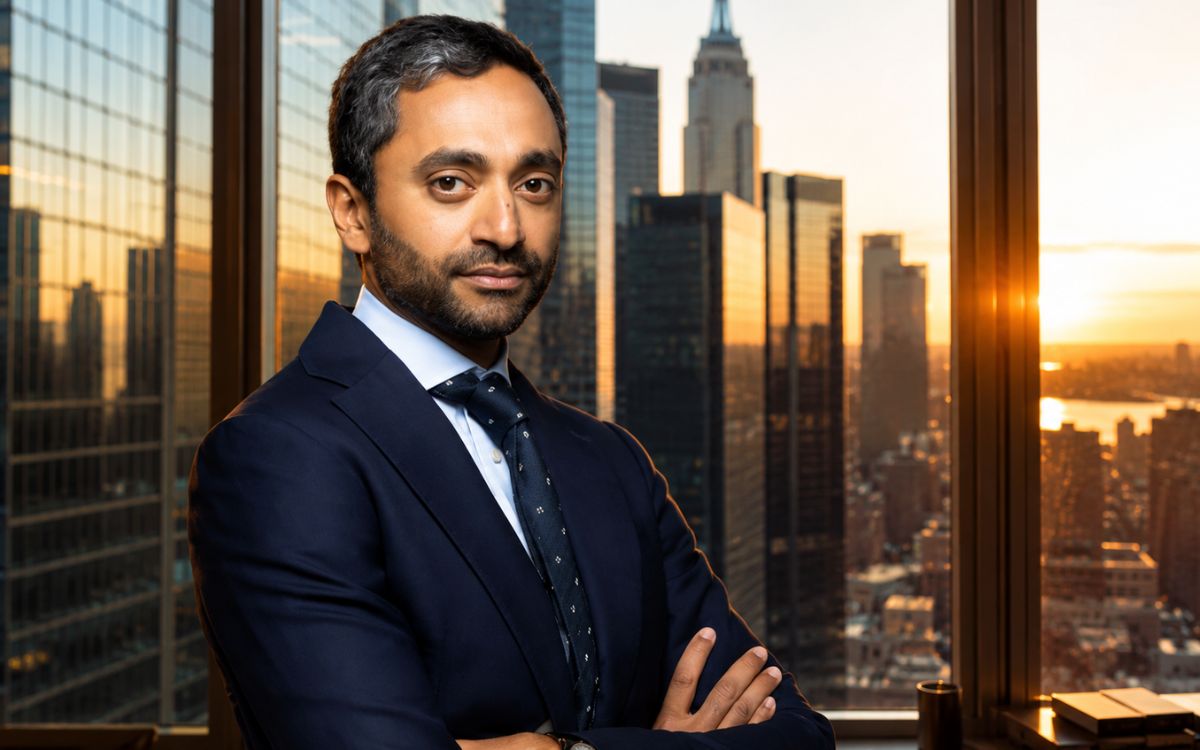
Chamath Palihapitiya is the founder and CEO of Social Capital, the venture firm behind an early stake in AI chip startup Groq, whose licensing deal with Nvidia closed in December 2025 at a reported $20 billion. He built his reputation as an early Facebook executive before earning the nickname “SPAC King” for the wave of blank-check companies he sponsored between 2019 and 2021, a run he has since called a mistake.
Who Is Chamath Palihapitiya?
Chamath Palihapitiya moved to Canada from Sri Lanka at around age five, settling in Ottawa, where his father worked for the Sri Lankan High Commission before the family sought refugee status in 1986, according to Bloomberg’s 2012 profile of him. He went on to earn a Bachelor of Engineering from the University of Waterloo, per his Forbes profile.
His path into technology and finance predates crypto entirely. He joined Facebook in 2007 and spent four years there in management roles, including vice president of user growth, CNBC reported in a 2017 piece. He left in 2011 to found Social Capital, the fund whose bets are covered alongside other builders and investors on our crypto personalities page, and which he has run ever since.
Chamath Palihapitiya’s Career and Contributions
Between 2019 and 2021, Palihapitiya sponsored a string of SPACs, taking Virgin Galactic public in late 2019 and later Opendoor and Clover Health, before Social Capital Hedosophia Corp V merged with online lender SoFi in a deal valued at $8.65 billion, CNBC reported in January 2021.
| Year | Milestone |
|---|---|
| 2007 | Joins Facebook, where his roles include vice president of user growth |
| 2011 | Leaves Facebook after four years and founds Social Capital |
| 25 October 2019 | Virgin Galactic completes its merger with his SPAC, Social Capital Hedosophia, with Palihapitiya as board chairman; NYSE trading starts on 28 October 2019 |
| 7 January 2021 | SoFi agrees to go public by merging with Social Capital Hedosophia Holdings Corp. V in a deal valued at $8.65 billion |
| January 2024 | Founds 8090 (8090 Labs), an AI software company |
| 29 September 2025 | American Exceptionalism Acquisition Corp. A, his new SPAC, completes a $345 million IPO |
| 24 December 2025 | Groq, an early Social Capital investment, signs a non-exclusive licensing deal with Nvidia, reported at about $20 billion; Groq stays independent |
| 29 June 2026 | 8090 closes a $135 million round led by Salesforce Ventures, and Palihapitiya takes over as CEO |
| 14 July 2026 | Tells CNBC’s Squawk Box that promoting SPACs on social media and on CNBC was a huge mistake |
| 12 August 2026 | American Exceptionalism’s quarterly report to the SEC says it has not yet selected a merger target |
Forbes describes him as the sponsor and investor behind at least half a dozen SPACs in total, part of a broader boom in which SPAC IPOs raised roughly $180 billion from the start of 2020 onward, according to Forbes, though the structure produced relatively few new billionaires.
Several of Palihapitiya’s own vehicles later traded well below their offer prices, and Forbes has noted that a CNBC index tracking post-SPAC companies fell 32% in a single year as the froth came out of the market. That stretch earned him the “SPAC King” label across financial media.
Social Capital was also an early backer of AI chip startup Groq, a bet that took years to pay off. When Nvidia agreed in December 2025 to license Groq’s inference technology and bring on its founding executives in a deal reported at roughly $20 billion, Bloomberg reported that Groq would continue operating as an independent company even as its leadership moved to Nvidia.
Forbes later reported that Social Capital held an estimated stake in Groq similar in size to co-founder Jonathan Ross’s roughly 9%, a position that could be worth close to what Ross himself was estimated to be receiving in cash from the deal.
In September 2025, Palihapitiya returned to the SPAC format with American Exceptionalism Acquisition Corp, a new vehicle aimed at AI, energy, defense, and decentralized finance that The Block reported was first filed with the SEC that August.
The SPAC ultimately raised $345 million and drew $1.4 billion in demand, more than five times oversubscribed, CNBC reported at the time. He also founded 8090, an AI enterprise software company, in 2024, which announced a $135 million funding round led by Salesforce in June 2026, CNBC noted in its July 2026 coverage of his remarks on AI spending across the industry.
Chamath Palihapitiya’s Views on Crypto and Markets
Palihapitiya’s public positions on crypto have shifted with the market, according to Forbes. In 2022, he warned that a wave of blockchain-based competitors was coming for Visa and Mastercard’s payments business. By April 2023, with prices under pressure and regulators circling exchanges, he told Forbes that “crypto is dead in America” for the time being.
Forbes has also reported him predicting bitcoin could eventually replace gold as countries adopt it, and describing his own bitcoin holdings as a kind of currency hedge that helps him rest easy about the dollar’s long-term direction.
More recently, speaking on a podcast at the World Government Summit, CoinDesk reported on March 5, 2026, that Palihapitiya argued bitcoin has a structural failing that limits its appeal to central banks: it lacks the privacy and fungibility that gold offers, since transaction histories on a public blockchain can taint individual coins by tying them to earlier owners.
He suggested bitcoin is unlikely to see another tenfold jump in value driven by sovereign reserve demand, while pointing to gold-backed stablecoins as a more promising area of innovation for cross-border settlement.
Chamath Palihapitiya in the News
On July 14, 2026, Palihapitiya appeared on CNBC’s “Squawk Box” and walked back his role in the SPAC boom in blunt terms. Asked by Andrew Ross Sorkin whether he would sponsor the same deals again, he said plainly, “That was a huge mistake,” referring specifically to promoting SPACs on social media and on CNBC itself.
Pressed on whether his SPACs worked out for the investors who bought in, he drew a distinction between the companies and employees involved, which he said benefited, and the speculators who bought shares expecting quick gains, who he acknowledged did not.
In the same appearance, covered separately by CNBC that day, he warned that heavy AI spending, a habit some in the industry call tokenmaxxing, is being undercounted by corporate finance teams and could eventually produce earnings surprises once the true costs show up in quarterly results.
Frequently Asked Questions
Need a refresher on Chamath Palihapitiya? Here are the questions readers most often ask about him.
Who is Chamath Palihapitiya?
Chamath Palihapitiya is a Sri Lankan-born venture capitalist and the founder and CEO of Social Capital, a private investment firm he started in 2011 after leaving Facebook, where he had spent four years in management roles including vice president of user growth. He also co-hosts the business podcast “All-In.”
What company did Chamath Palihapitiya found?
He founded Social Capital in 2011 and later launched 8090, an AI enterprise software company, in 2024. He is also the sponsor behind more than half a dozen SPACs over the years, including the 2025 vehicle American Exceptionalism Acquisition Corp.
Is Chamath Palihapitiya still a billionaire?
It is unclear. Forbes has not listed him on its Billionaires ranking since 2021, and his personal holdings are private, though the Groq-Nvidia licensing deal reported in December 2025 is widely seen as a significant boost to Social Capital’s balance sheet.
Is Chamath Palihapitiya still involved with SPACs in 2026?
Yes. He launched American Exceptionalism Acquisition Corp in September 2025, and as of his July 2026 CNBC appearance he had not announced a completed merger target for the vehicle.
What does Chamath Palihapitiya think about bitcoin?
As of March 2026, he has argued that bitcoin lacks the privacy and fungibility central banks require of a reserve asset, comparing it unfavorably to gold on those specific points. His public bitcoin takes have swung between bullish and skeptical over the years, but he has stayed consistently more optimistic about the growth of gold-backed stablecoins as the next phase of digital finance.