Key Takeaways
- Blockchain is expanding beyond crypto into finance, payments, supply chains, and tokenized assets, showing real-world adoption by major institutions in 2026.
- Blockchain stocks represent companies in exchanges, mining, infrastructure, and services, with performance tied to both crypto activity and broader tech demand.
- Stocks can offer higher growth potential but greater volatility and single-company risk, while ETFs provide diversification and are easier to manage.
Blockchain isn’t just about cryptocurrency anymore. In 2026, it’s being used across finance, payments, supply chains, and even tokenized assets. Major exchanges and financial institutions are already building blockchain-based systems for trading and settlement, which shows how quickly the technology is being adopted for real-world use.
For investors, that opens up another way to get involved. Instead of buying and managing volatile crypto assets directly, you can gain exposure through stocks and ETFs tied to blockchain growth. This approach blends the familiarity of traditional markets with the potential upside of emerging technology.
In this article, you’ll find some of the best blockchain stocks and ETFs to watch in 2026, along with how they can fit into a well-rounded investment strategy.
What Are Blockchain Stocks?
Blockchain stocks are shares of companies involved in developing, using, or supporting blockchain technology. These businesses operate across different parts of the ecosystem, including crypto exchanges, mining operations, payment platforms, and infrastructure providers.
Some companies earn revenue directly from blockchain activity, such as trading fees or mining rewards, while others benefit indirectly by supplying hardware, software, or enterprise solutions. Because of this, blockchain stocks can vary in how closely they track the crypto market, as well as in their risk and growth potential.
What Are Blockchain ETFs?
Blockchain ETFs (Exchange-Traded Funds) are funds that invest in a group of blockchain-related stocks. Instead of picking individual companies, you get exposure to many businesses in the industry through a single investment.
These ETFs often include companies in crypto trading, fintech, semiconductors, and blockchain infrastructure. By spreading your investment across multiple companies, they lower the risk of relying on just one, making them a simpler and more balanced way to invest in blockchain.
Best Blockchain Stocks To Buy In 2026
1. Nvidia (NVDA)

Nvidia is one of the most important companies supporting the blockchain space behind the scenes. It designs GPUs (graphics processing units), which are specialized chips built to handle complex calculations at high speed. These are widely used in crypto mining, where powerful computing is needed to validate transactions and secure certain blockchain networks.
Even as the industry shifts, Nvidia’s role stays relevant because its hardware is also used in AI, cloud computing, and data centers. Many blockchain platforms rely on these same technologies to process data, enhance security, and scale their networks. This gives Nvidia a broader foundation, so it’s not overly dependent on crypto alone.
Why it stands out:
- Produces GPUs used for crypto mining and heavy computing.
- Strong demand from both the blockchain and AI industries.
- Well-established leader with more stable, long-term growth potential.
2. Coinbase Global (COIN)
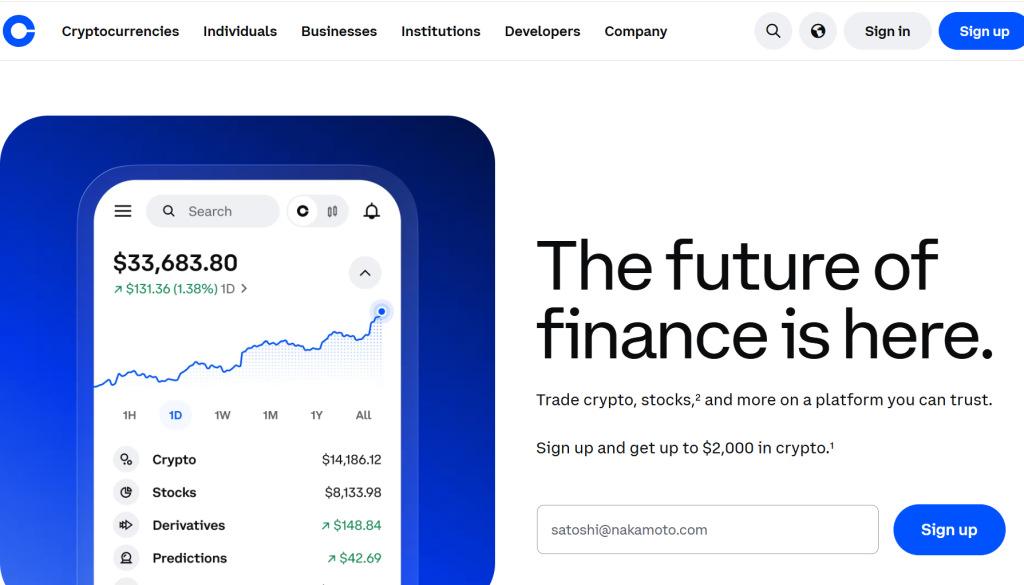
Coinbase Global is one of the largest crypto exchanges in the world and a main entry point for both individuals and institutions entering the blockchain space. It allows users to buy, sell, and store digital assets, and also provides custody services for institutions that need secure storage for large crypto holdings.
As blockchain adoption increases, Coinbase benefits from higher trading activity and growing demand for its services. It has also been expanding its institutional offerings, including trading tools, custody, and compliance-focused solutions, helping it build a strong reputation in regulated markets as governments continue to shape clearer crypto rules.
Why it stands out:
- Direct exposure to crypto adoption through trading and custody services
- Growing focus on institutional clients and advanced financial services
- Strong presence in regulated markets with an established global brand
3. PayPal (PYPL)

PayPal has been gradually adding blockchain and crypto features to its platform, allowing users in supported regions to buy, sell, hold, and transfer cryptocurrencies directly within their accounts. This integration gives millions of users an easier way to access digital assets without needing a separate crypto exchange, making PayPal an important link between traditional finance and blockchain-based payments.
As crypto adoption grows, PayPal is positioned to benefit through increased payment activity, transaction volume, and potential expansion of crypto-enabled services. Its long-standing presence in digital payments, combined with its move into crypto, allows it to serve both everyday consumers and businesses exploring blockchain-based payment options.
Why it stands out:
- Large global user base across consumers and merchants.
- Integration of crypto buying, selling, and payments within its platform.
- Strong foundation in fintech with ongoing expansion into blockchain services.
4. Marathon Digital Holdings (MARA)

Marathon Digital Holdings sits among the biggest players in Bitcoin mining, operating large-scale facilities that help secure the Bitcoin network. Its core activity involves using specialized hardware to validate transactions and add new blocks to the blockchain, earning Bitcoin as rewards.
Its performance is closely tied to Bitcoin’s price and overall network activity. When demand for Bitcoin increases, mining becomes more competitive and can support higher revenue, although factors like energy costs and mining difficulty also play a role. This gives investors direct exposure to the infrastructure side of blockchain rather than just the asset itself.
Why it stands out:
- Direct exposure to Bitcoin mining and blockchain network operations
- Revenue influenced by Bitcoin price and mining rewards
- Strong upside potential, but with higher sensitivity to market and operational risks
5. Riot Platforms (RIOT)
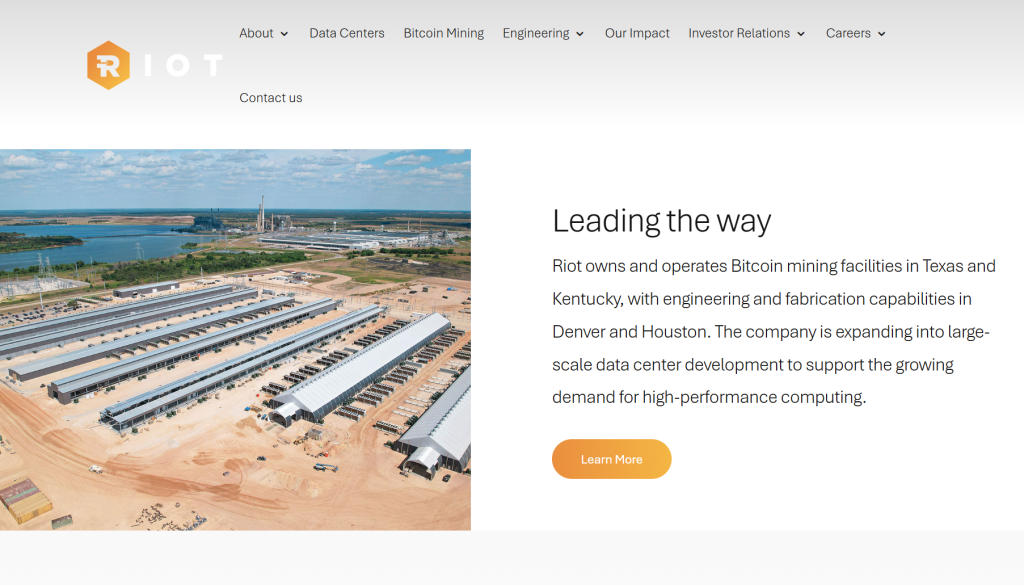
Riot Platforms focuses on Bitcoin mining and continues to grow its operations by expanding its computing power, also known as hash rate. This allows the company to mine more Bitcoin over time as it scales its facilities and improves efficiency.
Its business performance is closely linked to Bitcoin’s price and mining conditions. When Bitcoin rises, mining revenues can increase, but during downturns, profitability can be pressured by fixed costs like energy and operations. This makes Riot more sensitive to market cycles while still providing direct exposure to the growth of blockchain infrastructure.
Why it stands out:
- Active expansion of mining capacity and infrastructure.
- Direct exposure to Bitcoin mining and network activity.
- High sensitivity to crypto market cycles with strong upside potential during bullish periods.
Best Blockchain ETFs To Buy In 2026
1. Amplify Transformational Data Sharing ETF (BLOK)
The Amplify Transformational Data Sharing ETF (BLOK) is one of the more established blockchain-focused ETFs, designed to invest in companies involved in the development and adoption of blockchain technology. It is actively managed, meaning the portfolio is regularly reviewed and adjusted based on market trends and opportunities within the sector.
Instead of focusing on a single type of company, BLOK spreads its holdings across different parts of the blockchain ecosystem. This can include fintech platforms, infrastructure providers, and companies supporting blockchain-based services. Holdings have included names like Robinhood, giving investors exposure to businesses related to crypto access, trading, and financial technology within a single fund.
Why it stands out:
- One of the more recognized ETFs focused on blockchain companies.
- Actively managed with a portfolio that evolves over time.
- Diversified exposure across multiple sectors within the blockchain ecosystem.
2. Siren Nasdaq NexGen Economy ETF (BLCN)
The Siren Nasdaq NexGen Economy ETF (BLCN) invests in companies involved in blockchain development and real-world applications across various industries. It focuses on businesses that are building or using blockchain technology in areas such as finance, supply chains, and digital infrastructure, rather than only on crypto exchanges.
It follows a rules-based index approach, selecting and weighting companies using set criteria instead of active management. This gives the ETF global exposure and a more balanced mix of blockchain-related firms across multiple sectors.
Why it stands out:
- Uses a rules-based index for selecting holdings.
- Provides global exposure to blockchain companies.
- Offers a balanced mix across industries using blockchain technology.
3. iShares Blockchain and Tech ETF (IBLC)
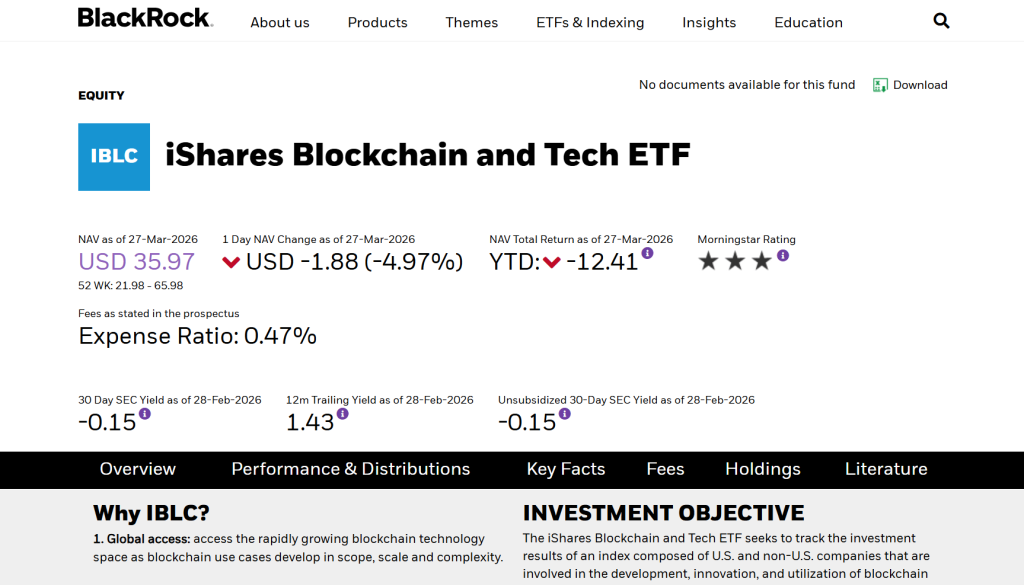
The iShares Blockchain and Tech ETF (IBLC) provides access to a range of companies involved in distributed ledger development and its real-world applications. Managed by BlackRock, it includes firms building underlying infrastructure as well as established technology companies that support or adopt the technology.
This ETF focuses on capturing growth from the expanding use of these systems across different industries, rather than concentrating on a single type of crypto business. As a result, it offers broad exposure to the sector through a single investment vehicle.
Why it stands out:
- Backed by BlackRock, a major global asset manager.
- Covers a wide range of companies in the distributed ledger space.
- Balances exposure between emerging firms and established tech companies.
4. Global X Blockchain ETF (BKCH)
The Global X Blockchain ETF (BKCH) invests in companies that earn from the crypto economy, with a strong focus on Bitcoin miners and infrastructure providers. Instead of spreading investments widely, it leans more toward businesses that are closely connected to mining and the day-to-day operations of blockchain networks.
As a result, the ETF tends to follow Bitcoin price movements and overall market sentiment more closely. When the market is doing well, it can perform strongly, but it can also drop more sharply during downturns compared to more spread-out ETFs.
Why it stands out:
- Focus on Bitcoin miners and crypto infrastructure companies.
- Performance closely tied to Bitcoin and network activity.
- More price movement due to its concentrated portfolio.
5. Bitwise Crypto Industry Innovators ETF (BITQ)

The Bitwise Crypto Industry Innovators ETF (BITQ) is designed to track companies with a strong business connection to the crypto sector, based on the revenue they generate from related activities. It follows a structured index and is adjusted from time to time to keep up with companies that meet its criteria.
What sets it apart is its focus on firms whose performance is closely linked to real-world crypto usage, such as trading activity, network growth, and service demand. Rather than spreading widely across the general tech sector, it focuses on businesses more directly affected by changes in the digital asset market.
Why it stands out:
- Uses a rules-based index tied to crypto-related revenue levels.
- Focused on companies whose earnings depend on crypto market activity.
- Portfolio is periodically adjusted to reflect changes in the industry composition.
Blockchain Stocks vs ETFs: Which Is Better?
Stocks
Stocks give you ownership in individual companies. This can lead to higher returns if you pick strong performers, but it also carries more risk because your results depend on a single company. Prices can be more volatile, and it usually requires more research, monitoring, and timing to make informed decisions.
ETFs
ETFs, on the other hand, invest in a group of companies within one fund. This built-in diversification helps spread risk across multiple holdings, which can make performance more stable. ETFs are generally easier to manage and are often preferred for long-term investing since they reduce the need to choose individual winners.
Note: If you want focused exposure and are comfortable with higher risk, individual stocks may be a better fit. If you prefer a more balanced approach with less effort, ETFs offer a simpler and more diversified way to invest in the blockchain space.
Key Trends Driving Blockchain Investments in 2026
1. Tokenization of Assets
More financial platforms and exchanges are exploring tokenization, in which real-world assets such as stocks, bonds, and ETFs are represented on a blockchain. This allows transactions to be settled faster, reduces the need for intermediaries, and improves transparency in ownership and transfers.
2. Institutional Adoption
Banks, asset managers, and financial institutions are increasingly adopting blockchain for settlement systems, cross-border payments, and asset management. This shift is helping improve efficiency, reduce costs, and bring more traditional financial activity onto blockchain-based infrastructure.
3. Integration with AI and Fintech
Blockchain is being combined with artificial intelligence, payment systems, and cloud infrastructure to support more advanced applications. These integrations are enabling smarter data processing, automated financial services, and improved security, expanding blockchain’s use beyond crypto trading into broader technology and finance use cases.
Risks to Consider
- Market Volatility: Blockchain-related stocks often move closely with crypto prices, leading to sharp price swings in both directions.
- Regulation: Government policies and changing regulations can affect how blockchain companies operate, impacting growth and market access.
- Technology Risks: Blockchain is still evolving, and not all projects succeed or gain adoption, which can affect companies built around them.
- Competition: The industry develops quickly, and new technologies or players can shift market leadership and reduce the advantage of existing companies.
Final Thoughts
Blockchain is growing beyond crypto and becoming part of everyday systems in finance, payments, and technology. As more companies and institutions adopt it, businesses connected to exchanges, payments, mining, and infrastructure are likely to keep expanding and shaping the space. For investors, both stocks and ETFs offer ways to get involved. Stocks can give higher upside but come with more risk, while ETFs offer a simpler and more balanced approach. Whichever you choose, it helps to think long term and stay aware of risks such as market swings and changing regulations as the industry continues to evolve.
You Might Also Like: