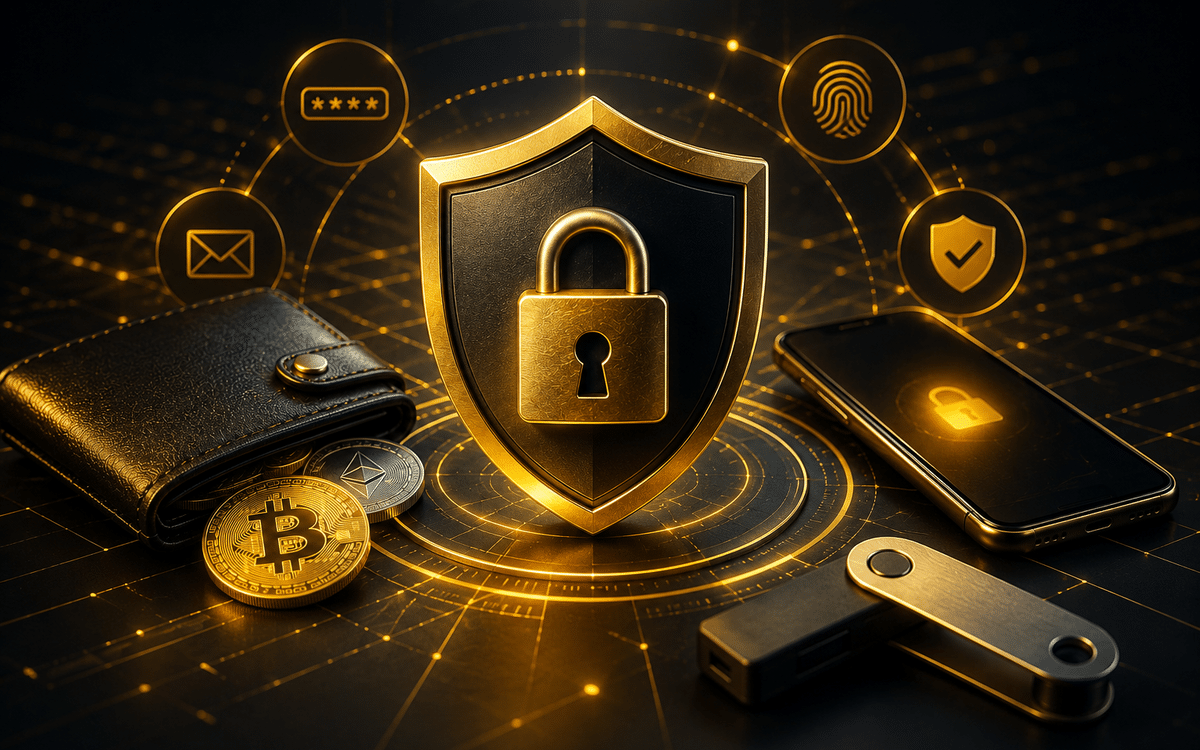
A smart contract wallet is a crypto account secured by code, not by a single private key. Where one key controls a traditional wallet outright, a smart contract wallet runs on rules you set: who can spend, how much, and what happens if your device is lost. Here’s how that works, and why it looks nothing like the wallet you’re used to.
How Does a Smart Contract Wallet Work?
Every wallet you’ve used before, MetaMask, Trust Wallet, Coinbase Wallet in classic mode, is an Externally Owned Account, or EOA: one private key controls everything, with no way to attach rules on top. A smart contract wallet flips that. The wallet itself is a small program on the blockchain, and that program decides what’s allowed, not a single key.
An EOA is a locked box with one physical key. Have it, and the box opens. Lose it, and it stays locked forever. A smart contract wallet works more like a checking account with rules attached, requiring a multi-signature approval over a set amount, letting a linked device freeze the account, or letting trusted contacts restore access if your phone is lost.
This runs on a standard called account abstraction, ERC-4337, live on Ethereum mainnet since March 2023, per the official Ethereum Improvement Proposal. Instead of a raw signed transaction, wallets submit a “UserOperation” describing what the user wants. Bundlers collect these requests and route them through the EntryPoint contract, which checks the wallet’s own rules before executing anything.
A newer standard, EIP-7702, shipped with Ethereum’s Pectra upgrade in May 2025. It lets an existing externally owned account (EOA) delegate to smart-contract code without changing its address, so some 2026 “smart wallets” can add programmable features without users starting over from scratch.
Why Does This Matter for Someone New to Crypto?
The single point of failure in crypto has always been the seed phrase: 12 or 24 words that mean permanent loss if forgotten and permanent theft if exposed. That risk keeps many newcomers wary of holding crypto directly.
Smart contract wallets close that gap. Safe, one of the largest providers, now secures more than $60 billion in assets, according to The Block, with its user base growing fast as more people move away from single-key custody. That growth reflects a shift toward rule-based accounts over a single key with no backup.
Hardware wallets and other self-custody options are also worth understanding when learning about different crypto wallet types.
Smart Contract Wallets vs. Traditional Wallets
Side by side, the practical differences come down to control, recovery, and how much setup you’re willing to do upfront.
| Feature | Traditional (EOA) wallet | Smart contract wallet |
| Access control | Usually controlled by a private key or seed phrase | Can enforce programmable rules, such as multisig, spending limits, passkeys, and session keys |
| Recovery if lost | No protocol-level recovery. Recovery depends on retaining the seed phrase/private key | Can support recovery methods such as guardians, additional signers, passkeys, or email-assisted recovery, depending on the wallet |
| Transaction batching | Typically one transaction per approval | Can combine multiple calls into one user-approved operation |
| Gas payment | Normally requires the chain’s native token | Can use a sponsor/paymaster. Some implementations can enable token-paid gas |
| Setup | Usually immediate: generate/import an address | Can be deployed on first use, so explicit upfront deployment is not always required |
| Examples | MetaMask standard account, Trust Wallet standard account | Safe, Argent, Coinbase Smart Wallet |
Table 1: EOA vs. Smart Contract Wallet at a Glance
Adoption is growing unevenly across networks and wallet providers. Base has become an important venue for Coinbase Smart Wallet, while smart-wallet features such as batching, programmable permissions, and sponsored gas are increasingly available through wallet-specific implementations.
How to Get Started With a Smart Contract Wallet
Setting one up takes a few extra steps compared to a regular wallet, but the order matters more than the number of steps.
Pick a Provider That Matches Your Use Case
Safe suits shared accounts, like a DAO treasury or a wallet split between co-founders. Argent and Coinbase Smart Wallet are built for individual, mobile-first use.
Set Up Recovery Before Funding It
Instead of writing down a seed phrase, you’ll typically add guardians (trusted contacts or devices), a passkey, or an email-based backup. Do this first, not after you’ve already moved funds in.
Deploy the Wallet
Most providers give you a wallet address before the contract is live on-chain, then deploy it the first time you send a transaction. That deployment adds a one-time gas cost, small but variable by provider and network.
Configure Optional Rules
Add a spending limit, require a second signature for large transfers, or set session keys that let a specific app act on your behalf for a limited time.
Test With a Small Amount First
Send a small transaction before moving anything significant, especially the first time you use the wallet on a new chain.
Common Mistakes to Avoid
Most of the friction with smart contract wallets comes from a handful of avoidable missteps, not the technology itself.
- Assuming one deployment covers every chain. A smart contract wallet address that works on Ethereum mainnet may need a separate deployment and a small gas payment the first time you use it on another network.
- Picking recovery guardians you can’t reach. Social recovery only works if the people or devices you choose are ones you can contact in an emergency, not just names that came to mind first.
- Treating “gasless” as “free forever.” Sponsored transactions are usually paid by the app or provider on your behalf, not eliminated. That sponsorship can change or end, so check what happens to fees before relying on it long term.
- Skipping the small test transaction. The most common recoverable mistake with any new wallet setup is sending a large amount before confirming the wallet, network, and recovery method all work as expected.
Choosing the Right Wallet for Where You Are
A regular wallet is still the simpler starting point if you’re brand new to crypto and just moving small amounts. Once you’re managing shared funds, holding anything you’d hate to lose to a misplaced phrase, or using DeFi apps regularly, a smart contract wallet like Safe, Argent, or Coinbase Smart Wallet is worth the slightly longer setup. Start with a small test transaction on whichever one fits your situation, and build up from there.
Frequently Asked Questions
These are the questions that come up most for anyone still deciding whether to make the switch.
Is a smart contract wallet safer than a regular wallet?
It removes the single point of failure a seed phrase creates, since a lost device doesn’t automatically mean lost funds if you’ve set up recovery. It doesn’t remove every risk. The wallet’s code and its recovery contacts become part of what you’re trusting.
Do I still need a seed phrase with a smart contract wallet?
Not in the traditional sense. Most providers replace it with guardians, a passkey, or an email-linked recovery flow instead of a written-down phrase, though some still offer an optional backup key.
Can I use a smart contract wallet across multiple blockchains?
Yes, but each chain generally needs its own contract deployment. The wallet interface handles this automatically in most cases, though it can come with a separate small gas fee the first time.
What is account abstraction, and how does it relate to ERC-4337?
Account abstraction is the general concept of letting a smart contract, rather than a single key, control a crypto account. ERC-4337 is the specific Ethereum standard that made this possible without a network-wide protocol change, and it has been live on mainnet since March 2023.
Are smart contract wallets free to use?
The wallet software itself is typically free. Deploying the underlying contract and, in some cases, individual transactions still involve gas costs, even when an app is sponsoring part of the fee.
What’s the difference between EIP-7702 and ERC-4337?
ERC-4337 creates a new smart contract account from scratch. EIP-7702, part of Ethereum’s May 2025 Pectra upgrade, lets an existing EOA temporarily take on smart contract features without changing its address.