Key Takeaways
- A self-custodial wallet puts the private keys solely in your hands, not an exchange, removing any third-party control over your coins.
- Setup requires generating a 12- to 24-word recovery phrase and writing it down by hand, never as a digital copy.
- With self-custody, you are responsible for protecting your private keys, recovery phrase, and wallet access.
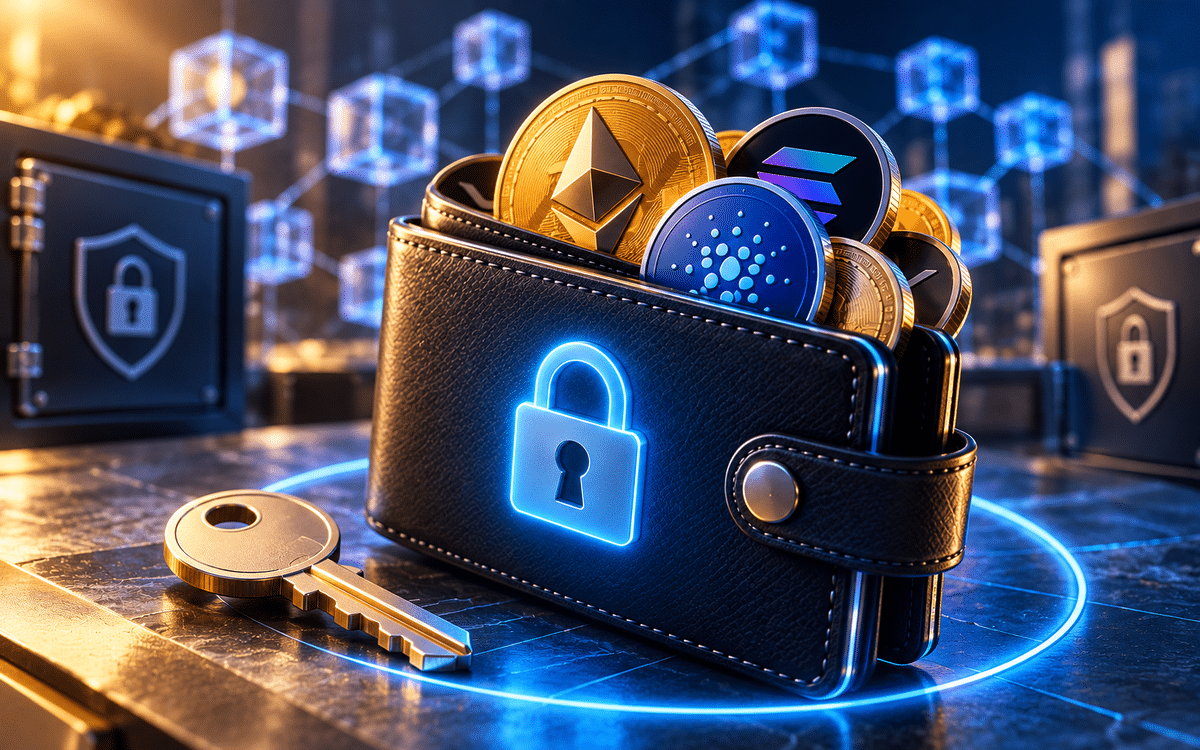
A self-custodial wallet is a crypto wallet where you, not an exchange or a custodian, hold the private keys that unlock your coins. No company sits between you and your funds, which means no one can freeze your balance or reverse a bad transaction on your behalf. It also means there’s no customer support line to call if you lose the keys yourself.
How Does a Self-Custodial Wallet Work?
Every self-custodial wallet runs on two linked numbers: a public key, which becomes your wallet address, and a private key, which proves ownership and must never be shared. The wallet doesn’t hold your crypto. Your coins exist as entries on the blockchain, and the wallet just reads your balance and signs transactions.
Think of a locked mailbox on a public street. Anyone can drop something in using the address, that’s the public key. Only the person holding the physical key can take something out, that’s the private key. Lose that key, and no landlord or postal service can let you back in.
To send funds, your wallet uses the private key to sign the transaction without ever exposing the key itself. The network checks the signature against your public key, and if it matches, the transaction goes through. Lose your phone or hardware device and your crypto is safe, since it still exists on-chain. Lose the private key or recovery phrase, and it’s gone.
Why This Matters If You’re New to Crypto
The alternative to self-custody is a custodial wallet, the kind built into exchanges like Coinbase or Binance. There, the exchange holds the private keys on your behalf, similar to how a bank holds your cash.
FTX customers learned that cost the hard way in November 2022. When the exchange collapsed, crypto sitting in a custodial account turned out to be a claim against the company, not direct ownership. Billions of dollars in customer funds got tied up in bankruptcy court for years.
A self-custodial wallet removes that counterparty risk entirely. The trade-off is one worth sitting with before you move anything significant: self-custody gives you full ownership that nobody can take through a bankruptcy, a frozen account, or a policy change, but it also means every security mistake along the way is yours alone to catch.
Self-Custodial vs. Custodial Wallets at a Glance
Choosing a self-custodial wallet over a custodial one comes down to a handful of practical differences. Here’s how they compare on the points that matter most.
| Feature | Self-custodial wallet | Custodial wallet |
| Who controls the private keys? | You. | A third-party custodian, such as an exchange. |
| Can access or transfers be frozen? | Not by the wallet provider through custody, but some token issuers can block transfers. | Yes. The custodian can restrict access or freeze funds, including in response to legal orders. |
| What happens if the provider fails? | You retain control if you have usable keys or recovery credentials, but may need another compatible wallet. | Access may be suspended, and funds may be tied up or lost in insolvency proceedings. |
| What happens if you lose access? | You can recover access with a valid backup. Losing all access and recovery credentials can mean permanent loss. | Account recovery is usually available, subject to identity and security checks. |
| Must you stay online to hold funds? | No. Hardware wallets can keep private keys offline. | No. Internet access is generally needed to use the platform, not merely to retain your balance. |
Table 1. Self-custodial wallet vs. custodial wallet, by key control and failure mode.
Neither custody model automatically provides government-backed protection for your crypto. In the United States, FDIC deposit insurance does not cover crypto assets or the failure of a crypto company.
SIPC protection generally does not cover ordinary cryptocurrencies or stablecoins, although qualifying securities held at a SIPC-member brokerage may be eligible.
With self-custody, you are responsible for protecting your private keys and recovery credentials. With custody, the provider manages the keys, while you must secure your account.
How to Set Up a Self-Custodial Wallet for the First Time
Setting up your first self-custodial wallet takes longer to do carefully than it does to do quickly, and the careful version is the one worth following. These steps apply whether you choose a software wallet on your phone or a hardware device that stays offline.
1. Choose Your Wallet Type
A software wallet, often called a hot wallet, is free and convenient for small, active balances. A hardware wallet, or cold wallet, keeps your private key on a dedicated offline chip and is the stronger choice for anything you plan to hold long-term. Our hardware wallet comparison breaks down the current options by use case.
2. Download or Unbox the Wallet From an Official Source Only
For software wallets, that means the developer’s own website or the official app store listing, never a link from a social media ad.
For hardware devices, buy directly from the manufacturer or an authorized retailer, since a tampered device can arrive pre-loaded with a compromised seed phrase.
3. Generate Your Keys and Write Down the Recovery Phrase on Paper
The wallet displays a 12- to 24-word recovery phrase exactly once during setup. Write it by hand on paper or a metal backup plate. Never save it as a screenshot, a note on your phone, or a file in cloud storage.
4. Send a Small Test Transaction First
Move a few dollars’ worth of crypto into the new wallet before committing anything significant, then confirm it arrived and that you can send it back out.
5. Restore the Wallet From the Recovery Phrase on a Second Device
This is the step most people skip, and it’s the one that proves the backup works. If the restore fails, you want to find that out now, not after you’ve moved your savings in.
Common Mistakes That Cost People Their Crypto
Even careful self-custody users get caught by habits that look harmless until they aren’t. Two specific failures account for a large share of the losses reported so far in 2026.
Blind Signing
On February 21, 2025, Bybit lost roughly $1.4 billion in Ethereum, as reported by CertiK, after attackers altered a transaction behind a compromised Safe{Wallet} interface.
The signers approved what the screen showed, not what the transaction did. Always read exactly what your device displays before approving.
Using Unofficial Wallet Software
Between April 7 and April 13, 2026, a fake Ledger Live app on Apple’s App Store. American musician Garrett Dutton lost 5.92 BTC worth about $424K after entering his recovery phrase into the fake app.
The real Ledger Live never asks for a recovery phrase and isn’t distributed through the Mac App Store. See common crypto wallet security mistakes to avoid more patterns like this.
Where Self-Custody Stands With EU Regulators in 2026
The EU’s Markets in Crypto-Assets Regulation hit a hard deadline on July 1, 2026. After that date, any crypto-asset service provider operating in the EU without full authorization had to stop serving clients there, according to ESMA’s April 17, 2026 statement.
That rule targets exchanges and custodians, not individuals. A self-custodial wallet falls outside MiCA’s licensing scope entirely. ESMA’s own guidance even lists a self-hosted wallet as an acceptable place for an unauthorized platform to send customer funds during wind-down.
Before you move anything beyond a test amount, repeat the recovery test from the steps above. Restore your wallet from its backup on a separate device and confirm it works.
Final Thoughts
A self-custodial wallet is the right call for anyone who wants outright ownership of their crypto and is willing to take on the responsibility that comes with it.
It suits long-term holders moving funds off an exchange, but it’s a poor fit for someone who isn’t ready to safeguard a recovery phrase or test their backup before relying on it.
The main risk isn’t theft from outside, it’s losing access through a skipped step like an untested restore or a phishing app disguised as wallet software. For more on choosing and setting up the right wallet for your needs, see the wallet hub.
Frequently Asked Questions
Still sorting out a few details before you set one up? These are the questions that come up most often.
Is a self-custodial wallet the same thing as a cold wallet?
Not exactly. Self-custodial describes who controls the private keys, while hot and cold describe whether the wallet stays connected to the internet. A self-custodial wallet can be a hot mobile app or a cold hardware device. Custodial wallets, by contrast, are almost always hot, since an exchange manages the keys on connected servers.
What happens if someone gets my recovery phrase but not my device?
Whoever has the phrase can recreate your wallet on a different device and move the funds out, even without ever touching your original hardware or phone. The device itself doesn’t prove ownership. The phrase does. If a recovery phrase is ever exposed, the safest move is to generate a brand-new wallet and transfer funds over immediately, rather than wait to see if anything happens.
Do I need a hardware wallet if I only hold a small amount of crypto?
It depends on how you use it. A reputable software wallet is reasonable for amounts you’re actively trading or moving, since the convenience trade-off matters less when the balance is small. For anything you plan to hold for months or years, a hardware wallet is the stronger choice because it keeps the private key fully offline.
Is it legal to use a self-custodial wallet in the EU after the MiCA deadline?
Yes. MiCA regulates crypto-asset service providers, not individuals holding their own keys. The July 1, 2026 deadline forced unlicensed exchanges and custodians to stop serving EU clients, but it placed no restriction on a person using their own self-hosted wallet.
Can I lose my crypto if the wallet company or app shuts down?
No, as long as you still have your private key or recovery phrase. Your coins live on the blockchain itself, not on the company’s servers. If a wallet provider shuts down, you can import your recovery phrase into a different compatible wallet and regain access without losing anything.