Key Takeaways
- DeFi coins power platforms that let users lend, borrow, trade, and earn interest without relying on banks or intermediaries.
- Layer-2 and scaling solutions help DeFi coins facilitate faster, cheaper transactions while keeping blockchain security intact.
- Choosing a DeFi coin wisely requires looking at its adoption, real-world utility, security, and long-term growth potential.
Decentralized Finance (DeFi) is providing new ways to manage, lend, and grow money. By cutting out banks and middlemen, it lets users lend, borrow, trade, and earn interest directly with one another, powered entirely by blockchain technology. It is faster, more transparent, and accessible to anyone with an internet connection, making finance more accessible than ever.
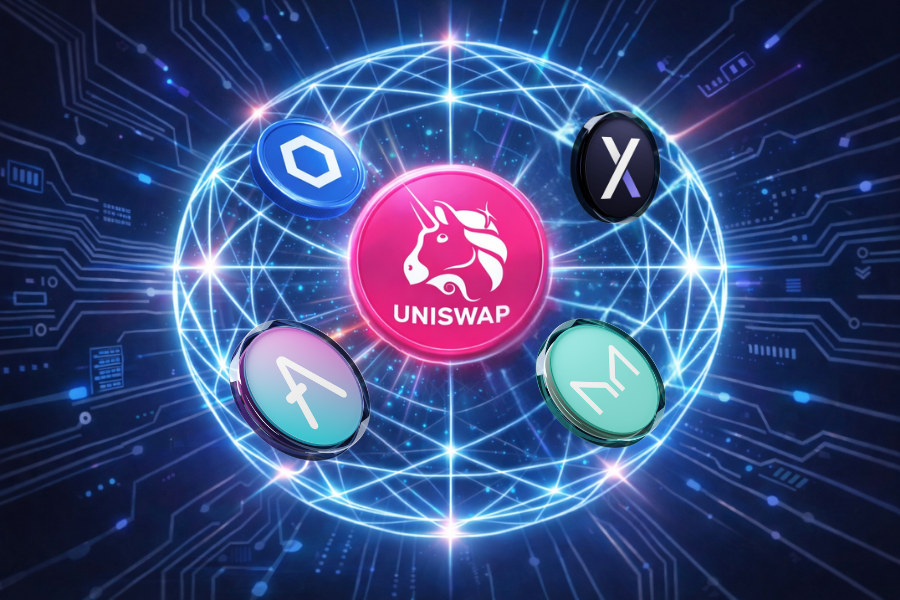
In 2026, the DeFi space is bigger and more exciting than ever. Some tokens stand out not just for their innovation but also for real-world adoption, usefulness, and the significant value locked in their networks. Here is a closer look at the Top 10 DeFi coins that are shaping the future of finance this year.
1. Uniswap (UNI)
Uniswap is more than just a token. It is the engine behind one of the most popular decentralized exchanges in DeFi. It lets anyone swap tokens straight from their wallet, provide liquidity, and earn fees without banks or middlemen. Over the years, it has become a hub for DeFi activity, with trading volumes and cross-chain liquidity growing steadily.
In 2026, UNI remains a standout because it is not just widely used. It gives holders a real voice in shaping the platform’s future. With continuous upgrades, strong liquidity, and a large total value locked (TVL), Uniswap continues to set the standard for what a decentralized exchange can do.
Why UNI Stands Out:
- Token swaps made simple: Powers one of the largest automated market maker (AMM) ecosystems.
- Governance in your hands: UNI holders can vote on upgrades and proposals.
- Liquidity you can trust: High TVL and active trading keep it at the top of DeFi.
- Expanding reach: Growing presence across multiple blockchains makes it more accessible than ever.
2. Chainlink (LINK)
Chainlink is not a typical DeFi protocol. It acts as the essential oracle network that brings trusted, real-world data into blockchain applications. By securely delivering price feeds, interest rates, market events, and other off-chain information to smart contracts, Chainlink ensures that DeFi platforms run reliably and transparently. This makes it a critical piece of infrastructure for lending platforms, decentralized exchanges, prediction markets, derivatives, and tokenized real-world assets (RWAs).
LINK’s utility grows as DeFi expands into more complex financial products. Its widespread adoption and secure, decentralized approach make it a cornerstone for protocols that rely on accurate, real-time data.
Key Strengths:
- Widespread adoption: Integrated across a large number of DeFi platforms.
- Critical infrastructure: Ensures smart contracts can operate reliably.
- Secure off-chain data: Feeds trustworthy real-world information into blockchain applications.
- Supports innovation: Enables products like prediction markets, derivatives, and tokenized real-world assets.
3. Maker (MKR)
Maker is one of the earliest and most influential projects in DeFi, built on the Ethereum blockchain. It powers the Maker Protocol, which allows users to generate the DAI stablecoin by locking up crypto assets. By combining decentralized lending with stable, reliable value, Maker has become a foundational platform in the DeFi ecosystem.
The platform is governed by MakerDAO, a decentralized organization where MKR token holders stake their tokens to vote on upgrades, risk parameters, and protocol changes. Holding MKR gives users influence over the ecosystem, similar to shareholders in a traditional company, demonstrating the strength and effectiveness of decentralized governance.
Key Strengths:
- Decentralized governance: MKR holders vote on protocol decisions and upgrades.
- Stablecoin foundation: Powers DAI, one of the most widely used decentralized stablecoins.
- Influence and participation: MKR ownership provides a direct voice in the Maker ecosystem.
- Proven DeFi pioneer: One of the first projects to combine decentralized lending and governance at scale.
4. Aave (AAVE)
Aave is one of the most established and widely used lending platforms in DeFi. It allows users to earn interest by supplying crypto assets or borrowing against collateral. The platform offers a flexible and secure environment for lending and borrowing across multiple blockchain networks, making it accessible to a broad range of users. Beyond standard lending, Aave includes features such as credit delegation, where users can delegate their credit lines to trusted parties, and advanced yield strategies that optimize returns for liquidity providers.
The AAVE token is central to governance, enabling holders to vote on protocol changes, upgrades, and risk parameters. Aave’s combination of high total value locked (TVL), advanced lending tools, and cross-chain support solidifies its position as a cornerstone of the DeFi lending ecosystem.
Why AAVE Stands Out:
- High TVL: One of the largest pools of locked value in DeFi.
- Comprehensive lending features: Offers flexible borrowing, credit delegation, and yield optimization.
- Cross-chain support: Accessible across multiple blockchain networks.
- Governance role: AAVE holders participate in decentralized decision-making, shaping the protocol’s future.
5. dYdX (DYDX)
For traders seeking advanced on-chain tools, dYdX delivers a decentralized platform for derivatives and perpetual contracts. By combining high-leverage products with fast execution and transparent smart-contract settlement, it delivers professional-grade trading to the DeFi ecosystem. The platform attracts both experienced retail traders and institutional participants, offering deep liquidity and a suite of sophisticated trading features.
The DYDX token supports governance and protocol incentives, allowing holders to vote on upgrades, fee models, and staking rewards. With growing adoption and a robust derivative ecosystem, dYdX has become a key hub for professional trading in decentralized finance.
Why dYdX Stands Out:
- Advanced derivatives: Supports perpetual futures, options, and leveraged trading.
- Professional trading tools: Institutional-level features accessible on-chain.
- Strong trader adoption: High liquidity and active user base.
- Governance and incentives: DYDX holders influence protocol upgrades and participate in rewards.
6. Synthetix (SNX)
Synthetix is at the forefront of bringing real-world assets on-chain. It enables users to mint and trade synthetic assets, called Synths, that track the value of currencies, commodities, and market indices. By providing reliable exposure to these assets, Synthetix expands the DeFi landscape, enabling users to participate in markets beyond traditional cryptocurrencies.
Synthetix relies on its SNX token to keep the network secure, allow users to mint Synths, and distribute rewards to participants. With deep liquidity and a solid derivatives infrastructure, the platform has become a go-to destination for synthetic assets, supporting a wide range of trading and financial activity across DeFi.
Key Strengths:
- Synthetic asset creation: Mint tokenized versions of real-world assets.
- Broad market exposure: Access currencies, commodities, and indices on-chain.
- Advanced derivatives infrastructure: Supports high-liquidity trading for complex products.
- Incentivized participation: SNX staking secures the network and rewards active users.
7. Curve DAO (CRV)
Curve DAO specializes in stablecoin trading, making swaps fast, efficient, and low-cost. Its platform is built for liquidity providers and traders who need reliable, high-capacity pools with minimal slippage. By focusing on low-volatility assets, Curve ensures deep liquidity and predictable returns, making it a go-to platform for yield farmers and market makers across DeFi.
The CRV token is central to Curve, powering governance and incentives. Holders can vote on protocol updates, pool parameters, and reward distributions, helping guide the platform’s evolution. With one of the largest total value locked (TVL) in DeFi, Curve remains essential for anyone looking to optimize stablecoin trading or maximize yield strategies.
Why CRV Stands Out:
- Stablecoin expertise: Optimized for efficient, low-slippage swaps.
- High liquidity: Deep pools support large trades and consistent yields.
- Governance influence: CRV holders shape upgrades, rewards, and protocol parameters.
- Core to DeFi strategies: Widely used by yield farmers and market makers.
8. THORChain (RUNE)
THORChain brings a new level of freedom to DeFi by enabling users to swap assets across blockchains without relying on wrapped tokens or centralized bridges. Its protocol enables native asset swaps, maintaining full decentralization and security while opening liquidity across multiple networks. This makes moving assets between chains faster, safer, and more seamless than traditional cross-chain methods.
The RUNE token powers the network, securing liquidity pools, rewarding participants, and supporting governance decisions. By aligning incentives for liquidity providers and maintaining the protocol’s integrity, THORChain has become a go-to solution for traders and DeFi users looking to navigate multiple ecosystems efficiently.
Key Strengths:
- Seamless cross-chain swaps: Trade assets directly between blockchains.
- Native asset support: No wrapping required, reducing risk and complexity.
- Decentralized security: Maintains trustless operations without centralized bridges.
- Incentivized participation: RUNE secures the network and rewards liquidity providers.
9. Loopring (LRC)
Loopring is a Layer-2 scaling solution built on Ethereum, designed to make transactions faster and more cost-efficient. By processing transactions off the main Ethereum chain, Loopring significantly increases throughput while keeping security anchored to Ethereum’s network. This approach allows users to execute trades, transfers, and other operations with minimal fees, often under a cent per transaction, making it highly accessible for everyday DeFi activity.
The protocol achieves this performance using zkRollups, a zero-knowledge proof technology that bundles multiple transactions into a single proof. This ensures that each transaction is valid without revealing sensitive data, maintaining privacy and integrity. With LRC serving as the governance and utility token, Loopring continues to attract users and developers seeking high-speed, low-cost solutions for decentralized trading and payments.
Why LRC Stands Out:
- Layer 2 efficiency: Speeds up Ethereum transactions while reducing costs.
- zkRollup technology: Ensures transaction validity with privacy and security.
- Low fees: Transactions cost a fraction of standard Ethereum gas fees.
- Governance and utility: LRC powers protocol decisions and network incentives.
10. The Graph (GRT)
The Graph operates as a decentralized indexing network that organizes blockchain data into searchable, easy-to-access structures called subgraphs. By enabling DApps to query blockchain information instantly, it removes the complexity and cost that developers often face when building on Ethereum and other networks. This makes it a vital tool for projects that need reliable, real-time data to operate efficiently.
GRT, the protocol’s native token, allows holders to take part in governance, voting on protocol updates, improvements, and network policies. Token holders can also delegate their voting rights to trusted participants to ensure decisions are made effectively. By providing a scalable, open-source solution for blockchain data and decentralized governance, The Graph has established itself as a foundational layer for the growing DeFi and Web3 ecosystem.
Key Strengths:
- Quick blockchain queries: Subgraphs enable fast, efficient data access.
- Developer-focused: Reduces the time and cost of building decentralized applications.
- Governance and participation: GRT holders shape protocol upgrades and policies.
- Essential Web3 infrastructure: Supports reliable data access for DeFi and other blockchain apps.
Final Thoughts
DeFi is reshaping finance by giving people direct control over their assets, faster transactions, and access to opportunities that were once limited to banks or institutions. From decentralized exchanges and lending platforms to synthetic assets, cross-chain swaps, and data indexing, the top DeFi projects showcase innovation, utility, and real-world impact. Tokens like UNI, AAVE, and MKR empower users with governance, while platforms such as Chainlink, The Graph, and THORChain provide the infrastructure and interoperability that make DeFi thrive. Together, they highlight a financial ecosystem that is more open, efficient, and inclusive, proving that decentralized finance is happening today.