Key Takeaways
- Mastercard agrees to buy BVNK for $1.8 billion to bridge fiat payment rails with on-chain transactions.
- BVNK’s infrastructure enables business payments across 130 countries using major blockchain networks.
- The deal underscores a growing trend of traditional finance firms integrating stablecoins for cross-border settlement.
The boundary between traditional banking and decentralized finance (DeFi) has become thinner than ever with Mastercard’s latest power move. The payments titan has agreed to acquire stablecoin infrastructure leader BVNK in a deal valued at $1.8 billion.
This acquisition, which includes a $300 million performance-based contingency, is designed to bolster Mastercard’s “on-chain” capabilities. By integrating BVNK’s robust API, Mastercard aims to allow its global network of financial institutions and fintechs to offer tokenized deposits and stablecoin settlements with the same ease as a standard wire transfer.
BVNK, which launched just five years ago, has quickly become the “plumbing” of the digital asset world. Their platform allows businesses to bypass the slow, expensive hurdles of traditional cross-border payments by utilizing stablecoins on various blockchain networks. For Mastercard, this isn’t just an experiment; it’s a necessity.
As Jorn Lambert, Mastercard’s Chief Product Officer, noted, the expectation is that every major financial firm will eventually provide digital currency services. This deal ensures Mastercard remains the primary bridge between the legacy economy and the emerging crypto-financial system.
Coinbase walks away from BVNK deal
The road to this acquisition was not without its drama. In late 2025, Coinbase was reportedly in the final due diligence stages for a $2 billion acquisition of BVNK before both parties “mutually walked away.” While no official reason was given, the cancellation cleared the path for Mastercard to step in.
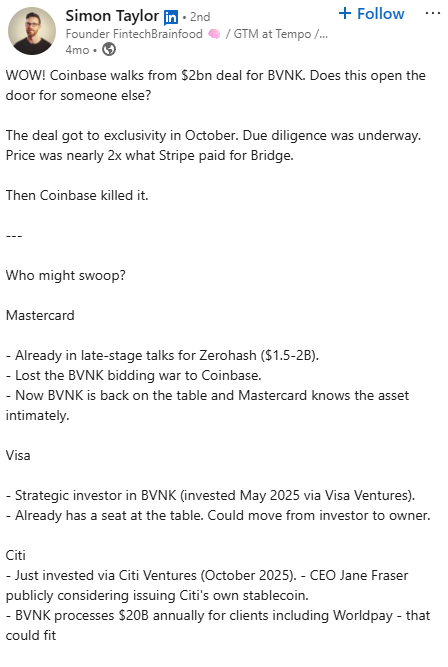
BVNK’s pedigree is already deeply rooted in traditional finance, having secured strategic investments from Visa Ventures and Citi Ventures last year. This highlights a fascinating tug-of-war between crypto-native exchanges and legacy payment networks for control over the stablecoin infrastructure layer.
Stablecoins could power global payments within 15 years
This acquisition isn’t just a random move—it actually lines up perfectly with what some big-name investors are saying. Take billionaire Stanley Druckenmiller: he recently predicted that blockchain systems could totally flip global payments on their head within ten years.
While he’s still a bit skeptical about Bitcoin as a ‘store of value,’ he thinks the speed and low cost of stablecoins beat our current banking systems hands down. And with new rules like the GENIUS Act finally giving the US some legal clarity, it feels like we’re right on the edge of stablecoins becoming the world’s main way to pay.
Final Thoughts
Mastercard’s $1.8 billion bet on BVNK is a clear signal that the “stablecoin-ization” of global finance is well underway. For businesses, this means faster, cheaper, and more transparent international payments are about to become the new standard.
Frequently Asked Questions
What does BVNK do?
It provides infrastructure that helps businesses send and receive payments using stablecoins across 130+ countries.
Why did Mastercard buy them?
To integrate blockchain technology into their existing payment network for faster cross-border transactions.
What happened with the Coinbase deal?
Coinbase and BVNK walked away from a $2 billion deal in 2025, allowing Mastercard to swoop in.