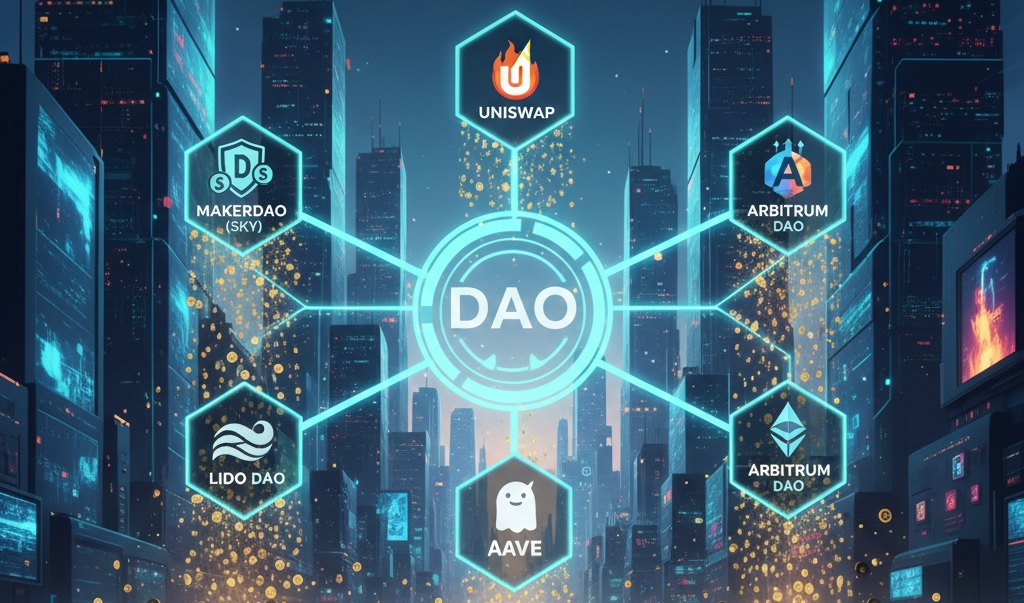
The top DAOs paying members in 2026 shifted from simple governance tokens to real value distribution models. MakerDAO (Sky), Uniswap, Aave, Lido, and Arbitrum lead this transformation by redirecting protocol revenue directly to token holders. Uniswap implemented fee switches burning UNI tokens worth millions. Aave redirected 100% of product revenue to its DAO treasury. These changes turn governance participation into actual financial returns rather than empty voting rights.
Key Takeaways:
- The top DAOs paying members in 2026 distribute billions in protocol revenue to token holders
- Uniswap’s fee switch burns tokens to create value for holders through supply reduction
- Aave redirected 100% of product revenue from Aave Labs to the DAO treasury
How Did MakerDAO Transform Into Sky for Member Rewards?
MakerDAO rebranded its entire ecosystem to Sky in 2025-2026. The transformation goes beyond cosmetic changes to fundamentally alter how members earn rewards. Sky focuses on simplifying DeFi earnings for mainstream users rather than just technical experts.
The Sky Savings Rate represents the protocol’s primary user incentive. Members deposit USDS stablecoin and earn yields without complicated DeFi strategies. The system automates reward distribution through smart contracts. Users simply hold USDS and watch balances grow.
What Changed with USDS and Governance Rewards?
USDS replaced DAI as the protocol’s primary stablecoin. The transition maintained the same stability mechanisms but improved user experience. USDS integrates more seamlessly with Sky’s simplified reward structure. Existing DAI holders could convert to USDS through straightforward processes.
Sky developed a Core Governance Reward Primitive as of February 2026. This framework structures compensation for active governance participants. The system includes several key features:
- Participation Tracking: Smart contracts monitor voting frequency and discussion contributions
- Tiered Rewards: More active members earn proportionally higher token distributions
- Automated Payments: Rewards distribute automatically without manual claiming processes
- Quality Metrics: The system weighs meaningful participation over simple vote casting
The rebranding addresses a major problem in DeFi adoption. Technical complexity scared away mainstream users despite attractive yields. Sky removes these barriers while maintaining security and decentralization. The approach targets the next billion crypto users rather than existing DeFi natives.
What Changed with Uniswap’s Fee Switch Implementation?
Uniswap evolved from pure governance token to value-accruing asset in 2026. The transformation ranks among the most significant changes in DeFi governance. UNI holders now capture direct value from protocol success rather than just voting rights.
How Does the Fee Switch Work?
The protocol fee switch represents Uniswap’s breakthrough innovation. Trading pools on Uniswap charge fees ranging from 0.05% to 1% depending on volatility. Previously, 100% of these fees went to liquidity providers. The fee switch redirects a portion to the protocol treasury.
Collected fees fund UNI token burns rather than accumulating as treasury assets. Token burns reduce circulating supply permanently. Basic economics says reduced supply with constant demand increases price. This mechanism directly links protocol growth to token holder value.
The burn mechanism creates deflationary pressure on UNI. High trading volume means more fees collected and more tokens burned. Bull markets accelerate the process as trading activity surges. Bear markets slow burns but don’t reverse the deflationary trend.
What Is Uniswap’s Growth Budget?
The UNIfication proposal introduced a 20 million UNI annual growth budget starting in 2026. This allocation funds ecosystem development through structured quarterly distributions.
The growth budget supports multiple initiatives:
- Ecosystem Grants: Funding for projects building on Uniswap’s infrastructure
- Strategic Partnerships: Capital for integrations with other protocols and platforms
- Research and Development: Investment in new features and protocol improvements
- Marketing Initiatives: Resources to expand Uniswap’s user base globally
Uniswap Labs absorbed the Uniswap Foundation’s ecosystem teams. This consolidation focuses resources on protocol growth exclusively. The DAO treasury funds these operations rather than relying on external capital. This alignment ensures development priorities match token holder interests.
Contributors receive compensation in UNI tokens rather than just fiat. This structure aligns incentives between builders and token holders. Successful protocol growth benefits everyone through fee generation and token value appreciation.
Why Did Aave Redirect 100% of Product Revenue?
Aave Labs proposed the “Aave Will Win” framework in early 2026. The plan fundamentally restructures the relationship between development company and DAO. This represents one of the most aggressive value transfer proposals in DeFi history.
The proposal redirects 100% of revenue from all Aave-branded products to the DAO treasury. This includes earnings from aave.com, the Aave App, and the upcoming Aave Card. Previously, Aave Labs retained these revenues as a separate entity. The new structure treats the DAO as the true protocol owner.
How Does Revenue Redirection Benefit Token Holders?
Direct member control over product revenue changes governance dynamics completely. Token holders now vote on how to allocate income from protocol tools. This eliminates conflicts between development company profits and token holder interests.
Revenue redirection creates multiple benefits for AAVE holders:
- Treasury Growth: All product income flows to DAO-controlled wallets
- Distribution Flexibility: Members vote on using funds for buybacks, staking rewards, or development
- Transparency: Blockchain records make all revenue flows publicly verifiable
- Aligned Incentives: Aave Labs’ success directly translates to treasury growth
The DAO considers a $50 million grant to facilitate Aave Labs’ transition. This includes $42.5 million in stablecoins and 75,000 AAVE tokens. The funding streams over time rather than paying upfront. This structure maintains accountability while providing operational capital.
Aave manages over $26 billion in total value locked across its lending markets. The protocol generates substantial revenue from interest rate spreads and liquidation fees. Redirecting this income to the treasury creates massive potential for token holder distributions.
How Does Lido Reward Liquid Staking Participants?
Lido dominates the liquid staking sector as the largest provider by total value locked. The protocol lets Ethereum holders stake without locking assets or running validators. This model revolutionized Ethereum staking accessibility for mainstream users.
What Are stETH Rewards?
Staked ETH holders receive stETH tokens representing their deposits plus accrued rewards. These tokens maintain 1:1 value with ETH while earning staking yields. Users can trade or use stETH in DeFi while earning staking rewards simultaneously.
The yield-bearing nature of stETH provides continuous returns to holders. Ethereum’s proof-of-stake consensus pays validators for securing the network. Lido aggregates these rewards and distributes them proportionally to stETH holders. No manual claiming process exists as balances grow automatically.
How Does Dual Governance Protect Members?
Dual governance represents Lido’s innovative approach to protecting different stakeholder groups. This structure gives stETH holders veto rights over major DAO decisions alongside LDO token holders.
The dual governance system works through several mechanisms:
- Veto Powers: stETH holders can block proposals that threaten their deposits
- Proposal Thresholds: Major changes require approval from both LDO and stETH holders
- Emergency Brakes: Users can trigger pauses if they detect dangerous governance actions
- Balanced Representation: Both governance participants and protocol users have meaningful voice
Traditional governance models only empower governance token holders. Lido’s approach recognizes that stETH holders have direct financial exposure to protocol decisions. This protection encourages larger deposits by reducing governance attack risks.
The DAO maintains a substantial treasury funding ecosystem grants and research. Money supports validator performance audits ensuring network security. Development grants encourage builders creating tools using stETH. This investment approach strengthens the entire liquid staking ecosystem.
What Makes Arbitrum DAO’s Treasury Strategy Unique?
Arbitrum manages approximately $1.10 billion in treasury assets as of early 2026. The Layer 2 scaling solution became one of crypto’s most valuable DAOs through strategic token distribution and ecosystem building. ARB token holders control deployment of these substantial resources.
Member reward programs let ARB holders vote on major network development initiatives. The DAO defines incentive structures rather than following predetermined rules. This flexibility allows rapid adaptation to changing market conditions.
How Does Arbitrum Incentivize Participation?
Active incentives boosted Arbitrum’s governance participation rates significantly above industry averages. The DAO rewards voters for engagement rather than just token holdings.
Arbitrum’s participation incentive structure includes:
- Vote Rewards: Token distributions for participating in governance decisions
- Delegation Bonuses: Additional rewards for delegating to active participants
- Proposal Incentives: Compensation for community members submitting quality proposals
- Committee Payments: Regular stipends for elected governance committee members
Participation rates exceed most other major DAOs as a result. This creates more representative governance outcomes reflecting broader community interests. Higher engagement reduces the risk of governance attacks or capture by small groups.
Network development grants fund projects building on Arbitrum’s infrastructure. The DAO allocates millions to teams creating valuable ecosystem tools and applications. These investments strengthen Arbitrum’s competitive position against other Layer 2 solutions. Token holders benefit through increased network usage and transaction fee generation.
The treasury size gives Arbitrum staying power through market cycles. Bear markets destroy projects with insufficient funding reserves. Arbitrum’s resources ensure continued development regardless of token price volatility. This financial stability attracts serious builders and long-term users to the ecosystem.
Frequently Asked Questions
Which are the top DAOs paying members in 2026?
The top DAOs paying members in 2026 include MakerDAO (Sky), Uniswap, Aave, Lido, and Arbitrum. These protocols redirect billions in revenue to token holders through various mechanisms including fee burns, revenue sharing, and staking rewards.
How does Uniswap pay UNI holders?
Uniswap implements a fee switch collecting portions of trading fees. The protocol uses collected fees to burn UNI tokens, reducing supply. This deflationary mechanism creates value through supply reduction rather than direct payments.
What is Aave’s 100% revenue model?
Aave Labs proposed redirecting 100% of product revenue from aave.com and other branded tools to the DAO treasury. Token holders vote on allocating this income rather than Aave Labs retaining profits as a separate company.
How do Lido participants earn rewards?
Lido participants receive stETH tokens that automatically accrue Ethereum staking rewards. The yield-bearing tokens grow in value over time without requiring manual claims or additional actions from holders.
Which DAO has the largest treasury?
Uniswap controls approximately $2.20 billion in treasury assets as of early 2026. Optimism and ENS follow with $1.50 billion and $1.10 billion respectively. These treasuries fund ecosystem development and member rewards.