Trading activity on the XRP Ledger (XRPL) became more concentrated in the second quarter of 2026, with fewer accounts moving significantly larger amounts of XRP.
Average daily order-book volume reached 3.57 million XRP, up 79% from a year earlier. At the same time, the number of accounts initiating those trades fell from 1,864 to about 1,100 per day.
That pushed average order-book activity to roughly 3,200 XRP per account per day, compared with about 1,070 XRP a year earlier.
The average value of tokenized assets and Ripple USD (RLUSD) held on XRPL reached a combined $4.26 billion in Q2, compared with just $99 million six quarters earlier.
Fewer Accounts Are Moving More XRP
The divergence between account activity and trading volume was most visible on the XRPL’s order book.
Daily accounts initiating order-book trades declined about 40% year over year, while trading volume increased 79%.
| Metric | Q2 2025 | Q2 2026 | Change |
| Daily order-book volume | ~1.99M XRP | 3.57M XRP | +79% |
| Daily order-book trading accounts | 1,864 | 1,111 | -40% |
| XRP traded per account per day | 1,072 XRP | 3,217 XRP | ~3x |
| Order-book share of DEX activity | 54% | 81% | +27 percentage points |
Table 1. XRP Ledger Trading Activity: Q2 2025 vs. Q2 2026
Total DEX volume averaged 4.42 million XRP per day, about 20% higher than a year earlier. Order books accounted for 81% of that activity, up from 54% in Q2 2025.
The number of assets traded against XRP on the order book also fell to about 319 per day, down from 480 a year earlier.
The data shows trading becoming heavier but more concentrated among fewer accounts. However, it does not prove that institutional traders are replacing retail users because one person or company can control multiple XRPL accounts.
Overall Account Activity Also Declined
The drop was not limited to order-book traders, as accounts transacting across XRPL averaged around 16,600 per day in Q2, down 24% from a year earlier. New accounts averaged about 2,800 per day, down roughly 25%.
| Metric | January 1, 2026 | June 30, 2026 | Change |
| Total XRPL addresses | 7.91M | 8.40M | +6.2% |
| Daily active addresses | 19,927 | 15,302 | -23.2% |
Table 2. Total XRPL Addresses and Daily Active Addresses
XRPL added roughly 490,000 addresses during the first half of 2026, even as daily active addresses fell by more than 23%.
The broader crypto market also saw weaker onchain activity during the period, as onchain exchange volume across major networks fell 46% year over year, while transaction fees across seven large programmable blockchains declined 38%.
By June 30, XRPL had about 8.40 million addresses, up from 7.91 million at the start of the year. The network continued adding addresses even as daily active usage declined.
Tokenized Assets Push XRPL Value Above $4 Billion
The amount of tokenized value held on XRPL moved in the opposite direction.
Tokenized assets averaged $3.72 billion during Q2, more than double the first-quarter level and more than 30 times the amount recorded a year earlier.
Average RLUSD stablecoin balances added another $539 million, bringing the combined average value to around $4.26 billion. Six quarters earlier, that figure was only $99 million.
| Metric | Q2 2025 | Q2 2026 | Change |
| Average RLUSD on XRPL | $73M | $539M | +642% |
| XRPL share of RLUSD supply | 20% | 34% | +14 percentage points |
| RLUSD transfer value | Base | — | +925% |
Table 3. RLUSD Growth on XRP Ledger
RLUSD was a major contributor to the increase, with the average supply on XRPL rising from $73 million a year earlier to $539 million, an increase of more than 600%.
The value transferred using RLUSD also increased more than ninefold, while XRPL’s share of total RLUSD circulation rose from 20% to 34%.
Institutional Infrastructure Continues to Expand
The increase in tokenized assets has come alongside infrastructure aimed at financial institutions.
During Q2, XRPL added upgrades around permissioned markets and multi-purpose tokens. In May, part of a tokenized U.S. Treasury fund was redeemed with the asset leg settling on XRPL in less than five seconds.
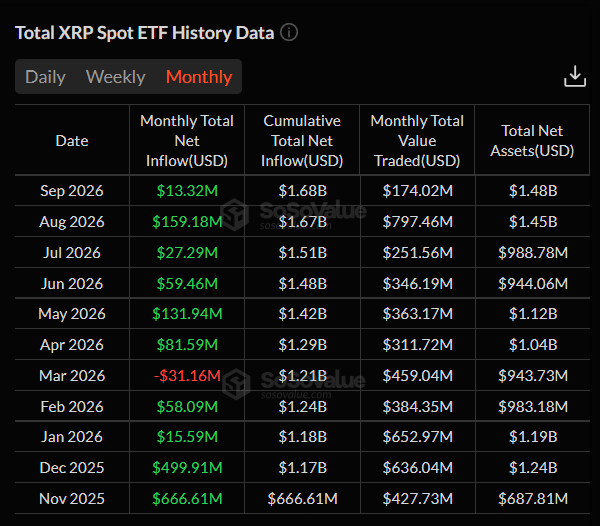
U.S. spot XRP ETFs also recorded $273 million in net inflows during the quarter, with inflows reported in all three months, according to SoSoValue data.
These developments give institutions more ways to gain XRP exposure or use XRPL for tokenized assets and settlement without relying on the same activity patterns as retail crypto users.
However, larger transaction sizes alone are not enough to identify the participants behind them. Therefore, the clearest conclusion from the Q2 data is that more value is moving through fewer active accounts.
What Comes Next
The main metric to watch is whether XRPL can keep increasing trading volume and tokenized-asset value while account activity stabilizes.
Ripple’s stablecoin growth will also matter as its average XRPL supply increased more than sixfold year over year in Q2, while tokenized assets pushed the value held on the network above $4 billion.
If trading remains concentrated among fewer accounts, the network could continue developing toward larger financial transactions even without a comparable increase in daily users. A recovery in active accounts alongside continued growth in volume would provide a broader sign of network expansion.
What this means for you: XRPL is handling more value even though fewer accounts are actively trading. The numbers point to larger transactions and growing tokenized assets, but they do not yet prove that institutions are replacing retail users.