Most NFT losses do not come from a hack. They come from a buyer skipping ten minutes of research, missing a hidden fee, or trusting a link that looked real enough. The NFT market has matured since the 2021 boom, but the mistakes that cost buyers money have stayed the same.
The market itself looks different than it did a few years ago. Ethereum NFT trading volume has stabilized around $720 million a month, a recovery from the 2024 low but still well below the 2022 peak, and roughly 505,000 wallets remain active on a regular basis. That is a smaller, steadier market than the 2021 frenzy, made up more of collectors with utility in mind than short-term flippers.
It is also a market where scams have grown more targeted rather than less. According to NFTPlazas, wallet-draining phishing losses jumped sharply at the start of 2026, and the average scam payout per victim has climbed year over year as fraud has moved from mass spam toward fewer, more convincing attacks.
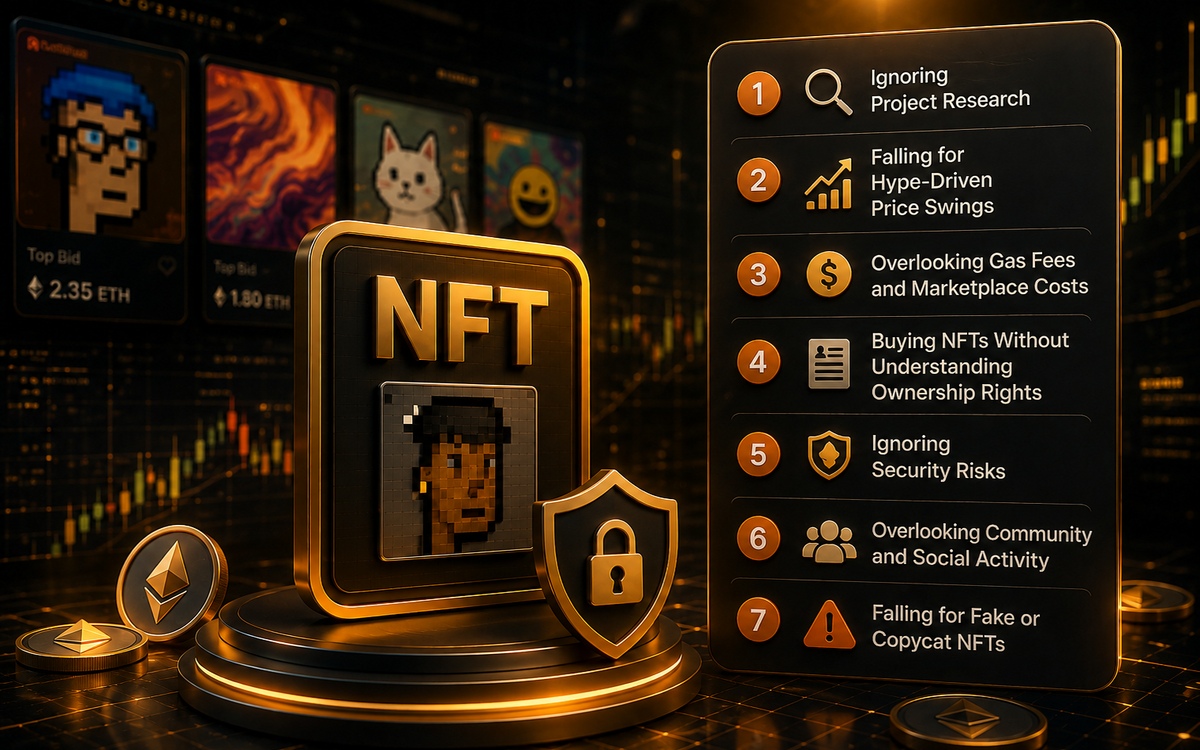
Whether you’re buying your first NFT, launching a collection, or just trying to understand how NFT marketplaces work, knowing these pitfalls in advance can save you real money. This article walks through the seven that show up most often, and what to do instead.
1. Ignoring Project Research
Many NFT buyers get caught up in hype, trending visuals, or celebrity endorsements and skip the research that could protect their money. Buying without checking the basics can mean ending up with a low-quality, abandoned, or outright scam NFT that has no long-term value.
What to do instead is investigate the team by looking at who’s behind the project, what they’ve built before, and whether they have a track record in the NFT or crypto community. A traceable, credible team is one of the strongest signals a project is worth your money.
Review the roadmap and utility to understand what the project promises, whether that’s access, in-game function, or other real perks, since projects with clear utility tend to hold value better than pure collectibles.
Then check community engagement: active, substantive discussion on Discord or Telegram usually signals real interest, while a channel full of bot replies and copy-pasted hype is a red flag.
2. Falling for Hype-Driven Price Swings
It’s easy to get swept up when an NFT suddenly spikes in price, but plenty of collections are pumped by coordinated hype and then dumped, leaving late buyers holding an asset that’s lost most of its value. Watch for sudden social media buzz with no matching updates from the team, and for anyone promising “guaranteed” or fast profits.
Rug pulls remain one of the more damaging patterns in this category. Estimates put 2025 rug-pull losses in the $1.8 to $2.8 billion range, and a large share of newly launched tokens and collections were flagged as likely scams within their first month. The pattern repeats because it works: a team builds hype, sells out a mint, and disappears once the money is in.
To stay safe, watch price trends over time rather than reacting to a single spike, research the people behind the project, and be wary of anyone pushing you to buy immediately or stirring up FOMO. A long-term view, focused on real value and utility, is the best defense against getting caught in a pump.
3. Overlooking Gas Fees and Marketplace Costs
NFT transactions, especially on networks like Ethereum, come with gas fees on top of the sale price. Many marketplaces also add their own listing, trading, or service fees. Ignoring these costs can quietly eat into your returns, especially if you’re flipping NFTs or buying several at once.
Some listings look cheap until fees are added, and the real cost of a purchase can end up meaningfully higher than the sticker price. Before buying or selling, add up gas plus every marketplace fee involved. A few minutes of math upfront can save you from a purchase that wasn’t worth it.
4. Buying NFTs Without Understanding Ownership Rights
Many buyers assume owning an NFT means owning the underlying artwork outright. In reality, most NFTs only grant proof of ownership of the token itself, not the copyright or commercial rights to the art. Some projects let you display or license the work; others restrict use entirely. Getting this wrong can create real legal exposure if you plan to sell, license, or use the art commercially.
Ways to check ownership rights include reading the licensing terms carefully and checking exactly what rights come with the purchase before you buy, not after. Then confirm permitted uses by looking at whether the project allows commercial use, resale, or derivative works, so you know what’s allowed.
5. Ignoring Security Risks
NFTs are valuable digital assets, which makes holders an attractive target. The most common threats are phishing links, fake marketplace sites, and compromised wallets, and the tactics have gotten more convincing over time. One recurring approach: a scammer poses as marketplace customer support on Discord, Telegram, or X, then sends a link to a fake site designed to capture login details or a seed phrase. Even experienced collectors get caught by this when they’re moving fast.
To protect your assets, use a hardware wallet for anything valuable, since it keeps private keys offline, and consider pairing it with one of the wallets built for NFT collectors for day-to-day use. Double-check marketplace URLs before connecting a wallet, and never share a seed phrase or private key with anyone. No legitimate marketplace or wallet provider will ever ask for either.
Watch for one more thing that’s become more common recently: AI-generated deepfake videos and voice clips used to impersonate founders or celebrities pushing a “giveaway.” If something feels urgent or too generous, slow down before connecting a wallet.
6. Overlooking Community and Social Activity
The strength of an NFT project often comes down to its community. Projects with active, engaged communities are more likely to deliver on their roadmap and hold value over time. Ignoring this signal can mean investing in a project that’s already losing steam.
When evaluating a project, look for substantive discussion on Discord or X, not just volume of posts. Also watch for transparent updates from the team about roadmap progress and how they respond to community questions. A healthy, honest community is one of the better indicators of long-term potential.
7. Falling for Fake or Copycat NFTs
As NFTs have gone mainstream, scammers keep building replicas of well-known collections to trick buyers. Picking up a copycat NFT by mistake means losing money on a worthless digital asset, and these fakes are often built to look nearly identical to the real thing.
To protect yourself, verify the creator’s profile on the marketplace and confirm it belongs to the legitimate artist or project team. Look for verification badges or official links tying the NFT back to the original collection, and check the blockchain ownership history, which shows the asset’s full provenance. These few checks go a long way toward avoiding a fake.
Your Next Step
If you’re buying your first NFT this month, start with the marketplace’s own verification badge on the collection, not the price chart. That single check filters out a large share of the copycats and low-effort scams covered above. For a deeper look at the pitfalls collectors run into after that first purchase, our guide on things every NFT collector should avoid covers the rest.
Financial disclaimer: Nothing in this article is investment advice. NFT prices are volatile and speculative; do your own research and consider your risk tolerance before buying, selling, or holding any digital asset.
Frequently Asked Questions
Here are a few questions first-time buyers tend to ask before making their first NFT purchase.
Is it still worth buying NFTs in 2026?
The market is smaller than its 2021 peak but more stable, with monthly Ethereum NFT volume settling around $720 million and roughly 505,000 wallets staying active. Whether it’s “worth it” depends on the project. Utility-driven collections have held up better than pure speculation plays.
How do I know if an NFT project is a scam before I buy?
Check the team’s track record, read the roadmap for specific commitments rather than vague promises, and look at whether the community discussion is substantive or just hype. No single check is foolproof, but the combination catches most scams.
What’s the single biggest mistake first-time NFT buyers make?
Skipping research because of hype or urgency. Whether it’s a celebrity endorsement, a fast-rising price, or a “limited time” mint, the pressure to move quickly is usually the setup for a bad purchase.
Can I get my money back if I get scammed buying an NFT?
Usually not. Most NFT transactions are irreversible once confirmed on-chain, which is why prevention (verifying URLs, checking creators, avoiding urgency) matters more than recovery after the fact.