Key Takeaways:
- Iran threatened 20% of global oil supply by issuing navigation warnings for the Strait of Hormuz after U.S.-Israeli strikes
- Bitcoin dropped from $65,600 to $63,000 during initial panic before recovering to $65,000 as markets processed the news
- Brent crude prices could surge past $100 per barrel if the strait closure persists beyond the weekend
- Major shipping companies suspended Strait of Hormuz transits with over 150 tankers anchored in open waters
Iran threatened 20% of global oil supply and crypto markets responded with sharp volatility following coordinated U.S. and Israeli military strikes on February 28, 2026. The Islamic Revolutionary Guard Corps issued navigation warnings restricting passage through the Strait of Hormuz, the world’s most critical energy chokepoint handling approximately 20 million barrels of oil daily. Bitcoin fell to $63,000 from $65,600 as investors fled crypto assets into traditional safe havens like gold and U.S. Treasuries. Energy analysts warn Brent crude could hit $100 to $130 per barrel if the disruption continues, potentially triggering inflation shocks across global markets.
How Did Iran’s Actions Disrupt Global Oil Markets?
When Iran threatened 20% of global oil supply through Strait of Hormuz restrictions, the immediate impact rippled across energy markets worldwide. The Islamic Revolutionary Guard Corps began broadcasting marine radio warnings instructing vessels not to pass through the waterway. Major shipping companies including Maersk and Hapag-Lloyd suspended transits through the strait in response.
Over 150 oil tankers currently sit anchored in open waters refusing to enter the passage. The strait carries crude exports from Saudi Arabia, Iraq, the United Arab Emirates, Kuwait, and Iran itself to major Asian economies. China receives half of its crude imports through this single chokepoint, making the disruption particularly significant for the world’s second-largest economy.
Beyond crude oil, the blockade threatens 20% to 25% of global liquified natural gas exports primarily from Qatar. This dual impact on oil and LNG creates compounding pressure on global energy supplies. The strategic importance of this 21-mile-wide waterway at its narrowest point cannot be overstated for international commerce.
The Price Impact on Energy Markets
Brent crude settled at $72.48 per barrel on Friday before the strikes occurred. Energy analysts project prices will surge $5 to $10 above current levels when markets reopen, with Barclays warning Brent could hit $100 per barrel. Some market observers predict spikes as high as $130 if the closure persists beyond several days.
The lack of spare oil capacity complicates the supply picture. Most of the world’s spare production comes from Gulf states that also rely on the Strait of Hormuz for exports. Saudi Arabia maintains a pipeline spanning from its eastern oil fields to the Red Sea coast. The UAE has a pipeline terminating at the Gulf of Oman that bypasses the strait. However, these alternative routes cannot replace the full volume that normally flows through Hormuz.
Why Did Crypto Markets React So Violently?
The weekend timing amplified crypto’s reaction when Iran threatened 20% of global oil supply because cryptocurrency markets remained the only venue open for investors to express fear. Traditional stock and bond markets were closed, funneling all risk-off sentiment into digital assets.
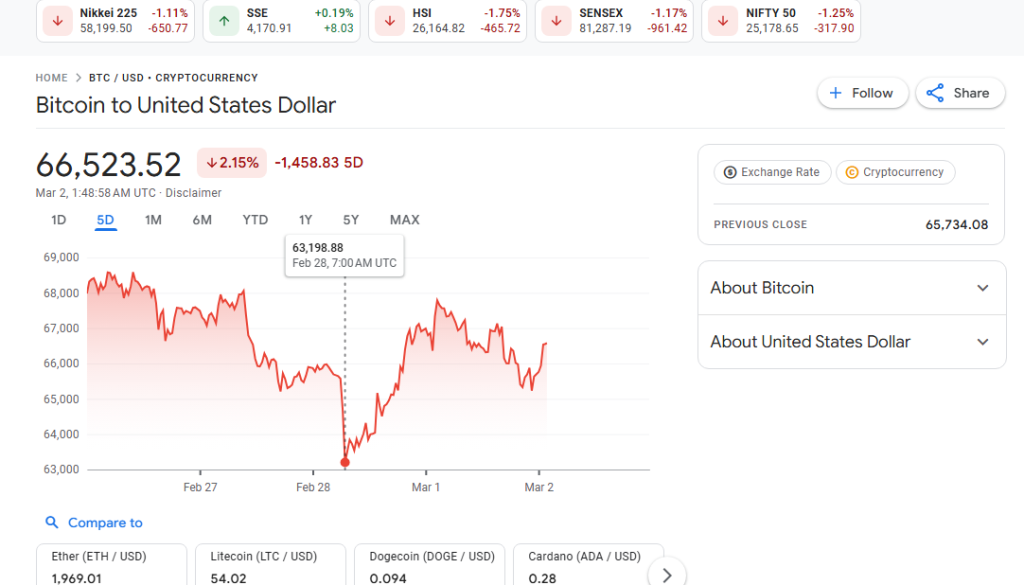
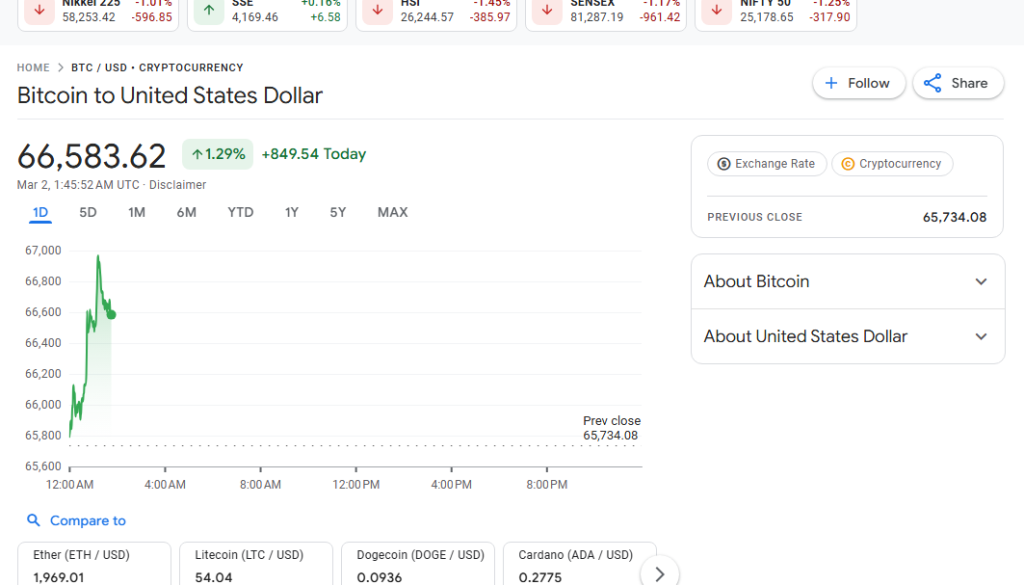
Bitcoin dropped from approximately $65,600 to $63,000 during initial panic as news of U.S.-Israeli strikes spread. The leading cryptocurrency later recovered to around $65,000 as traders assessed whether Iran would follow through on blockade threats. Oil-linked futures on Hyperliquid surged more than 5% as speculators bet on energy price spikes.
Crypto’s behavior during the crisis confirmed its status as a risk-on asset rather than a safe haven during geopolitical shocks. Capital rotated out of digital assets and into traditional stores of value. Gold climbed to $5,380 per ounce while U.S. Treasury bonds saw increased demand from investors seeking safety.
The correlation between crypto and traditional risk assets became evident as both responded similarly to escalating tensions. Crypto social media on X amplified fears that Iran’s actions could trigger prolonged bearish pressure through inflation shocks.
The Inflation Connection
Crypto traders fear that sustained oil price increases will force central banks to maintain higher interest rates. The Federal Reserve and other major central banks have been cautiously managing inflation throughout 2025 and early 2026. A spike in energy costs could reignite inflationary pressures just as monetary policy was beginning to ease.
Higher interest rates reduce liquidity available for speculative assets like cryptocurrency. The inverse relationship between rates and crypto valuations means prolonged energy disruption could extend bearish conditions. This explains why Bitcoin struggled to maintain gains even after initial panic subsided.
What Are the Realistic Scenarios for the Strait of Hormuz?
Experts disagree on whether Iran threatened 20% of global oil supply represents a genuine long-term blockade or temporary posturing. Some analysts argue that complete closure remains unlikely because Iran itself exports approximately 1.65 million barrels daily through the strait to China. Blocking the waterway would eliminate Iran’s primary revenue source during an economic crisis.
Geography also complicates Iran’s ability to enforce a total blockade. The shipping lanes run predominantly through Omani territorial waters rather than Iranian waters. The Iranian side features shallower depths unsuitable for large oil tankers, while the Omani side offers deeper channels. Ships could theoretically continue transiting through Omani waters even if Iran attempted to block its own territory.
Dr. Anas Alhajji, an energy market expert, noted on X that most waterways lie in Oman rather than Iran. He emphasized that the Strait of Hormuz has never been successfully blocked despite numerous regional conflicts. The waterway’s width and international protection make complete closure extremely difficult to maintain.
The Worst-Case Scenario
However, even partial disruption carries severe consequences. Bob McNally, former White House energy advisor and founder of Rapidan Energy, warned that Iran possesses large stockpiles of mines and short-range missiles capable of making the strait unsafe for commercial traffic. Ships don’t need to be physically blocked if insurance companies refuse to underwrite voyages through contested waters.
The insurance question may prove more decisive than military capabilities. Fox Business reported that several oil companies and trading firms have already paused shipments through the waterway. This voluntary suspension by commercial operators could achieve what military blockade cannot.
If the closure extends beyond several days, Asian countries dependent on Gulf oil would begin hoarding supplies. China, India, Japan, and South Korea combined receive three-quarters of the oil flowing through Hormuz. A sustained disruption would trigger what McNally called “the mother of all bidding wars” as these nations compete for limited alternative supplies.
What Tools Can Governments Use to Stabilize Markets?
The Trump administration could release oil from the Strategic Petroleum Reserve if prices spike dramatically. The reserve currently holds approximately 415 million barrels according to Department of Energy data. However, analysts at ClearView Energy Partners warned that even combined strategic stocks from the U.S. and International Energy Agency members might prove insufficient for a full Hormuz crisis.
OPEC members with spare capacity could increase production to offset Iranian exports. Saudi Arabia, the UAE, and Kuwait maintain some unused production capacity that could partially compensate for disrupted supplies. However, these countries also export through the Strait of Hormuz, limiting their ability to help unless alternative export routes become viable.
The duration of any closure will determine whether governments can effectively manage the crisis. Short-term disruptions lasting days or weeks can be handled through strategic reserves and demand management. Prolonged closures extending months would overwhelm available mitigation tools and potentially trigger global recession.
How Should Crypto Investors Respond?
The crisis when Iran threatened 20% of global oil supply demonstrates crypto’s continued vulnerability to macroeconomic shocks. Investors treating Bitcoin as digital gold discovered that geopolitical tensions drive capital into traditional safe havens instead. This pattern has repeated consistently across major global events since 2020.
Portfolio diversification becomes essential when crypto correlates closely with risk assets during crises. Holding positions across digital assets, precious metals, and traditional securities provides better protection than concentrated crypto exposure. The weekend’s volatility punished investors fully allocated to cryptocurrency without hedges.
Technical analysis suggests Bitcoin could test the $60,000 support level if Middle East tensions escalate further. The broader chart pattern shows potential for deeper correction if risk-off sentiment intensifies. Traders should watch oil prices closely as sustained energy inflation would likely pressure crypto valuations through tightening monetary policy.
Long-term holders may view geopolitical dips as accumulation opportunities. Historical patterns show that Bitcoin often recovers from crisis-driven selloffs once immediate fears subside. However, the recovery timeline depends entirely on how quickly the Strait of Hormuz situation resolves.
Frequently Asked Questions
Could Iran completely close the Strait of Hormuz?
Most experts argue that Iran threatened 20% of global oil supply represents a temporary disruption rather than sustainable blockade. Geography favors continued shipping through Omani waters. However, Iran’s mines and missiles could make the strait unsafe enough that commercial traffic voluntarily stops.
How high could oil prices go if the closure continues?
Analysts project Brent crude could reach $100 per barrel initially, with potential spikes to $130 if disruption extends beyond several weeks. The exact price depends on how much oil gets diverted through alternative routes and whether OPEC increases production.
Why did Bitcoin fall instead of rising as a safe haven?
Crypto has consistently behaved as a risk-on asset during geopolitical crises rather than a safe haven. Investors flee to gold and government bonds during uncertainty. Bitcoin’s correlation with technology stocks and speculative assets drives it lower during risk-off periods.
What happens if inflation rises from oil price spikes?
Higher inflation would likely keep interest rates elevated longer than markets currently expect. This reduces liquidity available for speculative assets including cryptocurrency. Sustained energy inflation could extend crypto’s bearish trend through 2026.
Should investors sell crypto during geopolitical crises?
Investment decisions depend on individual risk tolerance and time horizons. Short-term traders might reduce exposure during acute crises. Long-term holders often view geopolitical dips as accumulation opportunities if they believe in crypto’s fundamental value proposition.