Grayscale filed an S-1 registration statement with the SEC on July 20, 2026, to launch a spot Worldcoin ETF trading on Nasdaq under the ticker GWLD, sending WLD up roughly 3% to 4.5% on the day to trade near $0.375 to $0.377.
Inside the GWLD Filing
Grayscale formed the trust on July 10 and filed just 10 days later, with Bloomberg ETF analyst James Seyffart confirming the filing on X.
Under the proposed structure, BitGo Bank & Trust would hold the fund’s WLD, the Bank of New York Mellon would serve as administrator and transfer agent, and CSC Delaware Trust Company would act as trustee. Authorized participants could create or redeem shares in baskets of 10,000, either by delivering WLD directly or through cash orders handled by liquidity providers.
Grayscale said it intends to list under Nasdaq’s generic listing standards, a mechanism that can allow crypto ETFs to launch faster once the underlying token satisfies eligibility requirements, rather than going through a fully individualized approval process.
Several terms remain blank in the filing, including the management fee, initial seed investment, and how much WLD each share would represent, meaning further amendments are expected before any launch.
Grayscale has converted trust products into spot ETFs before, taking its Bitcoin Trust public in January 2024 after prevailing against the SEC in court, followed by Solana and Dogecoin funds in late 2025.
The filing also lands about a week after T. Rowe Price launched the first active crypto ETF covering multiple assets, and alongside Grayscale’s own Hyperliquid ETF, part of a broader wave of new crypto fund launches this year.
The Risks Buried in the Prospectus
Worldcoin, the token behind World Network’s proof-of-personhood system, verifies users through iris scans captured by a device called the Orb.
Grayscale’s own prospectus names biometric data collection as a central product risk, and regulators in Spain, Portugal, Germany, Hong Kong, Brazil, Kenya, and Indonesia took enforcement action against the project’s biometric practices between 2024 and 2025.
The filing separately flags World Chain’s centralized sequencer, WLD’s price volatility, and the possibility WLD could be treated as a security as additional material risks, warning that an adverse regulatory decision could reduce the token’s value or force the trust to close.
Token concentration and unlock schedules also add further risk as the 100 largest wallets hold about 90% of circulating WLD, and team and investor token unlocks continue until around July 2028.
As of June 30, roughly 3.5 billion WLD tokens were in circulation with a combined market value near $1.4 billion and daily trading volume of $135.1 million, placing WLD as the 41st-largest crypto asset by market capitalization at the time of filing, according to figures in Grayscale’s prospectus.
Readers new to how spot crypto ETFs work more generally can find context in our guide on 5 things Bitcoin ETF investors should know.
What Comes Next
WLD remains roughly 97% below its March 2024 peak near $11.74 to $11.80, and recent price action has been choppy. A June treasury purchase gave the token a brief lift before layoffs at lead developer Tools for Humanity dragged it back down. Moreover, sentiment around WLD’s ties to OpenAI cofounder Sam Altman has cooled since reports that OpenAI may not go public this year.
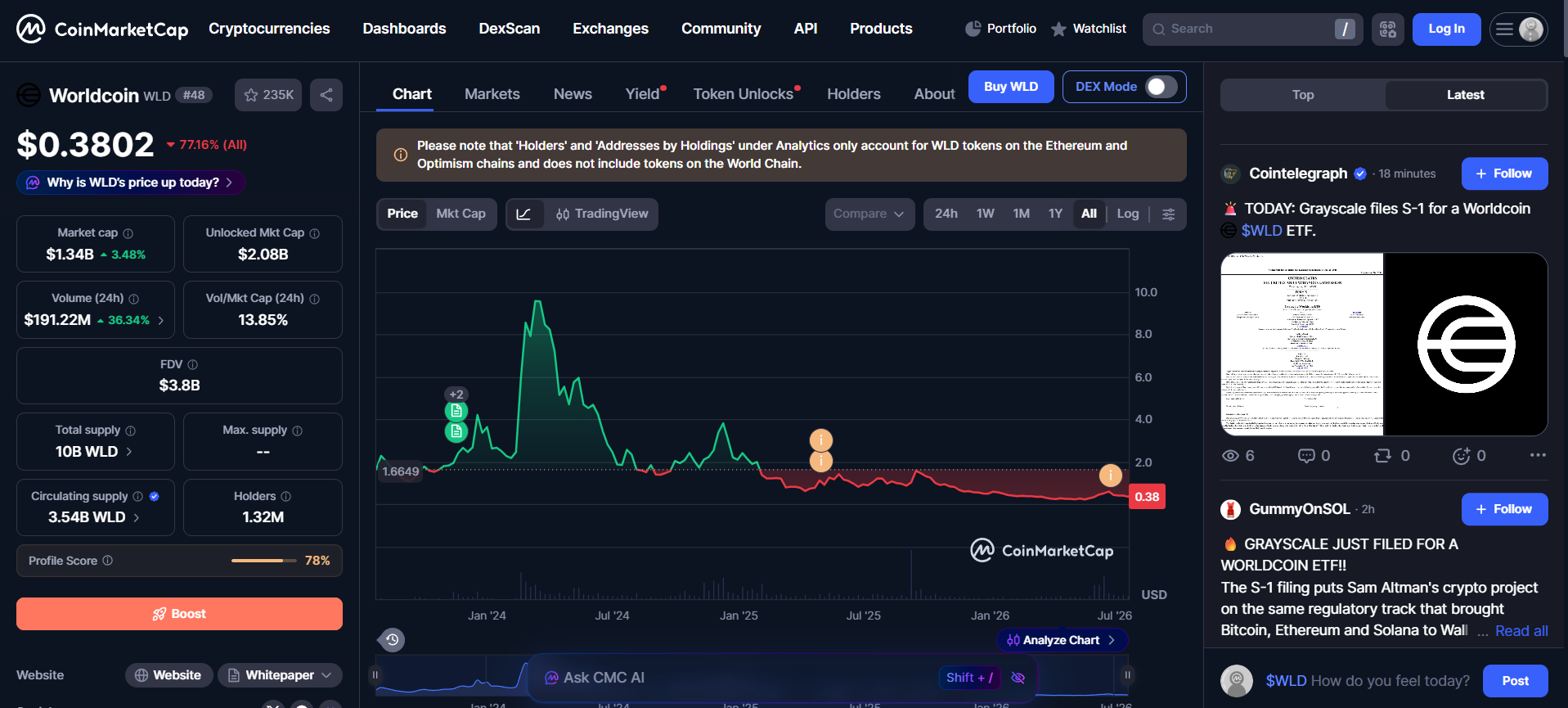
The token’s gain also coincided with Bitcoin trading back above $65,000 for the first time in weeks, suggesting part of the move reflects broader market strength rather than WLD-specific news alone. GWLD cannot begin trading until the SEC approves the registration and Nasdaq clears the listing, and Grayscale has not disclosed a target timeline.
What this means for you: easier brokerage access to WLD through an ETF wrapper does not change the token’s underlying concentration, unlock overhang, and regulatory exposure, all of which Grayscale’s own filing treats as real risks rather than footnotes.