
Hyperliquid, the decentralized perpetual futures exchange, is pushing US regulators for a path into the American derivatives market, working through the Commodity Futures Trading Commission (CFTC) and the Securities and Exchange Commission (SEC) rather than waiting for broader crypto legislation to pass.
What Hyperliquid Is Asking For
Hyperliquid currently blocks US users entirely. Its policy arm, the Hyperliquid Policy Center, funded by the Hyper Foundation, has been running outreach in Washington aimed at getting regulators to interpret existing rules favorably or to create new ones that would allow regulated firms to offer perpetual futures on markets built on Hyperliquid’s blockchain infrastructure.
Policy Center CEO Jake Chervinsky framed the goal as opening a route for regulated intermediaries, not necessarily Hyperliquid itself, to plug into that infrastructure.
In July, the Hyperliquid Policy Center and Phantom jointly asked the CFTC to clarify that developers of onchain software should not automatically face exchange or clearinghouse registration requirements, and separately urged regulators to let registered firms use blockchain infrastructure for execution, margining, clearing, and settlement.
Their filing argued that self-custodial markets do not fit neatly into rules written for traditional intermediaries, since users retain control of their own funds throughout, and said the current framework leaves American users walled off from onchain derivatives while development continues offshore.
Why This Sits Outside the CLARITY Act Entirely
Perpetual futures and vaults are not covered by the CLARITY Act at all, according to The Information, meaning the CFTC and SEC will shape this specific corner of the market regardless of how or when that legislation eventually resolves.
Perpetual futures currently sit in a genuine gap. They are not banned outright in the US, but they do not fit neatly under the Commodity Exchange Act, which governs clearing, margin, and execution rules for derivatives on registered venues.
That gap has already fueled enforcement actions against both centralized and DeFi platforms offering off-exchange derivatives. Regulators have shown some willingness to adapt existing rules rather than leave the gap unaddressed.
In late May, the CFTC approved the first perpetual contract tied to Bitcoin’s spot price, with plans to review contracts tied to other assets on a case-by-case basis. In June, it opened a public comment period on proposed changes to 24/7 energy futures and oil-linked perpetual contracts.
Our earlier coverage of the CFTC’s recent guidance to prediction market platforms shows the same agency actively shaping adjacent corners of crypto derivatives markets around this same period.
A Jurisdictional Wrinkle Tied to Hyperliquid’s Own Growth
About 32% of Hyperliquid’s second-quarter trading volume was tied to stocks and other real-world assets, potentially placing parts of Hyperliquid’s business under the simultaneous jurisdiction of both the CFTC and the SEC. A regulated US pathway would need to account for that dual exposure, not just the crypto-native side of the business.
The Business Case Behind the Push
Hyperliquid reportedly generated more than $900 million in profit last year, and VanEck’s Matthew Sigel has separately estimated that its HYPE token could generate roughly $800 million in annualized revenue.
Meanwhile, centralized-exchange futures volume fell to $4 trillion in July, the lowest level since December 2023 and down sharply from peaks above $10 trillion in late 2025, while decentralized exchange perpetual volume dropped roughly 21% to $531 billion over the same month, ending a two-month recovery that had started in April.
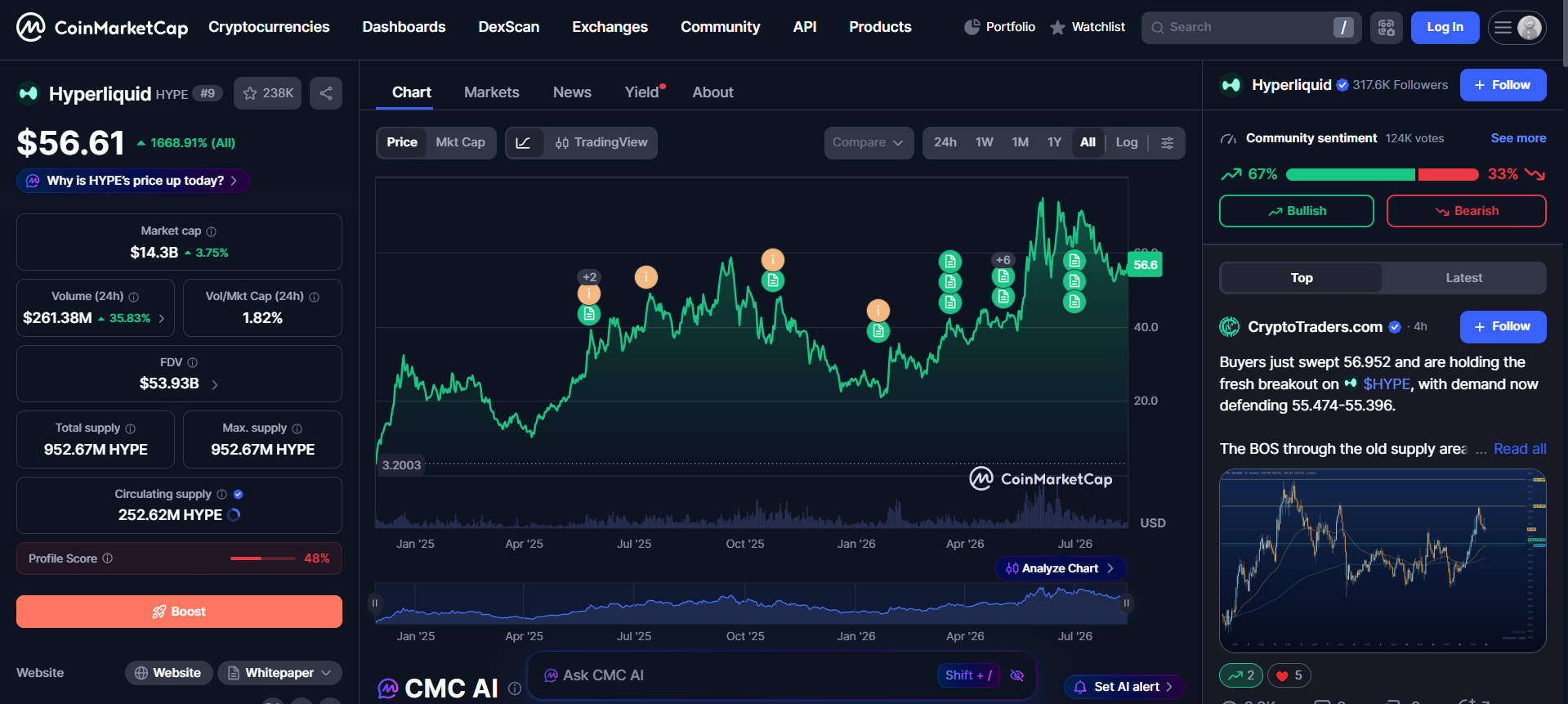
HYPE continues to attract buyers despite the slowdown, currently trading near $56.61 at the time of this reporting.
What Comes Next
Nothing here changes Hyperliquid’s current access for US users, and no timeline has been given for when the CFTC or SEC might respond to the Policy Center’s July filing.
What this means for you: this is a slower-moving regulatory process. Even if regulators eventually agree, US access would most likely arrive through regulated third-party firms offering products built on Hyperliquid’s infrastructure rather than Hyperliquid itself opening directly to American users.