

Bitcoin is holding around the $75,000 to $76,000 area after the Federal Reserve raised interest rates by 25 basis points and delivered hawkish guidance on inflation.
The Federal Open Market Committee (FOMC) raised the federal funds target range to 3.75% to 4.00% on September 16 as Fed Chair Kevin Warsh said the economy is strengthening, financial conditions are not clearly restrictive, and the central bank remains highly focused on bringing inflation back to its 2% target.
Normally, a rate hike combined with hawkish guidance would put strong pressure on risk assets. Bitcoin did fall toward $75,000, but it has so far avoided a deeper breakdown despite tighter monetary policy and renewed spot Bitcoin ETF outflows.
That makes the $75,000 area the most important short-term level. If BTC holds it, buyers may get another chance to challenge $77,000 to $78,000. A sustained break lower would shift attention toward the $71,500 to $73,600 support zone.
Bitcoin Holds Above $75K Despite Hawkish Fed
Bitcoin entered the FOMC decision under pressure after several weak sessions, with higher rate expectations and a stronger US dollar (DXY) already weighing on the market.
The Fed then delivered a 25-basis-point increase, while Warsh emphasized that inflation remains the central bank’s main concern. He said the economy is strengthening and that he was “hard-pressed” to describe financial conditions as restrictive.
Warsh also said the FOMC widely shared that view and stressed that the Fed must be confident inflation is moving toward its 2% objective before easing its focus on price stability.
Despite that backdrop, Bitcoin held around $75,000. That does not make the setup bullish by itself, but it suggests sellers still haven’t forced a decisive breakdown, even after receiving a clearly hawkish policy signal.
| Level | Role |
| ~$70,000 | Major structural support |
| $71,500–$73,600 | Main downside support zone |
| ~$75,000 | Immediate support |
| $75,000–$76,000 | Current trading area |
| $77,000–$78,000 | Near-term resistance |
| ~$81,600 | Major upside resistance |
Table 1. Bitcoin Key Support and Resistance Levels
The immediate question is whether $75,000 can continue acting as support once the market fully digests the Fed decision.
Fed Raises Rates by 25 Basis Points
The hike was widely anticipated before the announcement, which helps explain why Bitcoin did not immediately collapse after the decision.
The more important part of the meeting was the Fed’s tone, with Warsh saying the rate decision came as the economy strengthened and arguing that financial conditions were not clearly restrictive.
Notably, Warsh did not submit an individual projection to the Fed’s dot plot, but the meeting’s broader message was still hawkish.
For Bitcoin, this means the September hike may already be priced in, while expectations for further tightening remain the bigger macro risk.
Bitcoin’s Resilience Is the Main Post-Fed Signal
Bitcoin’s ability to stay above $75,000 is one of the more important signals after the Fed meeting.
A rate hike, hawkish guidance, and continued inflation concerns would normally create a difficult environment for Bitcoin and risk assets. Yet the cryptocurrency has so far avoided a sharp post-meeting selloff.
Bitcoin had already weakened into the decision, so some of the rate-hike risk may have been priced in beforehand.
Still, holding support is not the same as confirming a reversal. BTC remains below the $77,000 to $78,000 area and needs to reclaim that zone before the short-term structure improves.
Bitcoin ETF Outflows Add Pressure After FOMC
US spot Bitcoin exchange-traded funds (ETFs) have turned decisively negative again, creating another headwind while BTC attempts to defend $75,000.
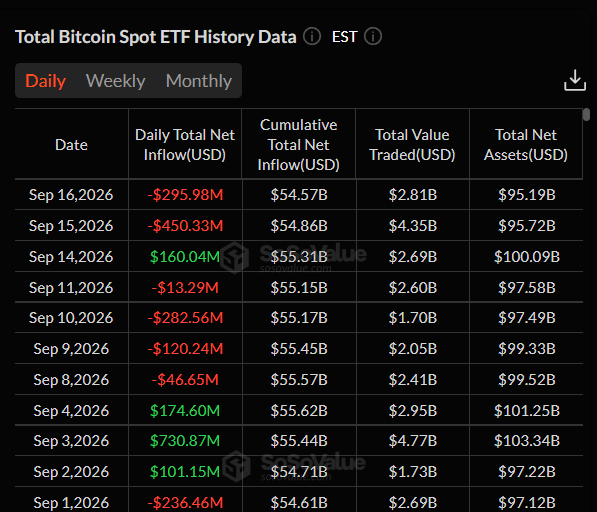
According to SoSoValue data, spot Bitcoin ETFs recorded $295.98 million in net outflows on September 16. That followed an even larger $450.33 million outflow on September 15.
Combined, roughly $746.31 million left the funds across the two sessions surrounding the Fed decision.
The weakness is not limited to those two days. Bitcoin ETFs recorded net outflows in six of the seven reported sessions from September 8 through September 16, with September 14’s $160.04 million inflow the only positive day, for a combined net outflow of about $1.05 billion.
Continued withdrawals remove some of that support as the market adjusts to higher interest rates.
Total ETF net assets also fell to approximately $95.19 billion on September 16 from $100.09 billion on September 14. That decline should not be interpreted as $4.9 billion of investor withdrawals because net asset values also move with Bitcoin’s price.
If ETF outflows continue while BTC remains below $77,000 to $78,000, pressure on the $75,000 level could increase.
$77K to $78K Is the First Recovery Test
Bitcoin needs to reclaim $77,000 to $78,000 before the short-term technical picture improves.
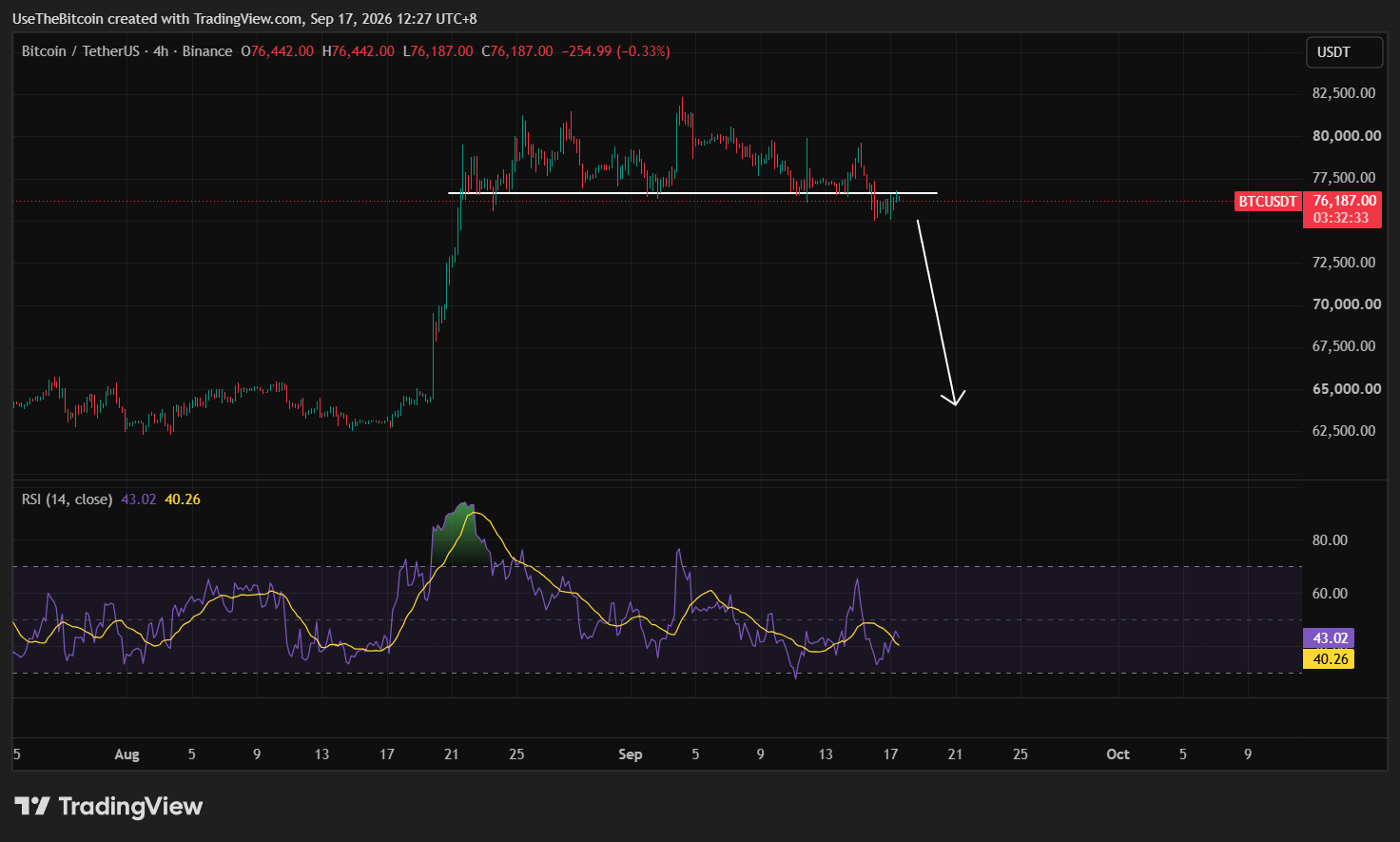
Bitcoin’s current price action places the larger downside support zone around $71,500 to $73,600, while the first meaningful resistance sits above the current price near $77,000 to $78,000.
$73,600 is an important support area, and around $81,600 is a larger resistance level. It also points to $70,000 as a significant structural support zone.
Therefore, $81,600 is the larger resistance that would need to break before the recent decline looks more like a completed correction.
Momentum Remains Weak Despite the Hold
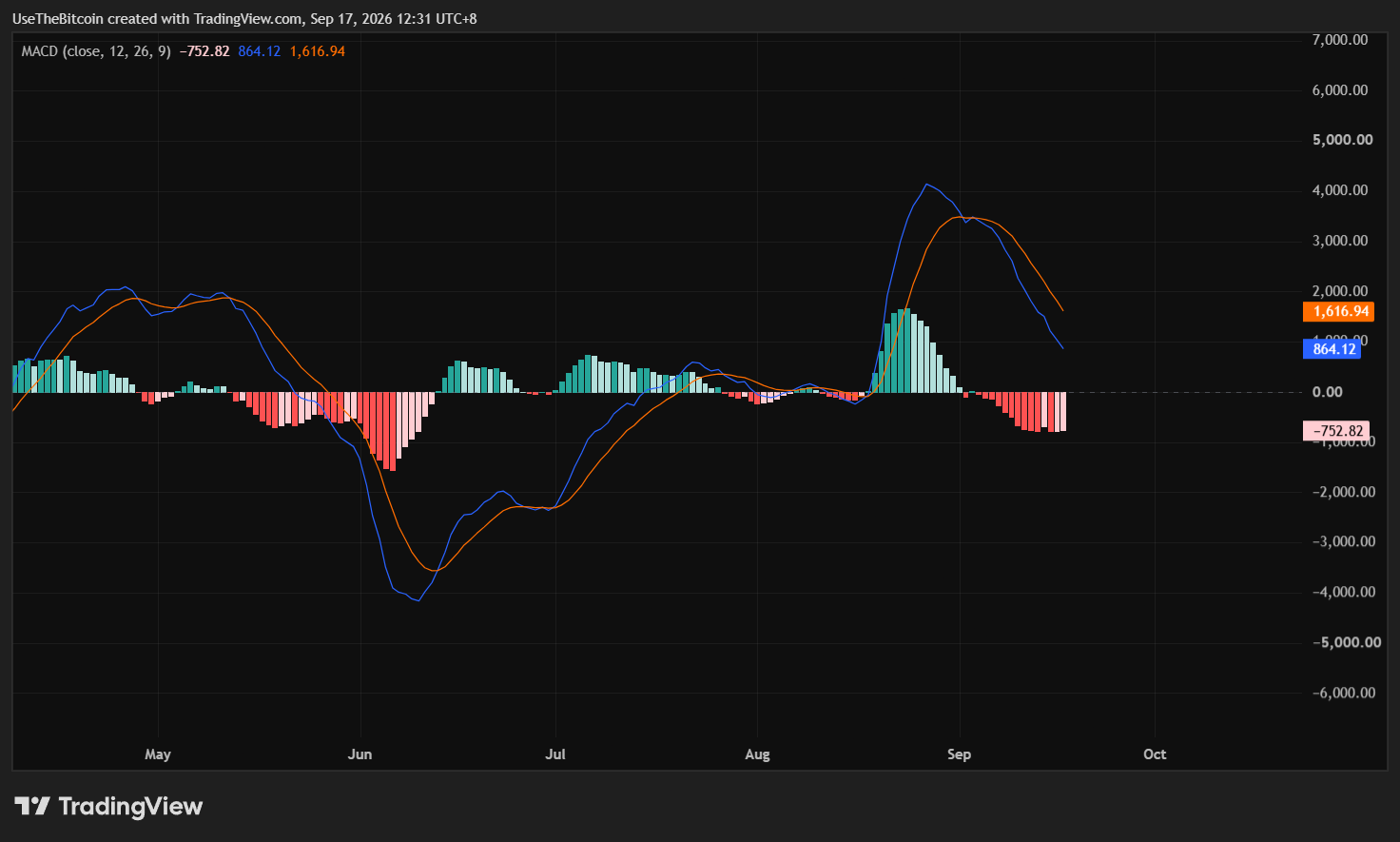
Bitcoin has defended support, but momentum has not yet turned convincingly bullish. The moving average convergence divergence (MACD) histogram remains below zero, suggesting short-term momentum still favors sellers.
The relative strength index (RSI), however, remains closer to neutral rather than deeply oversold.
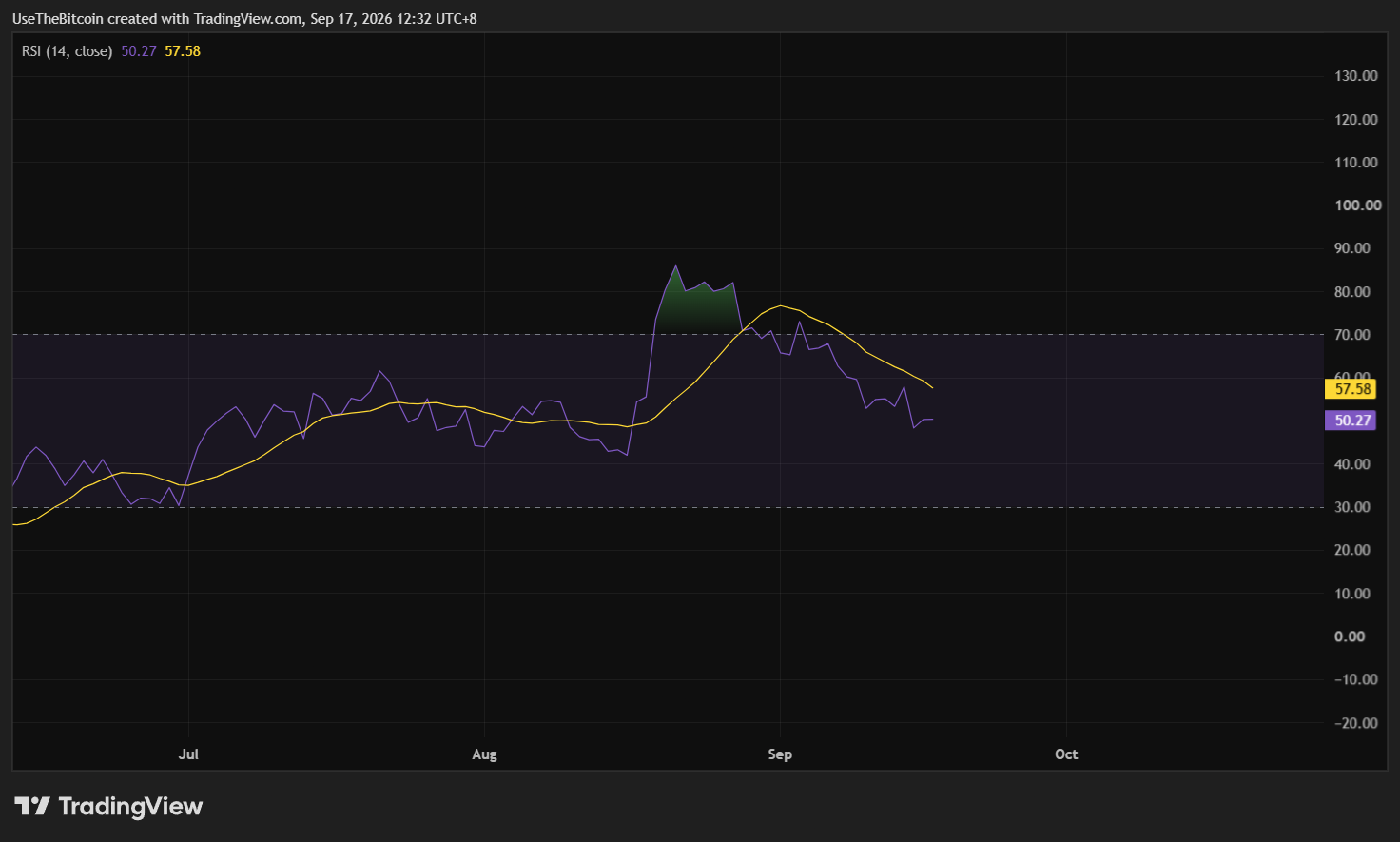
Bitcoin has not broken down, but buyers have not produced a strong recovery either. The market remains caught between support around $75,000 and resistance near $77,000 to $78,000.
A reclaim of resistance would begin shifting momentum back toward buyers, and a break below $75,000 would do the opposite.
Higher Rates Remain Bitcoin’s Main Macro Risk
The interest rate decision may be over, but the macro risk remains.
Higher interest rates increase the returns available on lower-risk assets and can strengthen the US dollar, both of which can make risk assets such as Bitcoin less attractive at the margin.
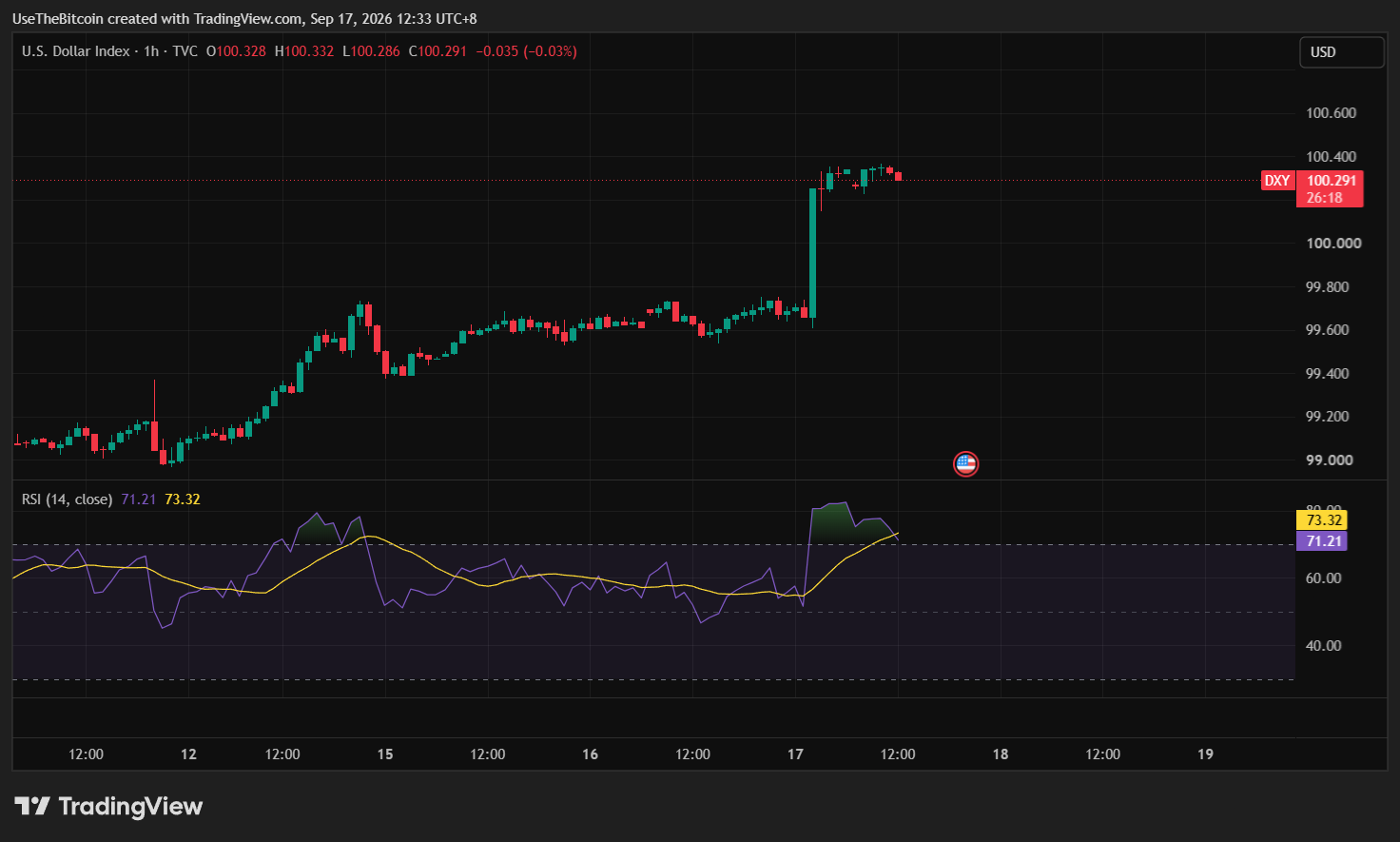
Warsh’s comments also suggest the Fed is not ready to declare victory over inflation. If the economy remains strong while inflation stays above target, policymakers may have room to tighten again.
That means incoming inflation, labor market, and growth data will continue to influence Bitcoin over the next several weeks.
A softer inflation trend could reduce expectations for additional hikes and support BTC.
Persistent inflation combined with strong economic activity could keep Treasury yields and the dollar elevated, making a sustained Bitcoin recovery more difficult.
| Scenario | Price Trigger | Possible Outcome |
| Bullish Case | BTC holds $75K and reclaims $77K-$78K | Recovery could extend toward $81.6K |
| Base Case | BTC remains between $73.6K and $78K | Post-Fed consolidation continues |
| Bearish Case | BTC loses $73.6K support | $71.5K and eventually $70K come into focus |
Table 2. Bitcoin Price Scenarios After the September FOMC Decision
Bottom Line
Bitcoin’s reaction to the September rate hike is more resilient than the macro backdrop might suggest.
The Fed raised rates by 25 basis points; Warsh emphasized that inflation remains too high and policymakers left the door open to further tightening. Meanwhile, US spot Bitcoin ETFs recorded roughly $746 million in net outflows between September 15 and 16.
Yet Bitcoin has held around $75,000 so far.
That makes $75,000 the most important immediate level. Holding it despite hawkish FOMC guidance and persistent ETF outflows would suggest sellers are struggling to force a deeper breakdown.
The first recovery test sits between $77,000 and $78,000. A break above that range, particularly alongside improving ETF flows, would strengthen the short-term recovery case and reopen the path toward $81,600.
If $75,000 fails, the stronger support cluster around $71,500 to $73,600 becomes the next area to watch, with $70,000 representing the larger structural support below.
This article is for informational purposes only and does not constitute financial advice. Crypto price predictions are based on analyst estimates and are not guarantees of future performance. Do your own research before making any investment decisions.
Frequently Asked Questions
Need a refresher? Here are some common questions about Bitcoin’s current price setup.
Why Didn’t Bitcoin Crash After the Fed Raised Rates?
The 25-basis-point rate hike was widely expected before the meeting, so part of the negative impact may already be priced into Bitcoin. BTC also weakened ahead of the announcement, which reduced the immediate surprise when the Fed delivered the expected increase.
What Is the Main Bitcoin Support Level Now?
Immediate support is around $75,000. Below that, the larger support area sits between approximately $71,500 and $73,600, with $70,000 acting as the next major structural level.
What Price Does Bitcoin Need to Reclaim?
Bitcoin first needs to recover the $77,000 to $78,000 resistance zone. A sustained move above that range would improve the short-term structure, while $81,600 remains the larger upside barrier.
Why Are Bitcoin ETF Outflows Important?
Spot Bitcoin ETFs create direct demand for BTC through their underlying holdings. Persistent outflows can reduce one source of market buying pressure, especially when Bitcoin already faces macro headwinds such as higher interest rates.
Could the Fed Raise Rates Again in October?
Yes. Warsh emphasized that the Fed remains focused on bringing inflation back to 2% and does not currently view financial conditions as clearly restrictive. Future rate decisions will depend heavily on inflation, employment, and growth data.