Bitcoin is trading above $77,000 after August inflation data pushed expectations for a Federal Reserve rate hike sharply higher ahead of the September 16 Federal Open Market Committee (FOMC) decision.
August headline Consumer Price Index (CPI) rose 0.4% month over month and 3.4% year over year, broadly matching expectations.
Core CPI increased 0.3% on the month, slightly above the 0.2% consensus, while the annual core rate eased to 2.4%, enough to shift rate expectations more hawkish.
Markets now price in roughly an 87% chance of a 25-basis-point rate hike, up sharply from around 70% before the CPI release.
Bitcoin briefly reached $79,890 on September 12 but retreated toward the $77,200 area as traders adjusted to the higher probability of tighter monetary policy.
Bitcoin Holds $77K After Another Failed $80K Push
Bitcoin has struggled to turn its August recovery into a clean breakout above $80,000.

BTC recently reached an intraday high of $79,890 before falling back toward $77,200. Earlier attempts above $80,000 and toward $82,000 have also failed, leaving price inside the same broad consolidation range that has controlled most of the month.
Immediate resistance now sits around $78,000, and clearing that level could allow another attempt at $80,000, while a stronger breakout would require BTC to reclaim the broader $80,000 to $82,000 zone.
Support begins around $76,900 to $77,300, and a sustained move below that area could shift attention toward $75,000.
| Level | Role |
| ~$75,000 | Major downside support |
| $76,900–$77,300 | Immediate support |
| ~$77,200 | Current price area |
| ~$78,000 | Near-term resistance |
| ~$80,000 | Psychological resistance |
| $80,000–$82,000 | Major breakout zone |
Table 1. Bitcoin Key Support and Resistance Levels
Bitcoin therefore remains caught between a well-defined support floor and repeated selling near $80,000.
CPI Pushed Fed Rate Hike Odds Toward 87%
The inflation report did not deliver the disinflation surprise Bitcoin bulls wanted.
Headline CPI increased 0.4% in August and remained at 3.4% year over year. Core inflation rose 0.3% month over month, above the 0.2% consensus, although the annual core rate eased to 2.4%.
Rate-hike odds climbed to roughly 87% as of this writing, while short-term Treasury yields moved higher. The two-year yield reached about 4.61%, reflecting stronger expectations that the Fed will tighten policy on September 16.
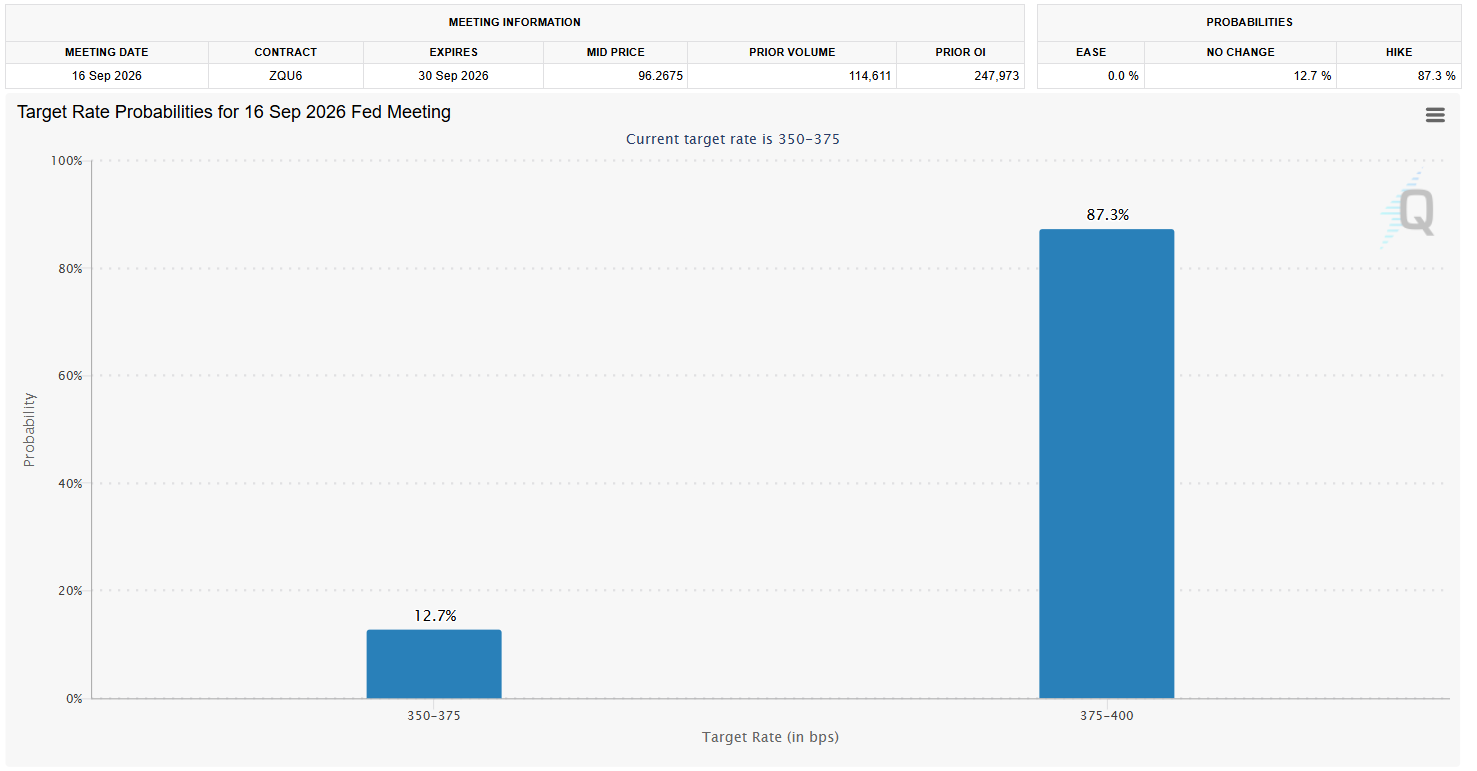
CPI influences Fed expectations, which affect Treasury yields and the dollar, which then influence risk appetite across Bitcoin, Nasdaq, and other risk assets.
A 25-basis-point hike is now increasingly priced in. The bigger uncertainty is what the Fed signals about additional tightening after September.
The Fed’s Guidance May Matter More Than the Hike
The September FOMC decision is scheduled for September 16.
A 25-basis-point hike would raise the federal funds target range from 3.50%-3.75% to 3.75%-4.00%.
Because markets are already assigning a high probability to the increase, Bitcoin’s reaction may depend more on the Fed’s forward guidance than on the rate decision itself.
A hike paired with language suggesting September could be a one-off adjustment may limit the downside.
A signal that policymakers expect several additional increases would likely put more pressure on Treasury yields, the dollar, and crypto markets.
| FOMC Scenario | Possible Market Reaction | Possible BTC Impact |
| 25 bps hike with balanced guidance | Hike largely absorbed by market | BTC may stabilize and retest $78K-$80K |
| 25 bps hike with hawkish guidance | Yields and USD move higher | BTC could lose $77K and test $75K |
| Surprise hold | Rate expectations fall sharply | BTC could challenge $80K–$82K |
Table 2. How the September FOMC Decision Could Affect Bitcoin
The Fed’s projected rate path may therefore matter more than whether the first 25-basis-point increase arrives.
Bitcoin ETF Outflows Add Pressure
Institutional flows have weakened as macro conditions have worsened.
US spot Bitcoin exchange-traded funds (ETFs) recorded a fourth consecutive day of net outflows on September 11, with approximately $13.29 million leaving the funds during the session.
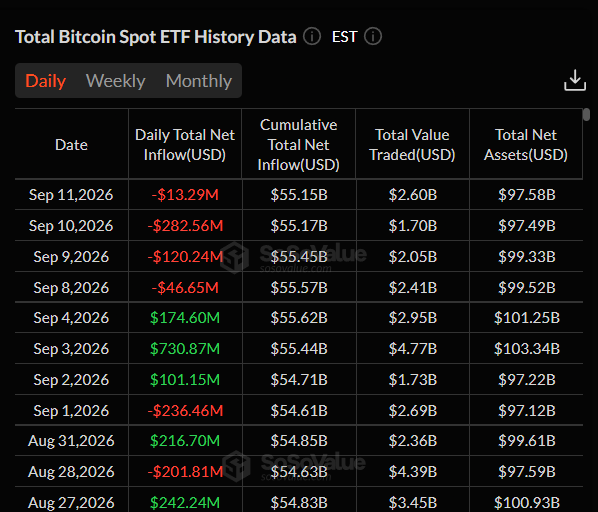
That follows several negative sessions as Bitcoin has struggled below $80,000.
ETF flows do not determine price on their own, but persistent outflows remove one source of spot demand that could otherwise help absorb selling near resistance.
A return to sustained inflows alongside a reclaim of $78,000 would strengthen the case for another attempt at $80,000.
Continued outflows would make that breakout harder, particularly if Treasury yields rise after the Fed meeting.
Bitcoin Golden Cross
Bitcoin’s 50-day exponential moving average (EMA) has already moved above the 200-day EMA, creating a golden cross since September 11.
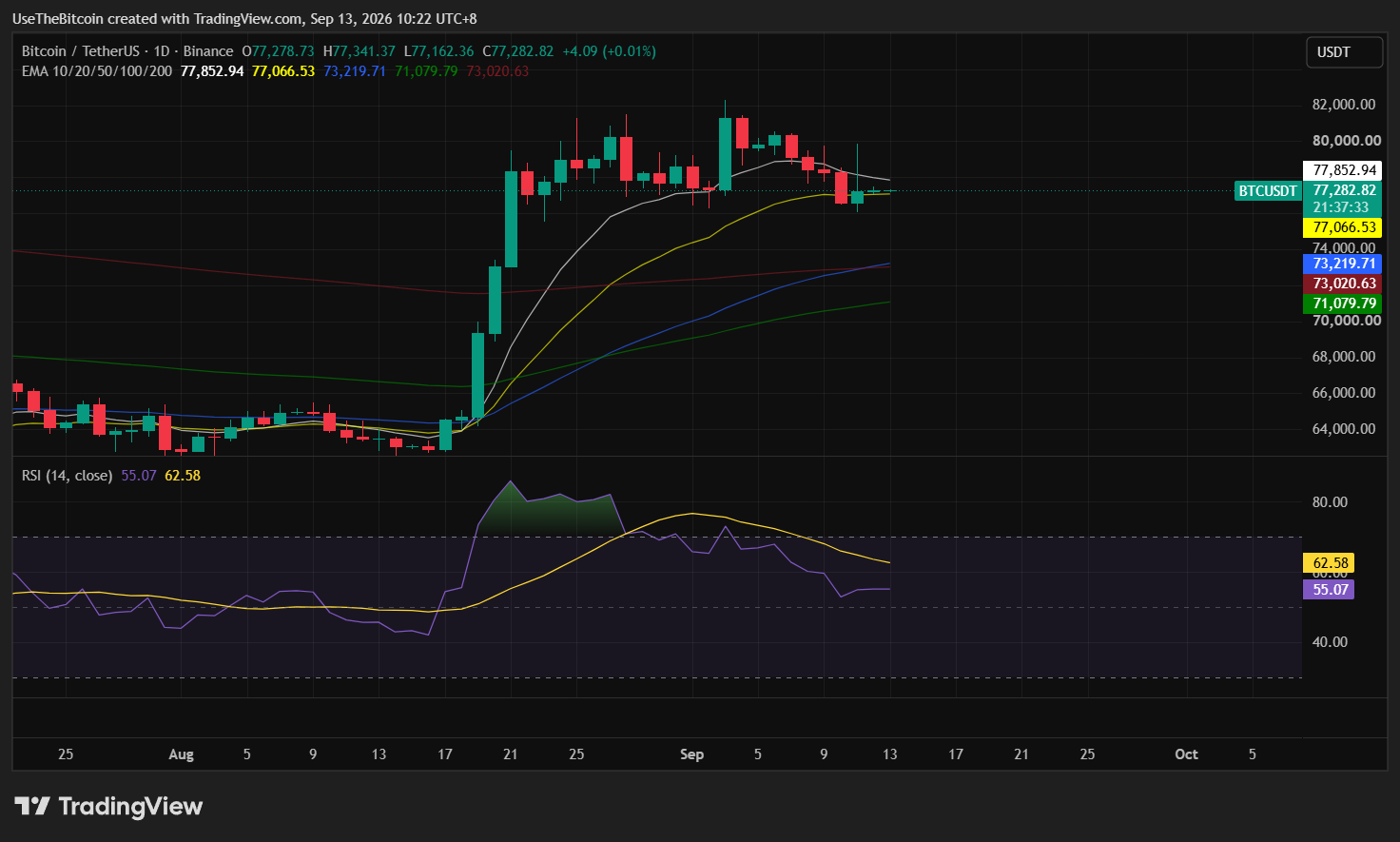
However, BTC did not immediately rally after the crossover, but that is not unusual. A golden cross is a lagging signal, meaning it often appears after price has already started recovering rather than at the exact start of a new move.
Bitcoin has also tended to pull back or trade sideways around a golden cross before moving higher in past cycles. The crossover can therefore be more useful as confirmation of an improving medium-term trend than as a signal that price must rise immediately.
But the current setup still needs price confirmation as Bitcoin remains below the $78,000 to $80,000 resistance area, so the golden cross becomes more meaningful if BTC can hold support and later reclaim those levels.
CLARITY Act Vote Adds Another September Catalyst
Bitcoin also faces an important US regulatory event one day before the Fed decision.
The Senate is expected to vote on September 15 on whether to proceed with debate on the CLARITY Act. The procedural motion requires 60 votes and is not the final vote on the legislation.
A successful vote could reduce some regulatory uncertainty around digital asset markets, custody and institutional participation.
A failed vote could disappoint crypto investors, although monetary policy is likely to remain the stronger short-term price catalyst.
| Scenario | Price Trigger | Possible Outcome |
| Bullish Case | BTC holds $77K, reclaims $78K and clears $80K | Buyers challenge the $80K-$82K resistance zone |
| Base Case | BTC remains between $75K and $80K | Consolidation continues through the Fed decision |
| Bearish Case | BTC loses $76.9K-$77.3K and then $75K | Macro pressure strengthens and a deeper correction becomes more likely |
Table 3. Bitcoin Price Scenarios Ahead of the September FOMC
The base case remains a range until Bitcoin either reclaims $80,000 or loses the support structure around $75,000 to $77,000.
Bottom Line
Bitcoin is holding above $77,000 after the August CPI report increased the probability of a September Fed rate hike to around 87%.
The inflation report was not dramatically hotter than expected, but the slightly stronger monthly core reading was enough to push Treasury yields and rate expectations higher, keeping BTC below $80,000 despite its strong August recovery.
The September 16 rate decision is now the main catalyst, but the Fed’s guidance on what happens after that meeting may ultimately matter more than the expected 25 bps hike itself.
This article is for informational purposes only and does not constitute financial advice. Crypto price predictions are based on analyst estimates and are not guarantees of future performance. Do your own research before making any investment decisions.
Frequently Asked Questions
Need a refresher? Here are some common questions about Bitcoin’s current price setup.
Why Did Bitcoin Rise After the CPI Report but Fail to Hold the Move?
Bitcoin initially moved higher after the inflation report because headline CPI came in largely in line with expectations, reducing the risk of an immediate upside inflation surprise. The rally was not sustained because monthly core inflation rose 0.3%, slightly above the 0.2% consensus, keeping pressure on Federal Reserve rate expectations and Treasury yields, which limited follow-through in Bitcoin.
What Are the Odds of a Fed Rate Hike in September?
Markets are pricing roughly an 87% chance of a 25-basis-point increase at the September 16 meeting following the latest CPI report.
What Price Does Bitcoin Need to Reclaim?
The first short-term level is around $78,000. Above that, $80,000 remains the main psychological resistance, while the broader breakout zone extends toward $82,000.
Could the CLARITY Act Vote Affect Bitcoin?
Yes, particularly through regulatory sentiment. The September 15 vote determines whether the Senate proceeds with debate on the bill, rather than whether the legislation becomes law immediately.
Why Do Treasury Yields Matter for Bitcoin?
Higher Treasury yields increase the returns available on lower-risk assets and can tighten financial conditions. If yields rise after the Fed meeting, Bitcoin may face additional pressure. Falling yields could make risk assets more attractive and improve the conditions for a BTC recovery.