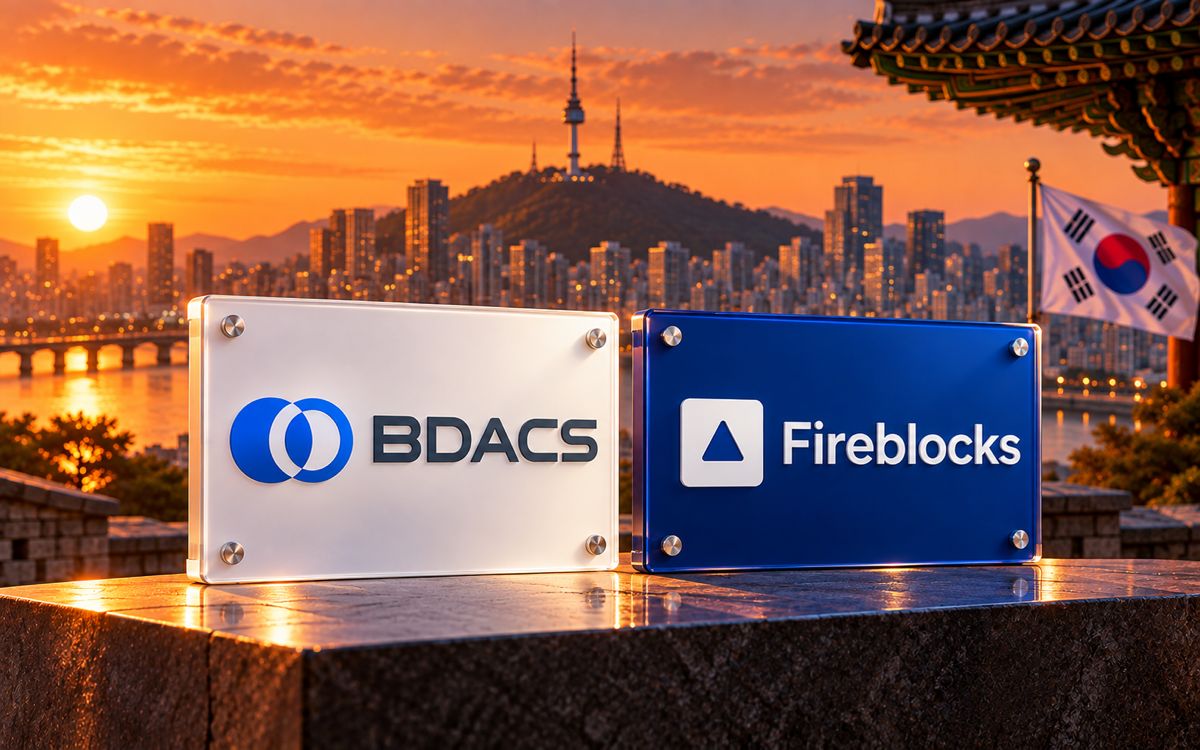
South Korean digital-asset custodian BDACS (Beyond Digital Asset Custody Service) announced on September 21, 2026, that it has selected Fireblocks to strengthen its custody infrastructure and support stablecoin transactions and cross-chain operations for institutional clients.
The integration will let BDACS manage custody, transfers, and stablecoin operations across multiple blockchains through a single security and policy layer, according to BDACS. BDACS already provides custody for assets including XRP and AVAX and supports KRW1, its Korean won-pegged stablecoin, a network first introduced through Avalanche’s staking infrastructure before expanding elsewhere.
BDACS CEO Ryu Hong-yeol said adopting Fireblocks has strengthened the security framework of the company’s MPC-based Prime Custody Solution, adding that BDACS aims to build an environment where domestic and overseas institutional investors can entrust assets more securely.
What Fireblocks Adds to BDACS’s Infrastructure
Fireblocks will provide infrastructure supporting BDACS’s custody operations, digital-asset transfers, and stablecoin activity across multiple blockchain networks. The platform uses multi-party computation (MPC) technology and policy controls to support institutional transaction management.
| Partnership Detail | Information |
| BDACS | South Korean digital-asset custodian |
| Fireblocks | Digital-asset infrastructure provider |
| Main focus | Custody, transfers, and stablecoin operations |
| Network approach | Multi-chain infrastructure |
| Client focus | Institutional and corporate clients |
Table 1. Key details of the BDACS and Fireblocks partnership.
BDACS said the integration will let it manage different assets and blockchain networks through a common infrastructure layer rather than maintaining separate systems for each asset or chain. The companies have not disclosed which additional assets or networks will be added, or how much transaction activity the upgraded infrastructure is expected to handle.
Fireblocks confirmed the partnership through its official X account, framing it as an expansion of its institutional footprint in South Korea:
BDACS’s Custody Scale Compared to the Broader Korean Market
BDACS reported more than ₩80 billion in assets under custody during the first half of 2026, a figure the company said represented the largest AUC among South Korean digital-asset custodians. The Financial Services Commission’s H2 2025 virtual-asset service provider survey, meanwhile, found that total virtual assets held by domestic custody and wallet-service providers had fallen by about 50% from the previous six-month period.
| Korean Custody Market | Reported Figure |
| BDACS AUC, 2026 | >₩80B |
| Domestic custody market, end-2025 | ~₩300B |
| BDACS AUC target | ₩3T |
Table 2. BDACS’s reported custody scale compared with the broader Korean market.
The figures come from different reporting periods, so they shouldn’t be treated as a precise current market-share calculation, though they show the scale of BDACS’s business relative to the domestic market measured at the end of 2025.
Why KRW1’s Cross-Chain Growth Made Fireblocks Relevant
The Fireblocks integration is particularly relevant to BDACS’s expansion of KRW1, which was initially launched on Avalanche and has since expanded to additional networks, including Circle’s Arc. BDACS has also announced a partnership with LayerZero to support KRW1’s cross-chain expansion.
Fireblocks says its infrastructure supports custody, stablecoin payments, tokenization, and trading operations across more than 200 blockchains and has secured more than $16 trillion in digital-asset transfers.
For BDACS, combining custody with multi-chain infrastructure could become increasingly relevant as institutional clients use different blockchain networks and stablecoins, a dynamic already shaping how South Korean crypto users buy and sell across an expanding set of platforms and assets.
What Regulatory Development Still Needs to Happen
South Korea’s financial authorities have been developing policies around corporate participation and the broader digital-asset market, while stablecoin and digital-asset legislation remain areas of active regulatory development.
BDACS said it plans to expand its use of Fireblocks as its institutional client base grows and as South Korea’s regulatory framework develops.
The partnership itself does not create new regulatory permissions for BDACS or determine how the country’s future stablecoin rules will operate.
What Comes Next for BDACS’s Infrastructure Rollout
BDACS plans to expand its use of Fireblocks infrastructure as its institutional client base grows. The companies have not disclosed the number of clients expected to use the infrastructure, projected transaction volumes, or specific new digital-asset products that will result from the partnership.
What this means for you: The BDACS and Fireblocks partnership is primarily an institutional infrastructure development rather than a new retail crypto service. Its significance lies in strengthening custody and stablecoin infrastructure as South Korea’s institutional digital-asset market continues to develop.
This article is for informational purposes only and does not constitute financial or investment advice. Digital-asset custody and stablecoin services involve technology, custody, regulatory, liquidity, and operational risks. Availability of services may vary by jurisdiction.