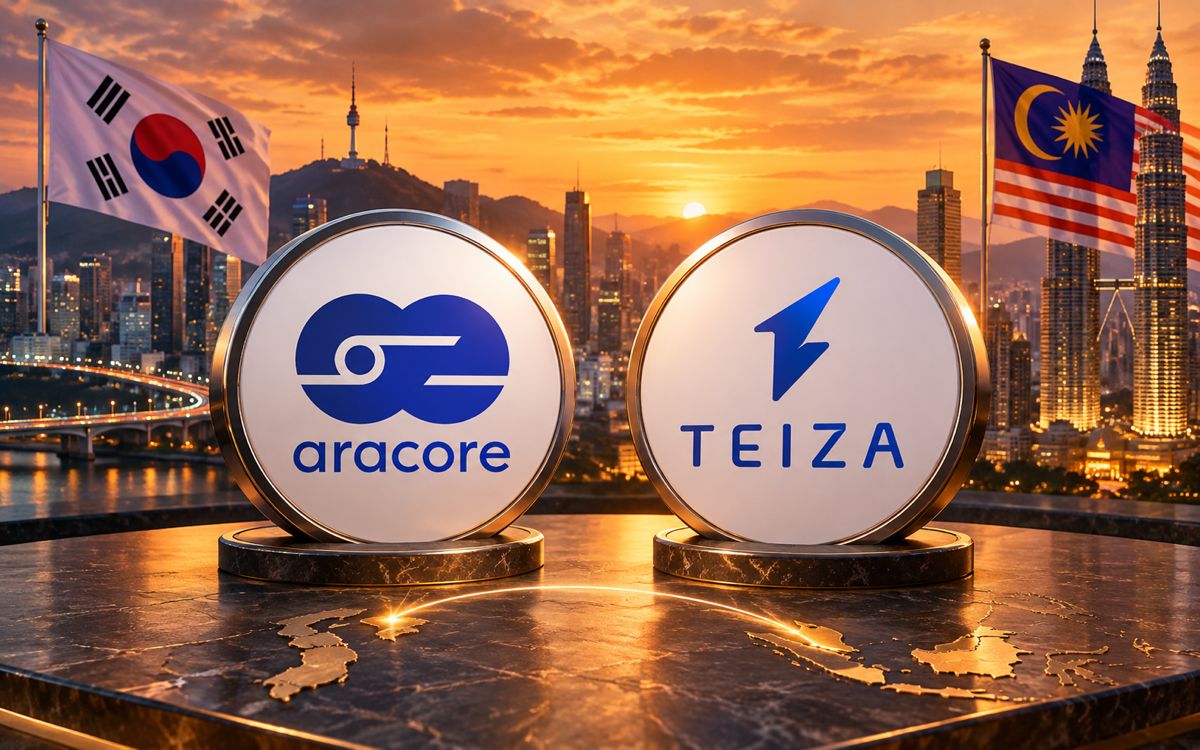
Aracore, the U.S. subsidiary of blockchain and AI company BPMG, announced on September 21, 2026 that it has signed a memorandum of understanding with Malaysian blockchain infrastructure company Teiza to explore an institutional stablecoin payment and settlement model connecting South Korea and Malaysia.
The companies will combine Aracore’s Institutional Settlement Network (ISN) with Teiza’s digital infrastructure and institutional network, which spans Southeast Asia, South Asia, and Central Asia, to identify cross-border payment and settlement use cases involving banks, financial institutions, and fintech companies.
The agreement focuses on identifying actual transaction demand before moving toward potential proof-of-concept work and pilot projects, representing an exploratory infrastructure initiative rather than the launch of a commercial Korea-Malaysia stablecoin corridor.
What Aracore and Teiza Bring to the Table
Aracore’s ISN is designed as an infrastructure layer connecting financial institutions with liquidity providers, on- and off-ramp providers, and settlement partners, coordinating settlement processes across participating entities rather than directly holding customer assets, a distinction covered in more depth in a guide to top crypto remittance options for sending money to Asia.
| Partnership Component | Role |
| Aracore ISN | Coordinates institutional settlement processes |
| Teiza | Provides Malaysian infrastructure and network |
| Target users | Banks, financial institutions, and fintechs |
| Potential asset | Stablecoins |
Table 1. Main components of the proposed Korea-Malaysia settlement model.
Teiza contributes its Malaysian digital infrastructure and network, giving the partnership a local channel for identifying potential participants. According to Aracore’s own announcement, Teiza launched the Malaysia Digital Consortium, formerly the Malaysia Blockchain Consortium, in November 2025 with 19 founding organizations, and the consortium has since grown to more than 30 members, including EthSystems and Gateway.fm. No specific bank has been named as a participant in the new MOU.
Malaysia Is Already Testing Ringgit Stablecoin Settlement
The MOU comes as Malaysia’s central bank already tests similar use cases. Bank Negara Malaysia said its Digital Asset Innovation Hub onboarded three 2026 initiatives involving ringgit stablecoins and tokenised deposits, testing wholesale payment applications including tokenised-asset settlement, and has engaged more than 30 participants since June 2025.
| Malaysia Digital-Asset Testing | Latest Data |
|---|---|
| DAIH initiatives onboarded | 3 |
| Participants engaged since June 2025 | 30+ |
| 2026 focus | Ringgit stablecoins and tokenised deposits |
| Cross-border testing | Included |
Table 2. Malaysia’s existing digital-asset experimentation relevant to the proposed settlement model.
That gives the Aracore-Teiza initiative a more specific context, since Malaysia is already testing wholesale stablecoin applications rather than starting from a regulatory blank slate.
This Follows a Similar Korea-Hong Kong Model
The Korea-Malaysia agreement is not Aracore’s first cross-border initiative. BPMG signed a three-way MOU with South Korea’s K Bank and Hong Kong-based HashKey Group on July 21, 2026, targeting a Korea-Hong Kong stablecoin remittance corridor, worth understanding alongside guidance on buying and selling cryptocurrencies in South Korea.
According to Aracore’s release announcing its Global Dollar Network membership, the company also joined the Paxos-led network in September, connecting with over 150 institutions including Mastercard, Kraken, Robinhood, and Worldpay. Aracore CEO Jihoon Cha said the company is building infrastructure connecting global institutions with diverse digital dollar ecosystems, not limited to a single stablecoin.
The Focus Stays on Testing Real Transaction Demand
Rather than immediately launching a payment corridor, Aracore and Teiza will first identify transactions where blockchain-based settlement could be practical, examining potential use cases before determining whether individual opportunities suit a proof-of-concept or pilot.
This matters because institutional cross-border payments involve more than transferring a digital asset between two wallets, since participants must also address currency conversion, liquidity, compliance, and settlement responsibilities across different financial systems.
What Comes Next for the Korea-Malaysia Model
Aracore and Teiza will first identify financial institutions and payment partners that could participate, then assess whether those opportunities warrant proof-of-concept or pilot projects.
No commercial launch date, specific stablecoin, or participating bank has been announced, and if the model is validated, the companies said they could explore extending the collaboration to additional Southeast Asian markets.
What this means for you: The Aracore-Teiza agreement is an early-stage attempt to develop institutional stablecoin settlement between South Korea and Malaysia. It does not yet provide a consumer payment service, but Malaysia’s existing experiments with ringgit stablecoins and tokenised deposits show the proposed model is entering a market already testing blockchain-based wholesale payment infrastructure.
This article is for informational purposes only and does not constitute financial or investment advice. Stablecoin payments and digital-asset settlement systems involve regulatory, liquidity, technology, custody, and operational risks. Any future products or services remain subject to applicable regulations and implementation.