Key Takeaways
- After the Feb 28 airstrikes, Nobitex saw a massive surge in crypto withdrawals as Iranians rushed to protect their assets amid rising geopolitical tensions.
- Hourly outflows from Iranian exchanges spiked to $2M, over eight times normal volume, showing how quickly investors reacted to the crisis.
- Withdrawals from Nobitex jumped over 700% within minutes, highlighting both the scale and speed of asset movements during the shock.
After the joint airstrikes on Iran on February 28, 2026, Nobitex, the country’s largest cryptocurrency exchange, saw a sudden surge in withdrawals. Millions of dollars in Bitcoin and other cryptocurrencies quickly left the platform as investors rushed to protect their assets amid escalating geopolitical tensions.
The spike shows how Iranians are increasingly turning to crypto as a fast and flexible way to safeguard their wealth during periods of crisis and instability. It also highlights the growing role of digital currencies in real-world events, offering a lifeline when traditional financial systems face disruption or restriction.
Magnitude of the Outflows
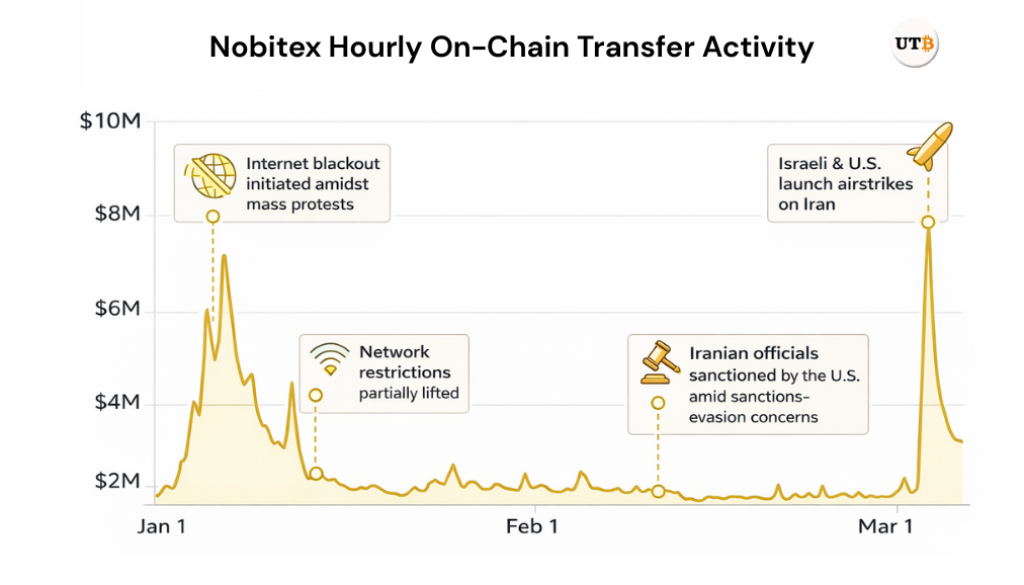
Hourly outflows soared
Blockchain and exchange data indicate that in the hours immediately after news of the airstrikes, withdrawals from Iranian platforms spiked dramatically. Outflows reached up to $2 million in a single hour, representing an increase of more than eight times the normal hourly volume observed earlier in 2026. This rapid movement highlights how quickly investors reacted to the sudden geopolitical shock.
Percentage spikes on Nobitex
Analytics firm Elliptic reported that withdrawals from Nobitex, Iran’s largest cryptocurrency exchange, jumped by over 700 % within minutes of the airstrikes. These extreme percentage changes show not only the scale of activity but also the speed at which investors attempted to move assets into safer channels.
Total movement over several days
Between February 28 and March 2, approximately $10.3 million in cryptocurrency left Iranian exchanges, with the majority being Bitcoin and other highly liquid assets. This figure shows that the outflows were sustained over multiple days, reflecting a combination of immediate panic withdrawals and more deliberate transfers to foreign exchanges or private wallets.
Why Bitcoin Outflows Spiked in Iran
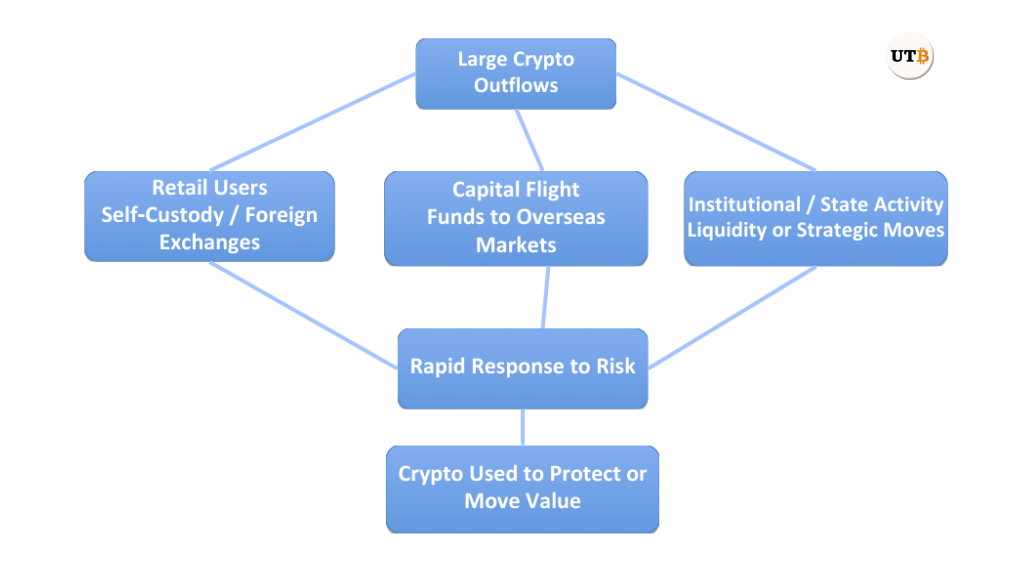
While we can’t know the exact identities or motives behind each transaction, several patterns help explain the recent surge in Bitcoin withdrawals:
1. Retail Users Protecting Wealth
Many everyday investors appear to have withdrawn crypto from centralized exchanges and moved it into personal wallets (self‑custody) or foreign platforms. With growing geopolitical tensions, strict bank controls, and the risk of internet shutdowns, crypto offers a fast and flexible way to keep savings safe and accessible.
2. Capital Flight and International Transfers
A big portion of the outflows seems to have been directed toward overseas exchanges, consistent with capital flight. Investors were likely trying to move their money out of Iran’s fragile financial system into safer markets, where it would be easier to access foreign currency or use their funds globally if needed.
3. Institutional or Government Activity
Not all movements are likely from individual users. Some transfers could come from exchanges managing liquidity, or from state or institutional actors, including sanctioned entities, moving funds strategically in response to the crisis.
Together, these patterns show a crypto market that reacts quickly to sudden events, with both ordinary users and larger players taking steps to protect value when uncertainty hits
Patterns in Iran’s Crypto Activity
This latest surge follows a familiar pattern in Iran’s crypto market, shaped by both politics and the economy:
- Past Conflicts – Previous protests and clashes with Israel often caused big spikes in crypto withdrawals. During these events, many Iranians quickly moved their assets to protect their money.
- Inflation and Sanctions – High inflation and strict international sanctions make traditional banking difficult. Many people now use crypto to preserve their savings and keep access to money outside Iran.
- Growing Use of Crypto – These repeated spikes show a clear trend: crypto is becoming an important tool for Iranians to protect their wealth and manage financial uncertainty when banks or the government can’t provide stability.
What This Means for Bitcoin and Markets
The recent surge in Bitcoin withdrawals from Iran shows how people are turning to cryptocurrencies as a quick and flexible way to protect their money during times of crisis.
1. Crypto as a ‘Financial Escape Valve’
During periods of geopolitical or economic stress, cryptocurrencies like Bitcoin provide a fast and flexible way to move money outside traditional banking systems. This allows individuals and institutions to protect value when conventional channels are slow, restricted, or at risk.
2. Market Sensitivity
While the total outflows from Iran are small compared to the global daily Bitcoin volume, such on‑chain activity can still affect regional market sentiment and short-term price volatility. Traders and investors often watch these flows as signals of local or regional stress in the crypto ecosystem.
3. Regulatory Implications
Continued patterns of off-exchange transfers show the ongoing tension between crypto’s borderless nature and international efforts to monitor and regulate cross-border flows, especially in countries under sanctions. These movements highlight both the opportunities and challenges of a global, decentralized financial system.
Final Thoughts
The surge in Bitcoin and crypto withdrawals from Nobitex after the February 28 airstrikes shows how quickly Iranians respond to sudden geopolitical shocks. Millions of dollars moved off the exchange as everyday investors and larger actors acted to protect their money, highlighting how crypto can serve as a fast and flexible way to safeguard assets when traditional financial systems are under strain. This event also highlights a bigger trend: during times of conflict or economic stress, more Iranians are turning to cryptocurrencies as a way to protect their money. Even though these outflows are small compared to global Bitcoin trading, they can still influence local market confidence, show the limits of traditional banking in the country, and illustrate the ongoing clash between crypto’s borderless nature and international rules.
Frequently Asked Questions
Why did Bitcoin withdrawals from Iran spike after February 28, 2026?
The surge followed joint airstrikes on Iran. Investors rushed to protect their assets amid geopolitical tensions, moving crypto off exchanges into personal wallets or foreign platforms.
How large were the outflows from Iranian exchanges?
Hourly outflows reached up to $2 million, over eight times the normal volume. Withdrawals from Nobitex alone jumped more than 700 percent within minutes.
Which cryptocurrencies were mostly withdrawn?
The majority were Bitcoin and other highly liquid cryptocurrencies, chosen for their ease of transfer and global accessibility.
Why did Bitcoin withdrawals spike in Iran?
The surge appears to be driven by three main factors: everyday investors securing crypto in personal wallets, capital moving to overseas exchanges, and possible transfers by institutions or government actors.
Are these outflows a common pattern in Iran?
Yes. Past conflicts, protests, inflation, and sanctions have repeatedly caused spikes in crypto withdrawals, reflecting crypto’s growing role as a financial safety tool.
Do these outflows affect the global Bitcoin market?
While the total is small relative to global trading, such activity can influence regional market sentiment and short-term price volatility.