

April 2026 has just become the most important month for Bitcoin institutional demand this year. US spot Bitcoin ETFs recorded $2.44 billion in net inflows across the full month, the highest monthly total of the year and nearly double the $1.32 billion recorded in March, according to data from Farside Investors and SoSoValue.
That single figure pushed cumulative lifetime inflows across all US spot Bitcoin ETF products to $58.5 billion, lifted total assets under management to $102 billion, and confirmed April as the most consequential month for crypto markets so far in 2026. But the more important question is not what happened; it is what this level of sustained institutional buying historically does to Bitcoin’s price in the weeks that follow.
Key Takeaways
- $2.44 billion is not just a record; it is a reversal. April erased the negative YTD flow position that had accumulated across Q1 2026. This structural shift from net outflow to net inflow at the institutional level is historically one of the most reliable leading indicators of sustained Bitcoin price appreciation.
- The ETF inflows are absorbing roughly 70 days of miner output per month at current levels. Post-halving mining supply is structurally limited. When institutional demand consistently exceeds new supply, exchange balances fall, available selling pressure declines, and price eventually rises.
- April’s record does not guarantee $80,000; it builds the foundation for it. Inflows are fuel, not price. The FOMC decision, BTC’s weekly close above $77,500, and sustained May inflow momentum are the three triggers that convert April’s structural buildup into a May price breakout.
The April inflow Data in Full – Fund by Fund
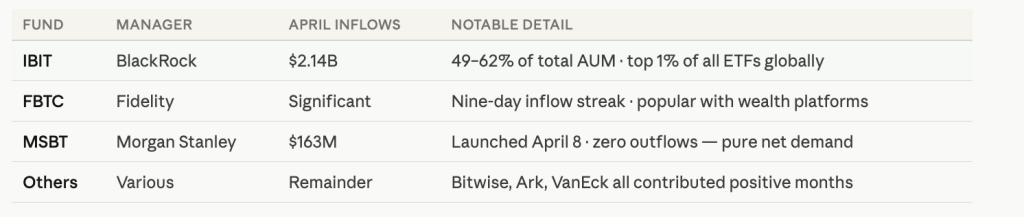
Source – Bitcoin ETF Inflow from X
The $2.44 billion headline figure is striking. But the breakdown by fund reveals something even more significant: the breadth of the buying. This was not one large institution making a single allocation. It was a sustained, multi-fund capital deployment across the entire month.
BlackRock’s iShares Bitcoin Trust (IBIT) and Fidelity’s Wise Origin Bitcoin Fund (FBTC) led all funds, with IBIT alone responsible for the bulk of the month’s net capital. The Morgan Stanley MSBT launch on April 8 is particularly significant; it recorded $163 million in inflows with no outflows, indicating real net demand rather than just reallocating existing funds. New money entering the ecosystem, not money shuffling between products, is the cleanest signal of genuine institutional appetite expansion.
How $2.44 billion in ETF inflows impacts Bitcoin’s price
The supply shock mechanism, ETFs absorb far more BTC than miners produce
April’s institutional demand returned with enough force to absorb supply well in excess of daily mining output. Bitcoin miners currently produce approximately 450 BTC per day following the April 2024 halving, worth roughly $33–$35 million at current prices.
The $2.44 billion in April ETF inflows represents approximately 70 days of total miner output bought in a single month. When institutional demand absorbs more Bitcoin per day than miners can produce, the supply available on exchanges tightens. Tightening exchange supply with sustained demand is the textbook precondition for a price breakout.
The $80,000 Question — What the Inflows Need to Push BTC Through Resistance
Bitcoin is currently consolidating in the $75,000–$77,500 resistance zone that has capped every rally since March. The $2 billion in ETF inflows over eight days demonstrates that institutional capital is not merely experimenting with Bitcoin exposure but is committing substantial assets through regulated, familiar vehicles.
To break through $77,500 and target $80,000, Bitcoin needs the current inflow pace to sustain through May; specifically, weekly inflow figures above $700 million consistently. The April weekly average of approximately $610 million is approaching, but not yet at that threshold. A FOMC-driven risk-on move, a CLARITY Act advancement, or a further Morgan Stanley MSBT ramp-up could provide the catalyst to cross it.
Final Thoughts
Three conditions need to align for May to build on April’s momentum. First, weekly ETF inflows must sustain above $700 million, the threshold where buying consistently outpaces the combined pressure of miner selling and long-term holder distribution. Second, Bitcoin must post a weekly candle close above $77,500; the level that has rejected every rally this quarter.
A close above it changes the macro technical structure from consolidation to breakout. Third, the FOMC meeting on April 29–30 needs to deliver either a rate hold with dovish language or a surprise cut; either outcome historically triggers risk-on positioning that flows into Bitcoin within 48–72 hours of the decision.
If all three align in the first two weeks of May, the path to $80,000 is technically clear. The first major resistance after $77,500 is the psychological $80,000 level, followed by $85,000.
Frequently Asked Questions
How much did Bitcoin ETFs receive in inflows during April 2026?
US spot Bitcoin ETFs recorded $2.44 billion in net inflows during April 2026 — the highest monthly total of the year and nearly double March’s $1.32 billion, according to Farside Investors data. The month included a single eight-day period from April 14–24, where inflows exceeded $2.12 billion, and one week with $996.4 million — the longest consecutive positive weekly streak of 2026.
What does high Bitcoin ETF inflow mean for BTC price?
High ETF inflows reduce the supply of Bitcoin available on exchanges because ETF providers must purchase spot BTC to back each new share issued. When monthly inflows absorb more Bitcoin than miners produce — as April’s $2.44 billion did — exchange balances tighten, selling pressure decreases, and price typically responds upward over a 4–8 week lag. However, inflows alone do not guarantee price increases if macro conditions simultaneously create selling pressure.
What is the Morgan Stanley Bitcoin Trust (MSBT)?
Morgan Stanley’s Bitcoin Trust (MSBT) launched on April 8, 2026, and recorded $163 million in inflows with zero outflows in its first weeks, indicating pure net institutional demand rather than fund rotation. Morgan Stanley is a $150+ billion wealth management firm whose clients are predominantly high-net-worth individuals and institutional investors. Its BTC product launch signals that traditional wealth management is now actively allocating Bitcoin, not just studying it.
Will Bitcoin reach $80,000 in May 2026?
A move to $80,000 in May 2026 is technically possible if three conditions align: (1) weekly ETF inflows sustain above $700 million, (2) Bitcoin posts a weekly close above $77,500 resistance, and (3) the FOMC April 29–30 decision delivers dovish guidance. If all three happen in the first two weeks of May, the path to $80,000 is clear with the next major resistance at $85,000. The invalidation level for the bull case is a weekly close below $73,000.
Related Read
$0 to $22,000: Crypto Airdrops that Created Overnight Millionaires