
The S&P 500 has gained 3.12% this month, adding roughly $2.1 trillion in market cap and pushing its total value to a record $70.5 trillion, while Bitcoin is up just 2% over the same stretch, trading near $64,600 and largely stuck in the same range it’s held for weeks.
Why the US Stock Market Rally Isn’t Lifting Bitcoin
Bitcoin has tended to track stocks more often than not since the 2020 Covid crash, which makes this month’s divergence notable.
Adam Haeems, head of asset management at Tesseract Group, which manages more than $500 million in client assets, cites the driving force behind the equity rally as the key reason.
“Partly because the equity rally is being driven by areas to which bitcoin has little direct exposure, particularly AI and semiconductor stocks,” Haeems said.
Paul Howard, senior director at market-making firm Wincent, made a similar point, noting that gains concentrated in AI and mega-cap stocks don’t necessarily translate into crypto flows the way a broad macro risk-on move would.
Even positive macro developments are reaching Bitcoin more slowly than they are reaching equities. The renewed drop in oil prices and hopes for normalized shipping through the Strait of Hormuz benefit both markets, but at different speeds.
“Equities receive a relatively immediate benefit through lower business costs. For bitcoin, the effect runs through inflation expectations and then Federal Reserve policy. That takes longer, and the outlook for September remains uncertain,” Haeems explained.
Crypto’s Own Headwinds Are Compounding the Problem
Bitcoin is also fighting battles specific to crypto that have nothing to do with equities.
The Coldcard hardware wallet exploit, which has drained an estimated $120 million from vulnerable wallets as of this week, has weighed on sentiment, with the figure climbing from earlier estimates as researchers identified additional affected addresses.
Our earlier coverage of the Coldcard firmware vulnerability covers the technical details and what affected users should do.
Separately, Strategy has now sold Bitcoin in three consecutive months. Haeems noted that neither event has triggered a broader credit event or forced liquidation cycle on its own, but together they have capped upside.
Rising bond yields are adding a separate, quieter pressure. Haeems said this is pulling capital out of crypto, specifically through stablecoins, with USDT’s supply falling to its lowest level since 2025. USDT has dropped from about $190 billion in April to $183 billion, while USDC has declined from $79.5 billion to $72 billion over the same stretch.
“With real Treasury returns at their highest since 2008, capital is being paid to remain outside crypto,” Haeems said.
The Halving Cycle Story Might Be the Most Important One
According to 10x Research founder Markus Thielen, a counterintuitive positioning dynamic tied to Bitcoin’s four-year halving cycle may explain the lack of bullish urgency better than any single headwind.
Traders have broadly come to believe the cycle points to a bottom in early October, and rather than acting on that belief, most are simply waiting on the sidelines for it to arrive.
“Bitcoin traders have shown little urgency to position for a move higher, even as US stocks rally. A key reason: Bitcoiners have suddenly, collectively bought into the four-year cycle thesis, which points to a bottom in early October, so they’re waiting on the sidelines. This is a notable reversal from last October, when most of these same traders dismissed the four-year cycle outright,” Thielen highlighted.
Thielen argues the market may be missing something important in the process. He said Bitcoin’s failure to fall further despite a hawkish Fed is itself a bullish signal that traders are underweighting, and that the four-year cycle has already bottomed rather than waiting until October.
ETF Flows Are Sending Mixed Signals
Spot Bitcoin ETFs recorded a $61.53 million outflow recently, snapping a three-week streak of already weak inflows, before rebounding to pull in $626 million this week, the strongest weekly tally since early May, according to SoSoValue data.
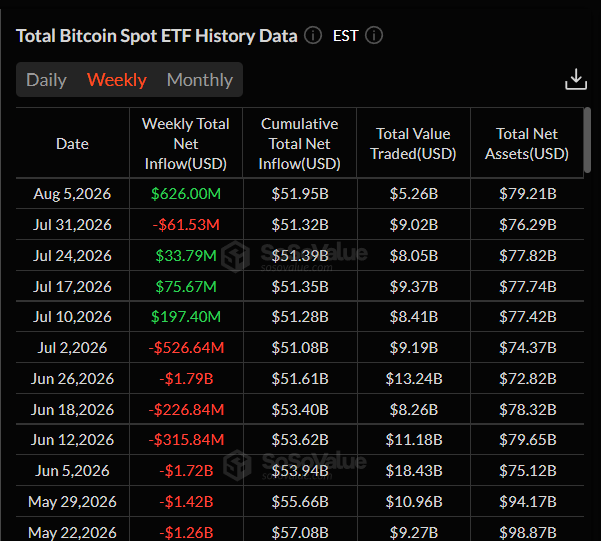
Vikram Subburaj, CEO of India-based, FIU-registered exchange Giottus.com, wants to see that trend hold before drawing conclusions. “Several consecutive days of inflows will be needed to confirm a sustained recovery in institutional demand,” Subburaj said, noting he’s watching a tight range with support near $63,000 to $63,400 and resistance between $64,500 and $66,000.
Market maker Wintermute has raised a separate concern about what the ETF flow represents. The firm suggested that the buying may not be directionally bullish at all but rather arbitrage-driven.
“That ETF bid getting absorbed without moving price says the marginal buyer in spot isn’t outright long,” Wintermute noted, pointing out that risk appetite has instead gone into single names, with ZEC up 10.9% on the week tied to DCG’s Fortitude expanding its Zcash mining footprint, and HYPE adding 5% on what the firm called “a dead beta day,” Wintermute said breadth likely needs Bitcoin’s own volatility to pick up off its current floor before spreading further.
Key Technical Levels
| Level | Role | Notes |
| $57,800-$60,200 | Broader daily support | Wider macro support zone |
| $61,800-$62,300 | 4-hour demand zone | Recent bounce point, defended twice in two weeks |
| $63,000-$63,400 | Near-term support | Cited specifically for the current tight range |
| $64,500-$66,000 | Near-term resistance | Upper end of the current tight range |
| $64,800-$65,400 | 4-hour resistance | Rejected multiple times over the past two weeks |
| $66,000 | Short liquidation magnet | Large short liquidation cluster sits just above this level |
| $66,200-$66,800 | Daily resistance | Confirmed break needed to shift the broader structure |
| $72,000-$74,000 | Next resistance zone | Only in play after a confirmed daily breakout |
Bottom Line
Bitcoin’s underperformance against the equities market is not about Bitcoin weakening on its own terms. It is a mix of an AI-driven rally that does not reach crypto directly, crypto-specific setbacks in the recent hardware wallet exploit and Strategy’s continued selling, a quiet capital drain into Treasuries via shrinking stablecoin supply, and a market that’s collectively decided to wait for an October bottom rather than position ahead of it.
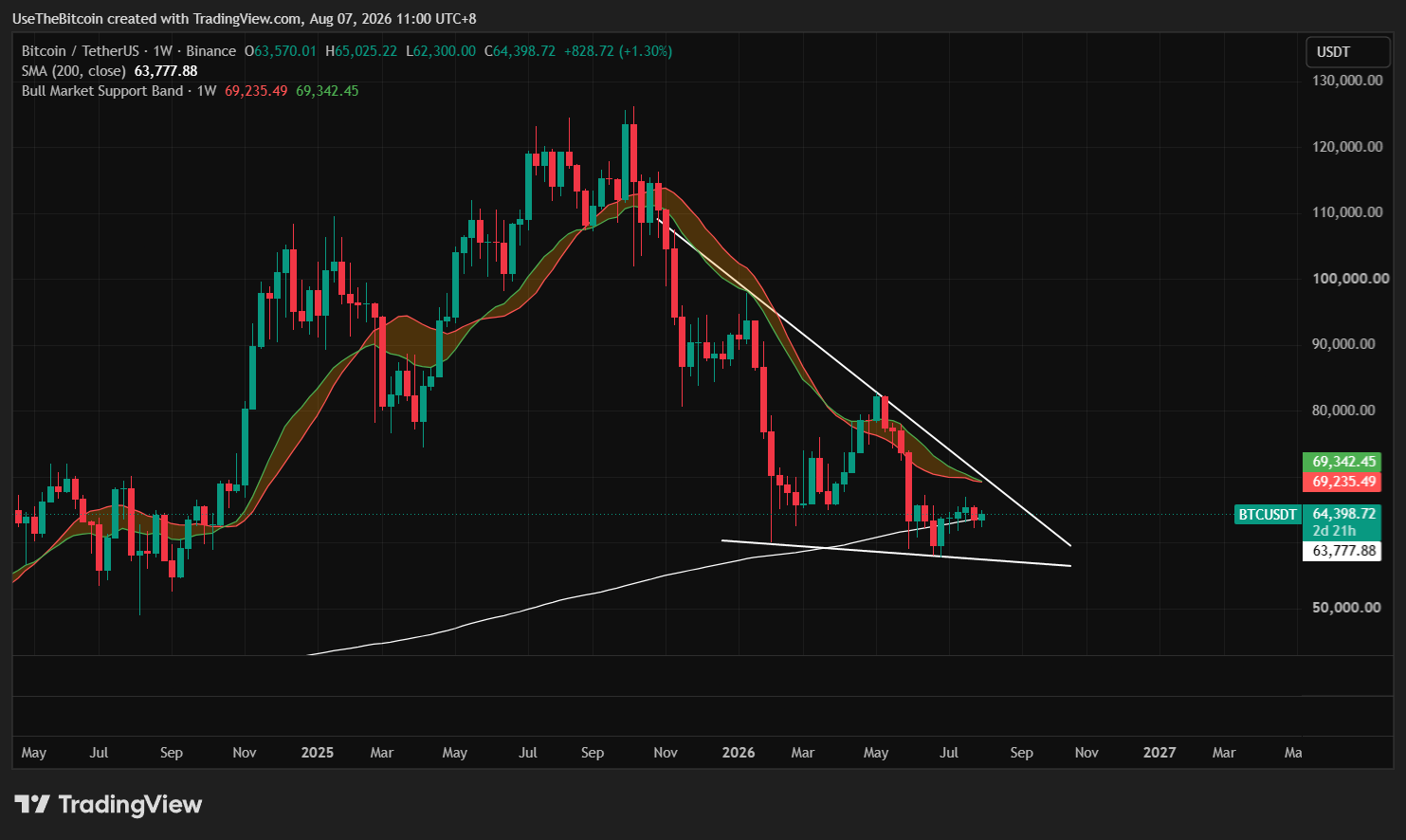
A confirmed break above $66,200 to $66,800 would be the clearest signal that buyers are taking control ahead of that timeline, while a failure to hold the $61,800 to $63,000 zone would suggest the wait-and-see positioning has more room to run before it resolves.
This article is for informational purposes only and does not constitute financial advice. Crypto price predictions are based on analyst estimates and are not guarantees of future performance. Do your own research before making any investment decisions.
Frequently Asked Questions
Need a refresher? Here are the questions traders are asking about Bitcoin this week.
Why is Bitcoin lagging the S&P 500 if they usually move together?
Bitcoin has tracked stocks fairly closely since 2020, but this rally is concentrated in AI and semiconductor stocks specifically, sectors Bitcoin has little direct exposure to. A broader macro risk-on rally would likely lift Bitcoin alongside equities, but a narrower, sector-specific rally doesn’t pull crypto along with it the same way.
What role is the four-year halving cycle playing right now?
According to 10x Research founder Markus Thielen, many traders have collectively decided the cycle points to an October bottom, and are simply waiting on the sidelines for that date rather than positioning ahead of it. He argues this sidelined positioning, combined with Bitcoin’s resilience despite a hawkish Fed, may itself be an underappreciated bullish signal.
Are ETF inflows confirming renewed institutional demand?
Not yet. A recent outflow was followed by the strongest weekly inflow since early May, but Giottus CEO Vikram Subburaj wants several consecutive days of inflows before treating it as a real trend, and market maker Wintermute has separately suggested some of that flow may be arbitrage-driven rather than a genuine directional bet on price.
How much has the Coldcard exploit affected Bitcoin sentiment?
The exploit has weighed on sentiment without triggering a broader credit event, with the estimated loss total climbing to around $120 million and counting as researchers identified additional affected addresses.
What would confirm a real breakout for Bitcoin from here?
A confirmed daily close above the $66,200 to $66,800 resistance zone would open the path toward $72,000 to $74,000. Until that happens, the more likely outcome is continued consolidation within the current range.