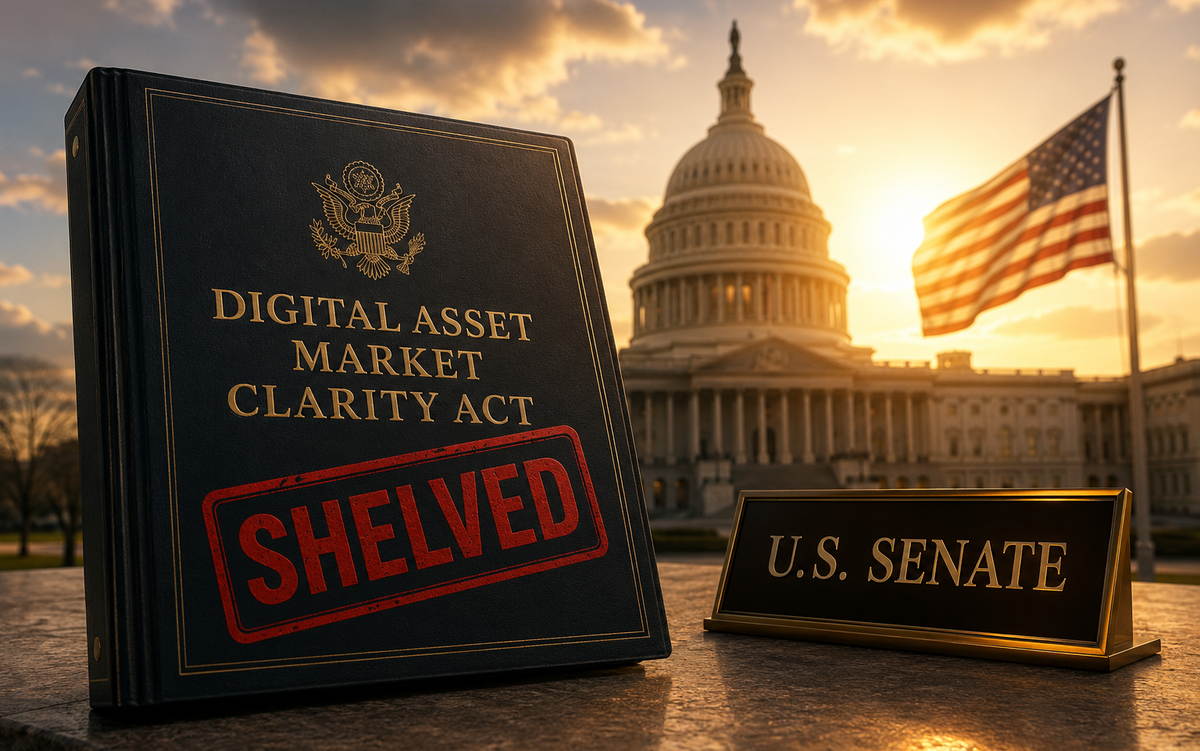
The CLARITY Act, crypto’s main push for federal market rules, has been pushed aside in the Senate this week while lawmakers work through a Russia sanctions bill and a batch of federal nominations. Senate Majority Leader John Thune began moving on the nominee package Monday and said the chamber would shift to the Russia sanctions bill Tuesday night, kicking off the formal process that leads to a final vote. A vote on the CLARITY Act now looks unlikely before next week, the final stretch before the Senate’s August 8 recess.
The Procedural Queue Blocking a Vote
Senate rules generally limit debate to one contested bill at a time, so the CLARITY Act cannot move until the nominations and the Russia bill clear the floor first. Cloture itself is a multi-step process: filing a motion, waiting out a mandatory delay, then holding the vote that ends debate, and that sequence alone typically eats up several days once Thune files it for the Russia bill.
The Russia sanctions bill, which would apply penalties to Russian leadership and tariffs on its trading partners, has been dedicated to the late Senator Lindsey Graham, one of its lead supporters. Graham’s funeral services this week, in Washington on Tuesday and in South Carolina on Wednesday, are also expected to pull senators away from floor business on both days.
With the Senate’s August 8 recess approaching, that leaves a narrow window. If the CLARITY Act doesn’t reach a vote before senators leave for the break, debate would resume in September, pushing any resolution back by at least a month.
What This Means for Crypto Investors
The delay doesn’t kill the bill, but it does extend the uncertainty we’ve been tracking around the CLARITY Act’s stalled progress all year. Exchanges and projects operating without a clear federal framework will keep waiting at least another month, and possibly longer if September brings new priorities. For a full breakdown of how the bill’s provisions could affect the market, check out our coverage on what the CLARITY Act is, crypto bill explained.
The Sticking Point Holding Up 60 Votes
Republicans hold 53 Senate seats, short of the 60 needed for cloture, so passage depends on at least seven Democrats crossing over. The main disagreement is an ethics provision that would bar top US officials, including President Trump, from backing or participating in crypto projects. Trump agreed to a compromise version last week, but Democrats have said the restrictions still don’t go far enough, a disagreement Coinbase has also weighed in on publicly.
Senator Cynthia Lummis, one of the bill’s sponsors, said in a post on X on July 27, 2026, that “North Korea’s Lazarus Group and other bad actors thrive on gaps in our financial rules.” She added that the CLARITY Act “gives the Treasury new sanctions authority and a safe harbor for companies to freeze suspicious transactions before the money moves.”
What this means for you: If you’re new to crypto, the CLARITY Act is the closest thing to a federal rulebook for how US exchanges, tokens, and custody rules would work, and this delay means the industry keeps operating under today’s patchwork of state rules and SEC enforcement actions for at least a few more weeks, possibly until September.