
Ethena, the protocol behind the synthetic dollar token USDe, announced plans on August 28, 2026, to extend its yield-generating basis trade beyond crypto and into equity perpetual futures, a market it says has grown tenfold since March and now pays funding rates several times higher than Bitcoin.
How the Basis Trade Works
Ethena’s strategy has stayed the same since USDe launched: hold a spot asset, sell its perpetual futures contract, and collect the funding premium that leveraged long traders pay to maintain their positions.
The framework applies to any market with a liquid spot asset, a liquid perpetual contract, and a structural funding premium, which is why Ethena has run this same trade across Bitcoin, Ethereum, and Solana, at a peak crypto basis allocation greater than $8 billion during 2025.
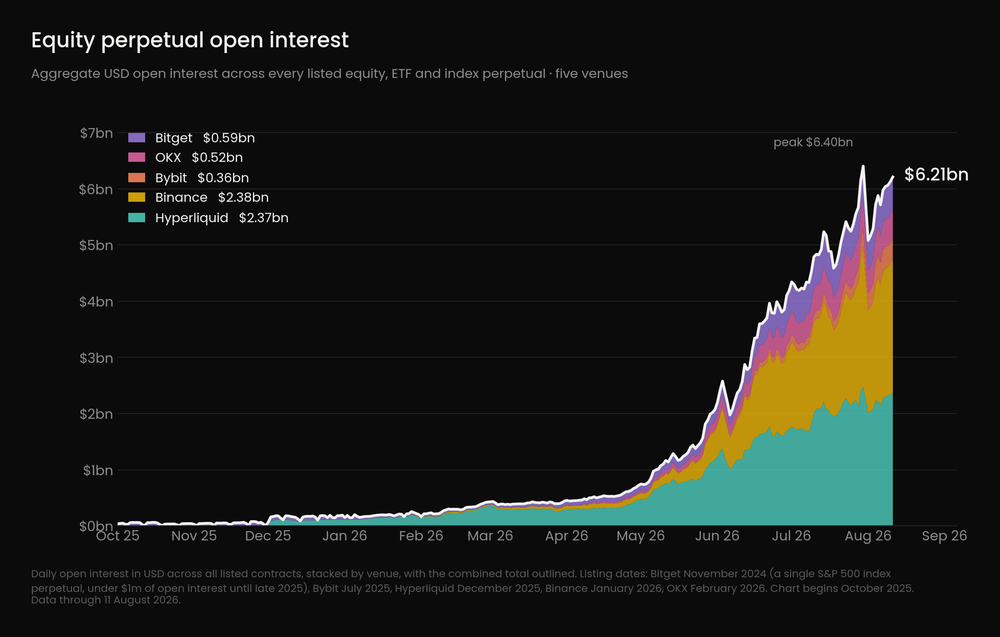
Equity perpetuals only recently became viable for this strategy. Hyperliquid listed the first contracts in December 2025, opening with eleven names and about $90 million in open interest, and Binance followed at the end of January 2026 with a single Tesla contract worth roughly $11 million.
Through the first quarter of 2026, open interest sat below the minimums Ethena requires to execute at scale, with volatile funding rates and pricing. That changed quickly as tokenized equities became one of the industry’s fastest-growing narratives.
As of August 11, 2026, combined open interest across both venues reached $6.2 billion, a tenfold increase since March 1 alone.
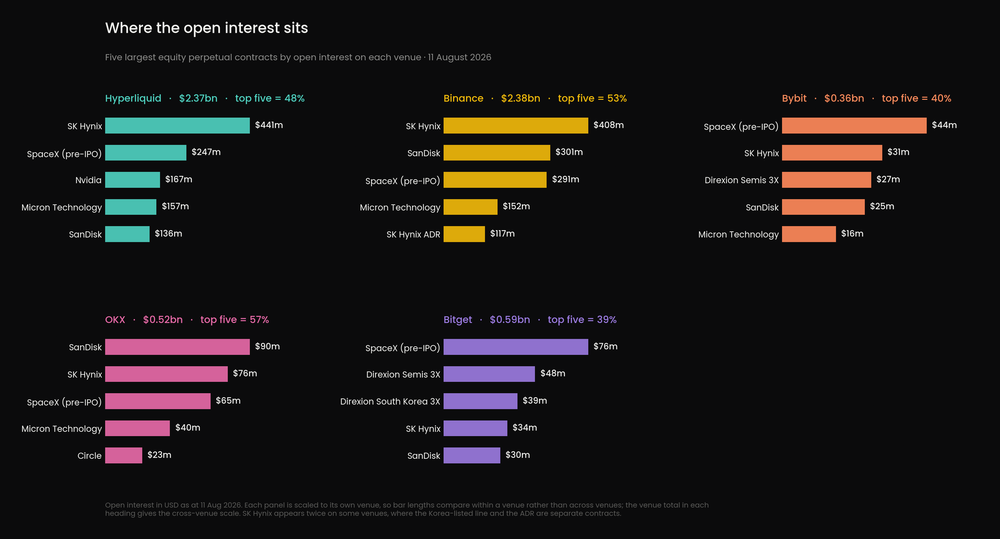
Open interest today concentrates heavily in memory and AI hardware names, which together account for roughly half the book on both exchanges, with SK Hynix alone representing 18% of Hyperliquid’s equity open interest.
Why Crypto Funding Cooled While Equity Funding Took Off
Bitcoin’s open-interest-weighted funding rate averaged 11.0% annualized across 2024, then compressed to 4.9% in 2025, and further to just 2.2% year to date as of August 11, 2026.
As a result, the crypto basis trade fell to just 1% of USDe’s backing assets until roughly two weeks before Ethena’s announcement, though improving crypto sentiment has since pushed that figure back up to 13%.
Equity perpetuals moved in the opposite direction. Once both Hyperliquid and Binance reached meaningful scale, funding was positive on 94% of trading days on Hyperliquid and 97% on Binance, with a median equity funding rate of 13.9% compared to 3.9% for Bitcoin over the same window.
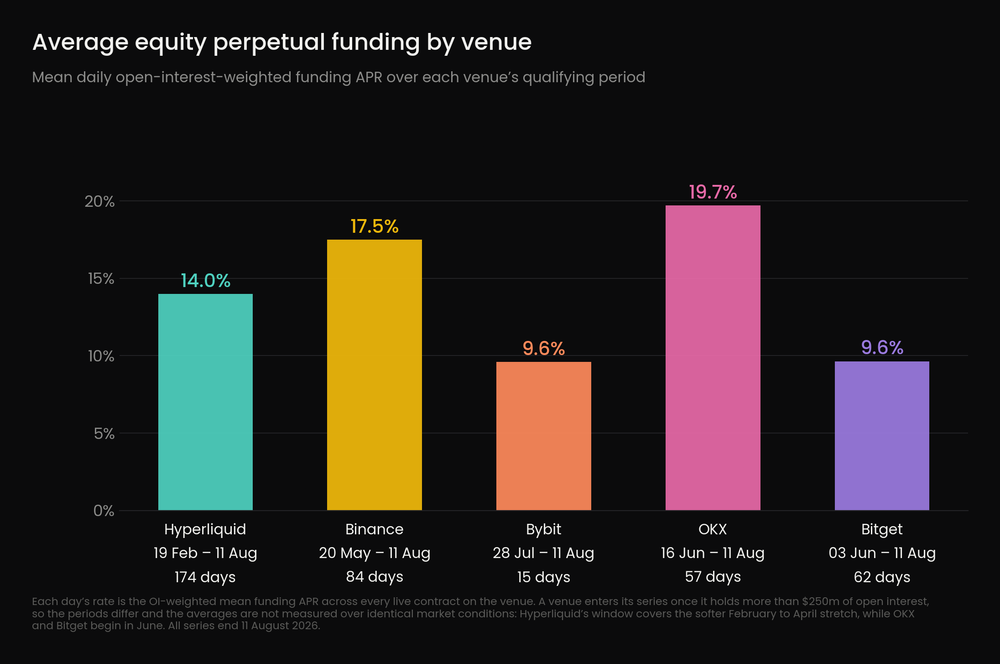
Ethan co-founder Guy Young pointed to a structural reason behind that gap. “One other interesting characteristic which makes this more attractive versus crypto is the natural positive skew of funding distribution,” Young said, explaining that stocks have tended to rise over long periods, creating persistent demand from traders willing to pay for leveraged long exposure, while crypto funding can compress or turn negative once demand for leverage dries up during a bear market.
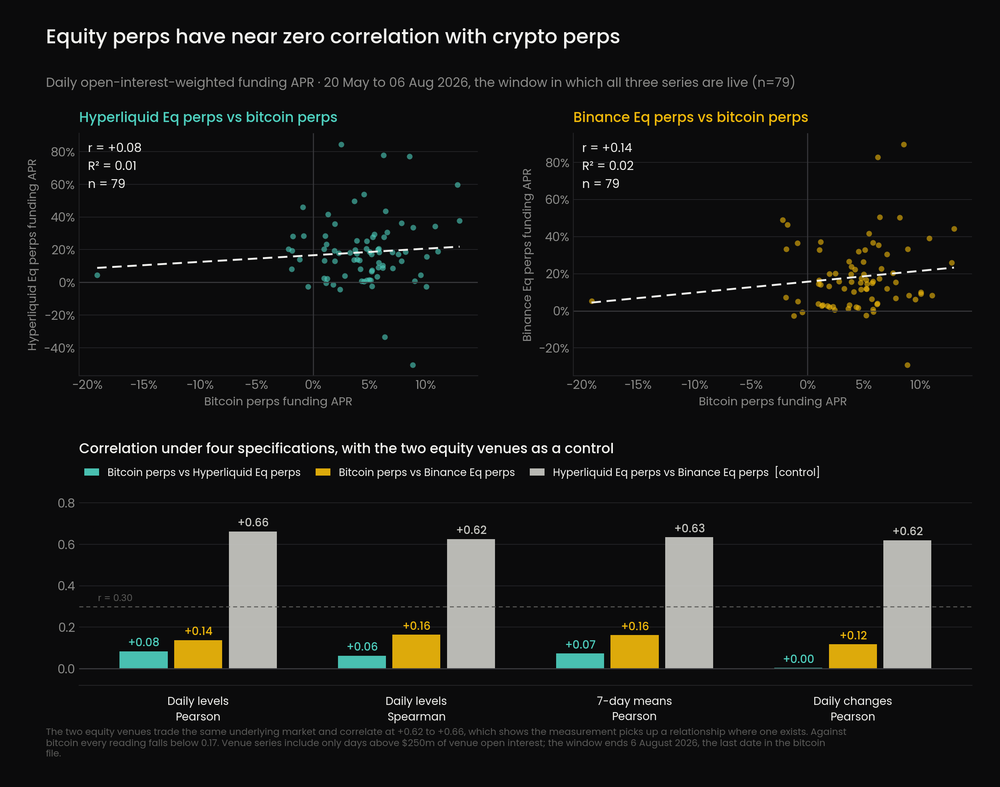
Ethena also highlighted that equity funding shows almost no correlation with bitcoin funding, with a daily correlation of just 0.08 on Hyperliquid and 0.14 on Binance across the measured window, suggesting this is a separate return stream rather than the same underlying exposure through a different instrument.
Just How Large Could This Market Become
The scale gap between the two markets is significant. Equity perpetuals carry about $6.2 billion in open interest today, compared with roughly $94 billion across the entire crypto perpetual futures market, but the underlying asset bases differ far more dramatically.
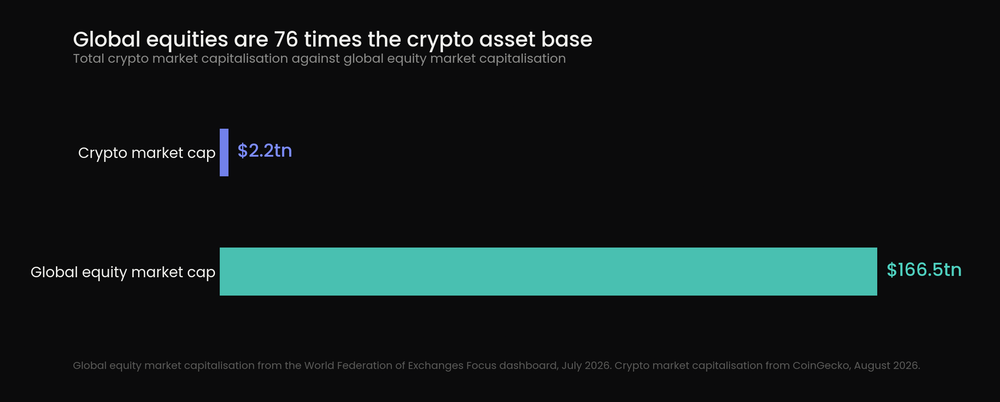
Total crypto market capitalization sits near $2.2 trillion, compared to a global equity market capitalization that reached $166.5 trillion in July 2026.
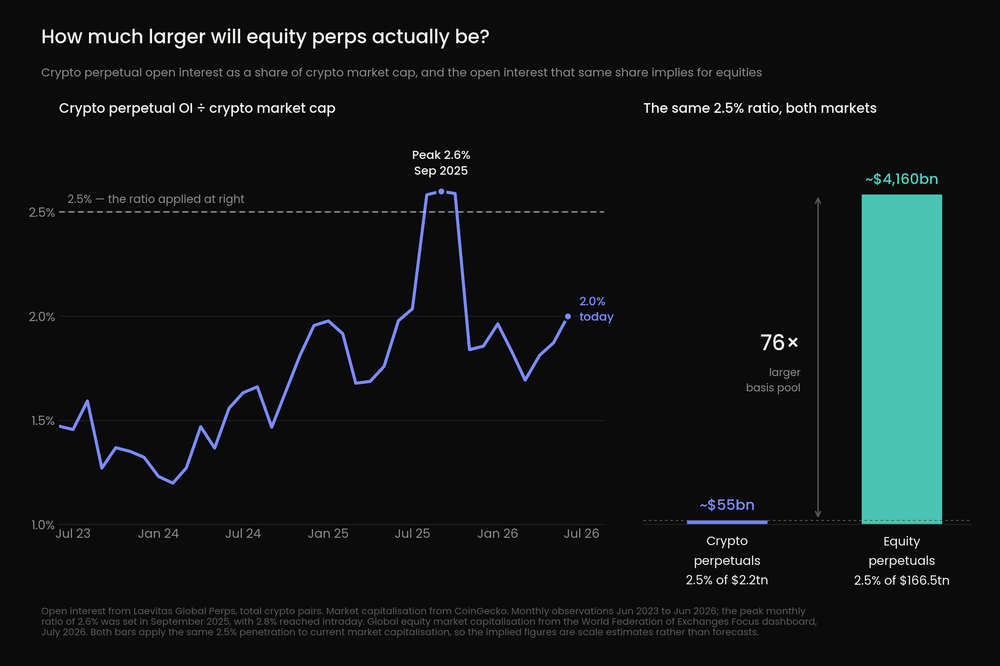
Ethena’s own published calculation applies crypto’s historical open-interest-to-market-cap ratio, which peaked around 2.6% in September 2025 and sits near 2.0% today, to the much larger equity market, implying roughly $4 trillion in potential equity perpetual open interest against a peak crypto open interest of $110 billion, a basis market close to 40 times larger running the identical trade on a bigger underlying base.
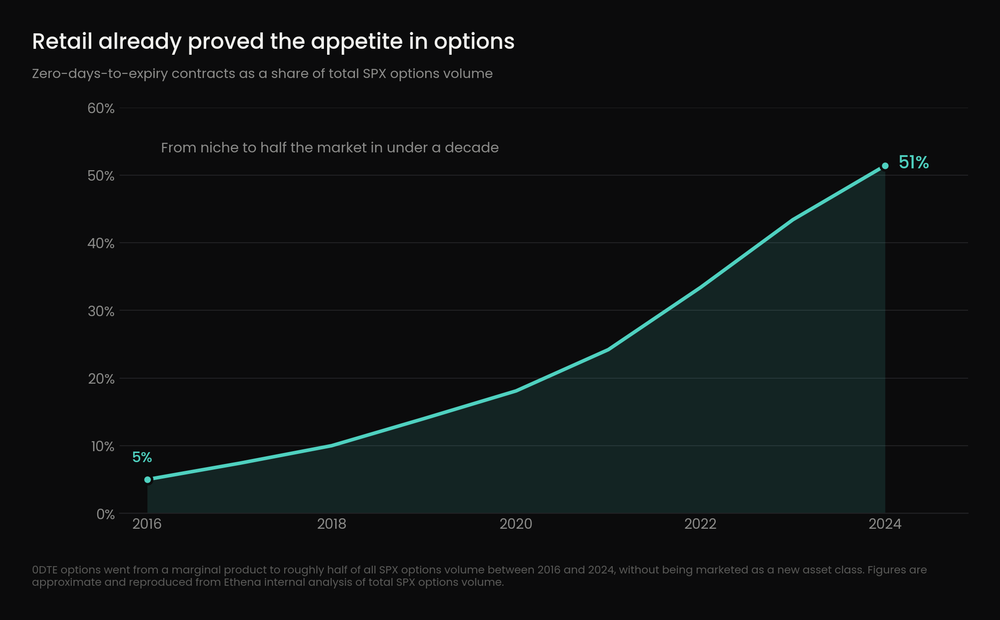
Ethena also drew a comparison to the growth of zero-day-to-expiry options in equities, which went from a niche product to 51% of all SPX options volume in under a decade, arguing this demonstrates proven retail appetite for short-dated, leveraged directional risk that a perpetual contract can express more simply than an option, without theta decay, bid-ask spread, or the cost of rolling a position forward.
Why Ethena Believes It Is Positioned to Capture This
Ethena pointed to infrastructure it says already meets the requirements for running this trade at scale.
The protocol has managed multi-billion-dollar delta-neutral hedged books across multiple venues through several full market cycles, including periods of acute stress, with collateral held by regulated custodians off the exchange itself, the same structure it already applies to its crypto backing, meaning a venue failure does not translate directly into a loss of principal.
New assets and markets must clear defined thresholds for spot liquidity, perpetual depth, funding persistence, and custody and counterparty standards before entering the backing portfolio, subject to review by Ethena’s Risk Committee, with positions sized against those limits and monitored continuously afterward.
Ethena describes itself as one of the only delta-neutral operators to scale past $10 billion, having facilitated more than $30 billion in mint and redeem flows without a loss impacting the protocol itself.
The Timing Behind This Move
This expansion comes as USDe’s own supply has fallen to somewhere between $4 billion and $5 billion, down from a peak near $15 billion, a decline that coincided with yield slipping below zero during the recent crypto downturn after peaking above 80% during the 2024 to 2025 bull run.
Young explained the delay in pursuing this specific opportunity as deliberate rather than reactive. “We took a cautious approach to what was a nascent market and waited until we saw deep, liquid markets with a data history we could study before moving into the opportunity at scale,” he said.
The protocol also previously added traditional credit exposure through Janus Henderson, which reportedly now accounts for around 12% of USDe’s backing, and announced a $1 billion facility with FalconX to place USDe backing into overcollateralized institutional loans.
The equity perpetual expansion also lands one day after Ethena Foundation unveiled a broader overhaul of ENA’s own token economics, eliminating monthly venture capital token unlocks while putting a vote to the community on directing revenue from Ethena’s businesses toward token buybacks.
What Comes Next
Ethena expects to announce its first exchange partners and specific deployments for the equity strategy within the coming weeks, and separately expects RWA perpetuals to overtake crypto derivatives as the largest single component of USDe’s backing within 12 to 24 months.
What this means for you: this expansion is still in its early deployment phase, with no exchange partners named yet, so treat Ethena’s growth projections, whether the more conservative 40 times figure from its own published math or the more casual 100 times framing from its founder, as forward-looking targets rather than a confirmed outcome, and watch USDe’s actual backing composition over the coming months as the more concrete signal of how this expansion is progressing.