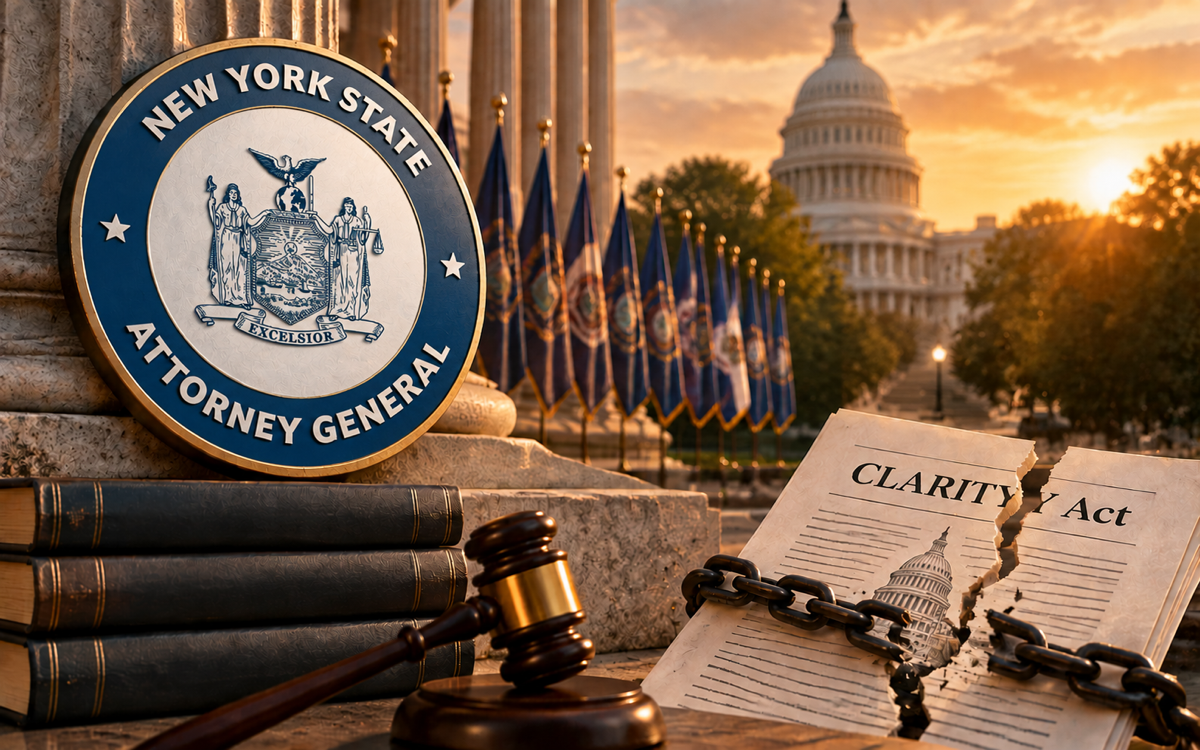
A bipartisan coalition of 18 state attorneys general sent a letter to Congress on September 14, 2026, urging lawmakers to remove provisions in the CLARITY Act that they say could limit states’ ability to enforce consumer protection laws and oversee digital asset markets.
Led by New York Attorney General Letitia James, the coalition argued that the proposed crypto market structure legislation could weaken state authority to investigate fraud, scams, and other harmful digital asset activities, a concern that echoes the patterns covered in a guide on avoiding scams when sending crypto for remittances.
The attorneys general said they support creating a clear federal framework for digital assets but want states to maintain their existing enforcement powers alongside federal regulators.
The letter comes as lawmakers continue negotiating the CLARITY Act, which aims to establish clearer rules for digital asset oversight and define responsibilities between the Securities and Exchange Commission (SEC) and Commodity Futures Trading Commission (CFTC).
Why States Say the Bill Could Cut Their Enforcement Power
According to the New York Attorney General’s Office, the coalition’s main concern is that parts of the CLARITY Act could restrict states from taking independent enforcement actions involving digital asset companies.
The attorneys general argued that state regulators have historically played a role in protecting consumers through securities laws, fraud investigations, and other state-level enforcement tools.
They are asking lawmakers to preserve a dual enforcement model where federal agencies establish national standards while states continue addressing violations affecting residents within their jurisdictions.
| Area | Current Role of States | Concern Raised by State AGs |
| Consumer protection | States can investigate fraud, scams, and harmful digital asset practices | CLARITY Act provisions could reduce state enforcement options |
| Crypto businesses | State regulators may act under existing laws | Federal rules could limit overlapping state authority |
| Market oversight | States provide additional enforcement alongside federal agencies | A narrower state role could create enforcement gaps |
Table 1. State attorneys general concerns about CLARITY Act enforcement provisions.
The coalition did not call for blocking federal crypto regulation entirely. Instead, it argued that federal rules should not prevent states from responding to consumer risks.
Which 18 States Joined the Challenge
The coalition includes attorneys general from Democratic and Republican-led states, making the issue one of regulatory authority rather than party politics.
Participating states include New York, California, Colorado, Delaware, Illinois, Maine, Maryland, Massachusetts, Michigan, Minnesota, Nevada, New Jersey, New Mexico, Oregon, Pennsylvania, Rhode Island, Vermont, and Washington.
The attorneys general said maintaining state authority is important because regulators at the state level can often respond quickly to emerging risks and local consumer complaints.
The letter also reflects broader concerns among state officials about how much authority should move to federal regulators as Congress develops a nationwide crypto framework, a tension similar to jurisdictional debates covered in a comparison of UK versus U.S. stablecoin regulation.
Why the Fight Goes Beyond SEC and CFTC Jurisdiction
The CLARITY Act is primarily designed to clarify the regulatory responsibilities of the SEC and CFTC. Supporters argue that clearer rules could reduce uncertainty for crypto companies and investors by defining whether different digital assets fall under securities or commodities oversight.
However, the state attorneys general dispute whether creating a federal framework should also limit states’ ability to enforce their own consumer protection laws. The disagreement adds another layer to negotiations that already include debates over decentralized finance, stablecoin rules, market oversight, and regulatory authority.
Why State-Level Enforcement Became a Flashpoint
The dispute centers on whether federal crypto regulation should replace parts of state oversight or operate alongside it. State regulators argue that maintaining multiple enforcement channels provides additional protection for consumers, particularly in an industry where fraud, scams, and failed projects have created significant losses.
The attorneys general said removing state authority could create gaps where certain violations may not receive timely enforcement. Federal lawmakers, meanwhile, are attempting to create a consistent national framework that avoids conflicting requirements across different jurisdictions.
What Happens Next in the CLARITY Act Fight
The coalition’s letter adds pressure on lawmakers as they continue revising the CLARITY Act before further votes. The final impact will depend on whether Congress modifies the enforcement provisions and how the legislation ultimately divides responsibility between federal agencies and state regulators.
The debate over state authority is expected to remain one of the key issues as lawmakers work toward a final version of the bill.
What this means for you: The CLARITY Act debate could determine not only which federal agency oversees crypto markets, but also whether state regulators can continue taking independent action against digital asset companies. The final legislation may affect how quickly regulators can respond to consumer complaints, fraud cases, and other risks in the crypto industry.
This is not financial advice. Cryptocurrency regulation remains subject to legislative changes, regulatory interpretation, and future enforcement decisions.