
Stripe plans to expand its stablecoin card programs to more than 100 countries by the end of 2026, as the payments company pushes stablecoins further into everyday spending and global financial services.
Henri Stern, Stripe’s head of stablecoins and crypto and the CEO of Stripe-owned Privy, outlined the company’s broader stablecoin strategy in a post on X. Current customers using Stripe’s stablecoin card infrastructure include Kraken, Ramp and Morse.
The expansion builds on Stripe’s existing card-issuing business and Bridge, the stablecoin infrastructure company it acquired in 2024. Bridge enables businesses and fintech companies to offer stablecoin-linked cards that let users spend digital-dollar balances through established card networks.
Stripe Targets More Than 100 Countries
Stripe’s stablecoin card expansion is designed to let businesses offer card products funded by stablecoin balances across more markets.
The company has already been working with Visa and Bridge on a global stablecoin-linked card program. In March, Visa and Bridge said the cards were live in 18 countries, with plans to expand to more than 100 countries across Europe, Asia-Pacific, Africa and the Middle East by the end of 2026.
The card programs allow users to spend stablecoin balances through familiar card payment infrastructure. Depending on the program, users can hold stablecoins in custodial or self-custody wallets, while the infrastructure handles payment conversion and settlement.
The 100-country target does not mean every Stripe stablecoin product or card will automatically be available to every user in those markets. Availability depends on local regulations, issuing partners, eligibility requirements, and the businesses offering the cards.
| Detail | Current Information |
| Company | Stripe |
| Stablecoin infrastructure | Bridge |
| Expansion target | More than 100 countries |
| Target date | End of 2026 |
| Existing card markets | 18 countries as of March |
| Current customers | Kraken, Ramp, and Morse |
| Card network | Visa-supported programs |
| Stablecoin approach | Supports multiple stablecoins and blockchains |
| Main use case | Spending stablecoin balances through cards |
Table 1. Stripe’s planned expansion of stablecoin card programs.
Stablecoin Card Spending Is Growing
Stripe’s expansion comes as stablecoin-based card spending grows beyond traditional crypto trading.
Data from Paymentscan showed that about $1.2 billion in stablecoins was spent through cards in September, roughly three times the amount recorded a year earlier. The figure represents the wider stablecoin card market rather than Stripe’s own card volume.
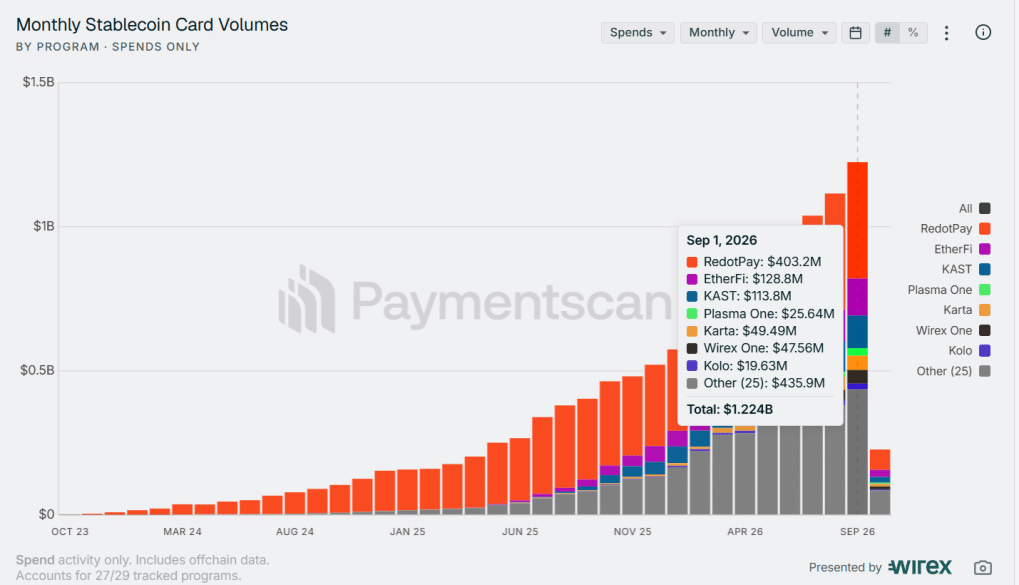
Source: Paymentscan – Monthly Stablecoin Card Volumes
Visa has also reported rapid growth in its stablecoin-linked card programs. More than 160 programs are operating across its network, while stablecoin-linked card payment volume increased nearly 200% year over year.
The figures suggest that stablecoins are increasingly being used as a funding source for conventional payment products rather than only for crypto trading, transfers, and settlement.
Bridge Connects Stablecoins to Visa Cards
Bridge is central to Stripe’s card strategy. Stripe acquired Bridge in 2024 for about $1.1 billion, adding stablecoin infrastructure that allows businesses to build payment products around digital dollars.
Bridge and Visa launched stablecoin-linked card issuing in 2025. The system allows developers to issue cards through a single API and lets cardholders spend from stablecoin balances at merchants that accept Visa, similar in concept to how prepaid crypto cards function today.
Visa and Bridge later expanded the program, with Bridge-powered cards planned for more than 100 countries.
This approach lets users use a familiar card while stablecoins operate behind the scenes. Merchants can keep receiving payments through existing card infrastructure instead of accepting stablecoins directly.
Stripe Is Adding More Stablecoin Options
The card expansion comes alongside a wider push to make Stripe’s financial infrastructure compatible with different stablecoins.
On September 30, Stripe launched support for Open USD (OUSD) across products including Treasury, Issuing, Global Payouts, Payments and Crypto Onramp.
Stripe said OUSD can be used to receive, hold, send and spend funds, including through Stripe’s card-issuing infrastructure.
OUSD is available on Base, Ethereum, Solana and Tempo, while Stripe continues to support other stablecoins and blockchains. The company said it will not require users to convert existing stablecoin balances into OUSD.
This fits with Stern’s description of Stripe’s approach as stablecoin and blockchain-agnostic, allowing businesses to select the assets and networks that fit their products.
Stablecoin Cards Could Help With Cross-Border Payments
One of the main use cases for stablecoin cards is cross-border money movement.
A business can pay a worker, contractor, or customer using a dollar-linked stablecoin, while the recipient can potentially spend that balance through a card instead of first converting the funds through a traditional banking system.
This can be useful in markets where accessing dollar accounts or receiving international payments can be difficult or expensive.
Stripe has also been expanding stablecoin-based financial accounts and payouts. The company says its stablecoin-powered Treasury products have already been made available to businesses across more than 100 countries.
The card expansion extends that model from holding and moving digital dollars to spending them through established payment networks.
What Comes Next
Stripe is expected to expand its stablecoin card programs across Europe, Asia-Pacific, Africa and the Middle East before the end of 2026. The exact countries and launch schedules will depend on local regulations, issuing arrangements and individual platform rollouts.
The bigger test will be whether businesses and consumers use these cards regularly enough to make stablecoins a practical funding option for everyday payments. Stripe’s expansion also puts it in a growing market alongside Visa, Mastercard and other payment companies building stablecoin-based card infrastructure.
What This Means for You: Stripe’s 100-country target does not mean every user will automatically receive a stablecoin card. Availability will depend on the platform offering the card, local rules, and eligibility. If the rollout expands as planned, more users could eventually spend stablecoin balances through familiar card payment networks without first converting them to traditional bank money.