Key Takeaways
- Donald Trump has publicly accused major banks of trying to “undercut” the GENIUS Act to protect their own profits.
- The primary friction point in the 2026 Market Structure bill is whether stablecoins should be allowed to offer interest-bearing yields.
- The CLARITY Act remains stuck in the Senate as banking lobbyists push for stricter rules on “yield-bearing” digital assets.
A path to resolution: The Battle for Market Structure
The debate over the future of American finance has moved to Truth Social. President Donald Trump has signaled that the passage of the Digital Asset Market Clarity Act (CLARITY Act) is a top priority for his administration’s “Crypto Agenda.” The President’s frustration stems from a perceived stalemate: crypto firms want the freedom to innovate with yield-bearing stablecoins, while banks are fighting to close what they call “loopholes” that could drain traditional savings accounts. Trump’s message is clear—if the U.S. doesn’t provide clarity soon, the industry will migrate to China.
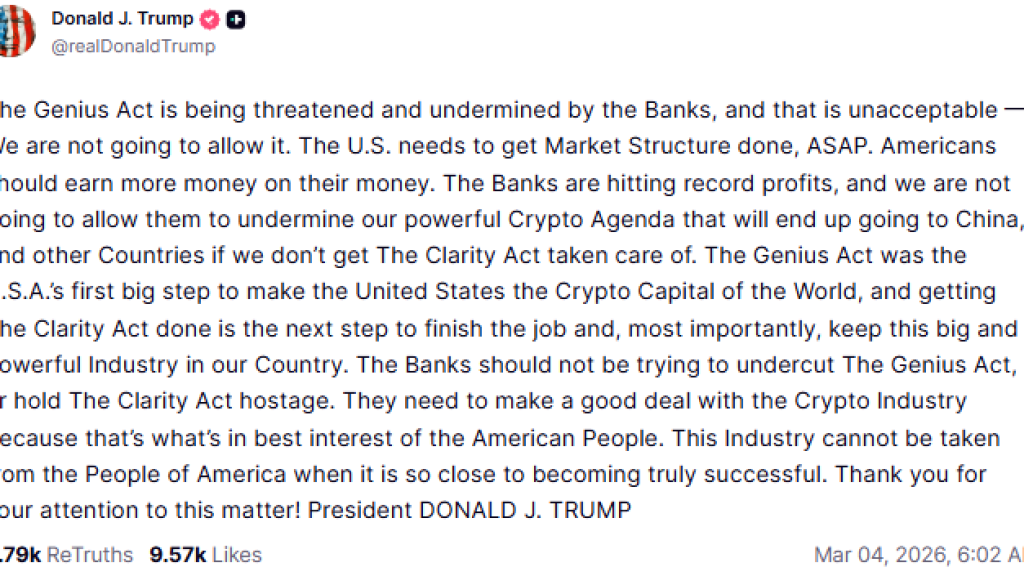
The GENIUS Act, which provided the initial roadmap for stablecoin issuers, is now the center of a tug-of-war. Banking representatives have reportedly been sending “red-lined” text to Congress, seeking to limit how stablecoins handle rewards.
The banking sector’s concern is simple: if Americans can earn 5% yield on a stablecoin that is as easy to use as a checking account, why would they keep their money in a traditional bank? JPMorgan CEO Jamie Dimon has been vocal in this camp, calling for a “level playing field” that subjects stablecoin issuers to the same rigorous capital rules as banks.
Why Stablecoin Yield is the New Political Battleground
The conflict represents a fundamental clash between “record profits” in the banking sector and the “Americans earning more on their money” mantra of the current administration.
Senator Cynthia Lummis and Representative French Hill have echoed the President’s urgency, suggesting that the Senate should simply adopt the House’s bipartisan version of the bill to end the deadlock.
However, until the “yield” issue is resolved, the CLARITY Act remains a hostage of the ongoing friction between the old guard and the new digital economy.
Final Thoughts
The tension between the White House and Wall Street over stablecoin yield is more than just a policy debate; it’s a battle over who controls the future of American liquidity. If Trump gets his way, the traditional banking monopoly on interest may be coming to an end.
Frequently Asked Questions
What is the GENIUS Act?
It is a piece of legislation providing a regulatory framework and roadmap for stablecoin issuers in the US.
What is the CLARITY Act?
The Digital Asset Market Clarity Act of 2025 aims to define the roles of the SEC and CFTC in overseeing the crypto market.
Why are banks against stablecoin yield?
Banks fear that high-yield stablecoins will compete with traditional deposits, potentially reducing bank liquidity.