Key Takeaways
- Cryptography is the math used to scramble data with keys, letting only an authorized party read it, change it, or prove who sent it.
- The same math secures HTTPS browsing, messaging apps, and password managers, not just crypto wallets.
- Bitcoin verifies transactions with the ECDSA signature scheme, while newer networks like Solana use EdDSA to sign and verify faster.
- On September 21, 2026, every FIPS 140-2 cryptographic module moved to historical status under NIST’s post-quantum migration.
Cryptography is the branch of applied math that scrambles information using keys so only an authorized party can read it, change it, or prove who sent it.
Every time a Bitcoin wallet signs a transaction or an exchange app loads over a secure connection, cryptography is doing that work in the background.
Three properties make it trustworthy: confidentiality, integrity, and authenticity. Understanding how those three fit together is the fastest way to understand why a crypto wallet behaves the way it does, and why the same math shows up everywhere else data needs protecting.
How Does Cryptography Work?
Cryptography scrambles plaintext, ordinary readable data, into unreadable ciphertext that only the matching key can unlock. Four mechanisms handle this inside a crypto wallet: encryption, public-key cryptography, hashing, and digital signatures.
Encryption and Decryption
Encryption takes plaintext and scrambles it into ciphertext using an algorithm plus a key. The algorithm is public and well understood, often a named standard like AES, the Advanced Encryption Standard that protects everything from banking apps to Wi-Fi traffic.
The key is the secret ingredient that decides what the output looks like, and changing the key produces a completely different result from the same input.
Decryption is that same process run in reverse: it feeds the ciphertext back through the algorithm with the correct key and recovers the original plaintext exactly. Without that key, the ciphertext stays meaningless.
A cryptographic system can use a mathematically flawless algorithm and still fail completely if the key gets copied, guessed, or stored somewhere carelessly. That is why key management matters more than the algorithm itself in most real-world breaches.
Symmetric encryption uses one shared key for both locking and unlocking, which makes it fast enough to encrypt an entire file or database in milliseconds.
The tradeoff is distribution: both sides need that key before they communicate, and anyone who intercepts it during the handoff can read everything encrypted with it from that point on. That distribution problem is the entire reason public-key cryptography exists.
Public and Private Keys Replace the Shared Secret
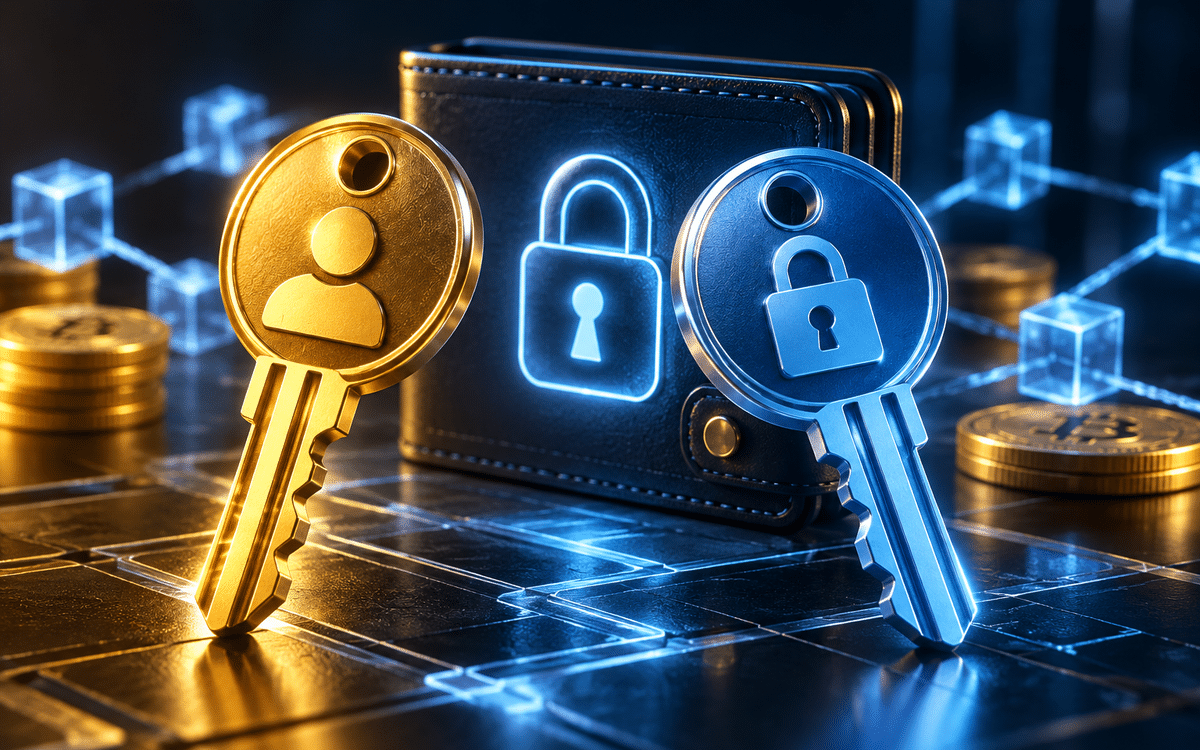
Public-key cryptography, also called asymmetric cryptography, solves that distribution problem with a matched pair of keys instead of one shared secret. A public key can be handed to anyone. A private key never leaves its owner.
Data locked with the public key can only be opened with its matching private key, so two parties can communicate securely without ever having exchanged a secret in advance.
RSA and elliptic curve cryptography, or ECC, are the two families behind most real-world asymmetric systems. RSA relies on how hard it is to factor the product of two large prime numbers.
ECC achieves similar security with much smaller keys by using the math of points on an elliptic curve, which is why it runs faster on the modest hardware inside a phone or a hardware wallet. Bitcoin’s key pairs are built on an ECC curve called secp256k1.
This pairing is also the mechanism behind a crypto wallet address. The address is derived from a public key, while the private key is the single piece of information that controls the funds. Our guide to public and private keys covers the mechanics of that key pair in more depth, including what happens when one gets lost.
Hash Functions Fingerprint Every Block
A hash function takes any input, however large, and compresses it into a fixed-length output called a hash. The same input always produces the same hash, but changing even one character produces a completely different one.
Bitcoin uses a hash function called SHA-256, which always outputs 256 bits regardless of whether the input is one word or an entire book.
Blockchains lean on that property to link blocks together. Each block stores the previous block’s hash inside itself, so altering any past transaction would change that block’s hash and break every hash that follows it.
That cascading effect is what makes rewriting blockchain history computationally impractical rather than just difficult.
Digital Signatures Prove Who Sent a Transaction
A digital signature is created by signing data with a private key. Anyone can verify it using the matching public key, without ever needing access to the private key itself.
Bitcoin relies on the ECDSA signature scheme for this, while newer networks, including Solana, use EdDSA instead, mainly because it verifies faster at scale.
Either way, the signature does two jobs. It proves the transaction came from the wallet’s actual owner, and it proves the transaction data was not altered after signing.
Where Cryptography Shows Up Outside of Crypto
Cryptography is not a crypto-specific invention. It is older than Bitcoin by decades and runs underneath most of the internet, whether or not a wallet is involved.
Secure Browsing and Messaging
The padlock icon in a browser’s address bar means the connection is running TLS. That protocol encrypts traffic between a device and a website using the same symmetric and asymmetric building blocks covered above.
Messaging apps like Signal use end-to-end encryption so that only the sender and recipient, not the app’s own servers, can read a message’s content.
Password Managers and VPNs
A password manager encrypts an entire vault of saved logins with one master password acting as the key. Losing that master password is just as unrecoverable as losing a crypto wallet’s private key.
A VPN works on the same principle, wrapping a device’s traffic in an encrypted tunnel so an internet provider or a public Wi-Fi network can see that data is moving, but not what it says.
Knowing that cryptography already protects a banking app or a messaging thread makes it easier to see why the same math, applied to a blockchain, can be trusted to protect funds with no company standing in the middle.
Common Cryptographic Attacks Worth Knowing About
Breaking cryptography outright is different from exploiting how people use it, and the second category causes far more real damage than the first.
- Brute-force attack. Tries every possible key until one works. Modern key lengths make this mathematically pointless against the algorithm itself, which is why attackers almost never bother trying it against a properly implemented system.
- Man-in-the-middle attack. Targets the connection instead of the key, inserting an attacker between two parties who each believe they are talking directly to the other, exactly what TLS and signed messages are designed to prevent.
- Replay attack. Takes a valid, previously signed message and resends it later, hoping a system will accept it a second time without noticing it already processed that exact transaction.
- Phishing. The attack that works because it targets the human holding the key rather than the mathematics protecting it, typically through a fake site or message built to mimic a wallet’s real login page.
Every attack in this list fails against cryptography that is implemented correctly and used carefully. None of them represents a flaw in the underlying math.
Why Does Cryptography Matter for Someone New to Crypto?
Cryptography matters for someone new to crypto because it lets money move with no bank vouching for it: a signed, hashed transaction proves its origin and that nothing was tampered with. The algorithms may not hold forever: NIST finalized its first post-quantum cryptography standards in August 2024, and some wallet providers have started prototyping quantum-resistant signing schemes.
The idea of moving money with no bank standing in the middle to vouch for it can feel uncomfortable at first. Cryptography is the reason that discomfort is misplaced.
A signed, hashed transaction carries its own proof of origin and its own proof that nothing was tampered with in transit, exactly what a bank’s internal systems are normally trusted to guarantee.
The crypto basics hub covers the surrounding fundamentals in more depth, from how a blockchain works to how gas fees get calculated.
None of this is static, either. The algorithms protecting a wallet today are not guaranteed to hold forever, part of why 2026 has turned into a real transition year for the cryptography underpinning the entire industry.
NIST finalized its first three post-quantum cryptography standards in August 2024. The agency then moved every remaining FIPS 140-2 validated cryptographic module to historical status on September 21, 2026, meaning only FIPS 140-3 validated systems now qualify for new federal procurement.
Bitcoin’s ECDSA signatures are not part of that migration yet. That is one reason some wallet providers have already started prototyping quantum-resistant signing schemes.
How to Check Your Own Cryptography Setup
To check your own cryptography setup, identify whether you use a custodial exchange account or a self-custody wallet, find where your seed phrase is stored and whether that storage is offline, confirm you are not reusing the same private key across wallets or services, and bookmark the official site of every wallet or exchange you use.
Understanding the theory only matters if it changes what you do with a wallet. Run through these steps to see where you stand.
- Identify what kind of wallet you are using. A custodial exchange account means the exchange holds the private key on your behalf. A self-custody wallet means you hold it, which also means you are responsible for protecting it.
- Find out where your seed phrase lives right now. A seed phrase is the human-readable backup of your private key, and wherever it is stored is wherever your cryptography lives in practice.
- Check whether that storage is offline. A hardware wallet or a piece of paper kept somewhere physically secure never exposes the key to an internet-connected device. A note app, a password manager synced to the cloud, or a screenshot does.
- Confirm you are not reusing the same private key across multiple wallets or services. Reuse multiplies the damage the moment any single one of those services gets compromised.
- Bookmark the official site for any wallet or exchange you use. Typing a URL from memory or clicking a search ad is how most phishing sites get their first click.
Final Thoughts
Cryptography is the entire reason a Bitcoin wallet can be trusted without a bank standing behind it. It suits anyone moving into self-custody, less so someone who only trades on a centralized exchange and never touches a seed phrase directly.
The main risk was never the math, it is how the private key gets stored, typed, or shared. Our guide to crypto wallet security mistakes covers specific storage mistakes to avoid.
Frequently Asked Questions
Still have questions? These are the ones that come up most once the basics above start applying to an actual wallet.
What is cryptography in simple terms?
Cryptography is the practice of using math to scramble information so only someone with the right key can read it or prove they sent it. In crypto specifically, it is what lets a wallet prove ownership of funds and lets a network verify a transaction without a bank or clearinghouse in the middle.
Is cryptography the same thing as encryption?
Encryption is one part of cryptography, not the whole field. Cryptography also covers hashing, digital signatures, and key exchange, all of which show up on a blockchain without necessarily involving encryption at all. A Bitcoin transaction, for example, is signed and hashed but not encrypted, since the ledger itself is meant to be publicly readable.
What’s the actual difference between a public key and a private key?
A public key can be shared freely and is used to verify signatures or receive funds. A private key must never be shared, since it is the only thing capable of producing a valid signature for that wallet. Losing a private key means losing access to the funds permanently, and exposing it to anyone else means losing control of those funds just as permanently.
Can quantum computers break Bitcoin’s cryptography today?
No cryptographically relevant quantum computer exists yet. Google set an internal 2029 deadline in a March 2026 post for finishing its own migration to post-quantum cryptography, citing faster progress than expected in lowering the qubit count needed to break RSA-2048-level encryption.
Bitcoin’s ECDSA signatures would face a comparable risk once that threshold is crossed. That is why the migration work referenced above is happening now rather than later.
Are blockchain transactions anonymous because of cryptography?
Not exactly. Cryptography makes transactions pseudonymous, not anonymous, since a wallet address is a public key rather than a name. Every transaction tied to that address is permanently visible on the blockchain, and once an address is linked to a real identity, for example through an exchange’s identity checks, its full transaction history becomes traceable.
Do I need to understand the math to use crypto safely?
Not at the algorithm level. Knowing where a private key should never go matters more than knowing the math behind ECDSA or hashing. The most useful next step is checking right now whether your private key or seed phrase lives on a hardware-backed device or somewhere softer, since that single detail decides how exposed your funds are.