Key Takeaways:
- US spot XRP ETFs now hold $1.06 billion in assets, capturing 1.17% of XRP’s total market cap as institutional money flows in
- XRP ETFs saw $39 million in net inflows during February’s first full trading week while Bitcoin and Ethereum ETFs faced major outflows
- Technical analysts predict XRP could reach $28-$70 based on historical patterns repeating from 2016-2017 bull run cycles
US spot XRP ETFs just crossed a major milestone. They now hold $1.06 billion in net assets according to SoSoValue data. That represents 1.17% of XRP’s entire market cap. The five approved ETFs posted strong weekly performance recently. They pulled in fresh capital while Bitcoin and Ethereum ETFs hemorrhaged money. This shift signals growing institutional interest in XRP as regulatory clarity improves.
How Much Money Is Actually Flowing Into XRP ETFs?
The numbers tell a compelling story about institutional appetite for XRP. Five primary US spot XRP ETFs launched in November 2024 after years of regulatory uncertainty. These funds from Bitwise, Franklin Templeton, Grayscale, 21Shares, and Canary Capital accumulated $1.229 billion in total inflows since launch.
BSCN (@BSCNews) JUST IN: RIPPLE ETFS NOW HOLD 1.17% OF $XRP’S MARKET CAP
According to data from SoSoValue, the five spot ETFs in the United States now boast net assets of $1.06 billion…
That’s a full 1.17% of $XRP’s total market cap.
Said ETFs posted a strong performance last week, seeing net inflows while other ETFs for $BTC and $ETH saw major outflows.
The first full trading week of February 2026 brought particularly strong action. XRP ETFs captured $39.04 million in net inflows during that period. Franklin’s XRPZ led the pack with $20.50 million. Bitwise’s XRP product pulled in $20.01 million right behind it.
These inflows matter more when you consider the broader context. Bitcoin and Ethereum ETFs saw massive outflows during the same timeframe. Money rotated out of those established products and into newer XRP vehicles. This rotation suggests investors see unique value propositions in XRP separate from other crypto assets.
Total assets under management peaked at $1.65 billion on January 5, 2026. A broader market correction in early February pulled that figure back to current levels. But the ETFs still hold roughly 793.3 million XRP tokens collectively.
XRP ETFs capture a smaller market share compared to Bitcoin products. Bitcoin ETFs control about 6.31% of total BTC supply. But XRP funds became one of the fastest growing digital asset products in the US market. The growth trajectory shows institutional demand building steadily.
Understanding how cryptocurrency exchanges work helps explain why ETF access matters. Traditional investors can now gain XRP exposure through standard brokerage accounts. They don’t need to navigate crypto platforms directly.
What Are Analysts Predicting for XRP Price Targets?
Technical analysts are making bold calls on XRP’s potential price trajectory. Historical patterns from 2016-2017 are repeating in 2026 according to chart analysis. This comparison fuels bullish predictions ranging from $28 to $70.
CryptoBull’s analysis points to monthly chart patterns matching the previous bull cycle. XRP printed five consecutive red monthly candles from October 2016 through February 2017. The same pattern appeared in late 2025 and early 2026. After that 2017 consolidation, XRP exploded from under $0.01 to nearly $3.40.
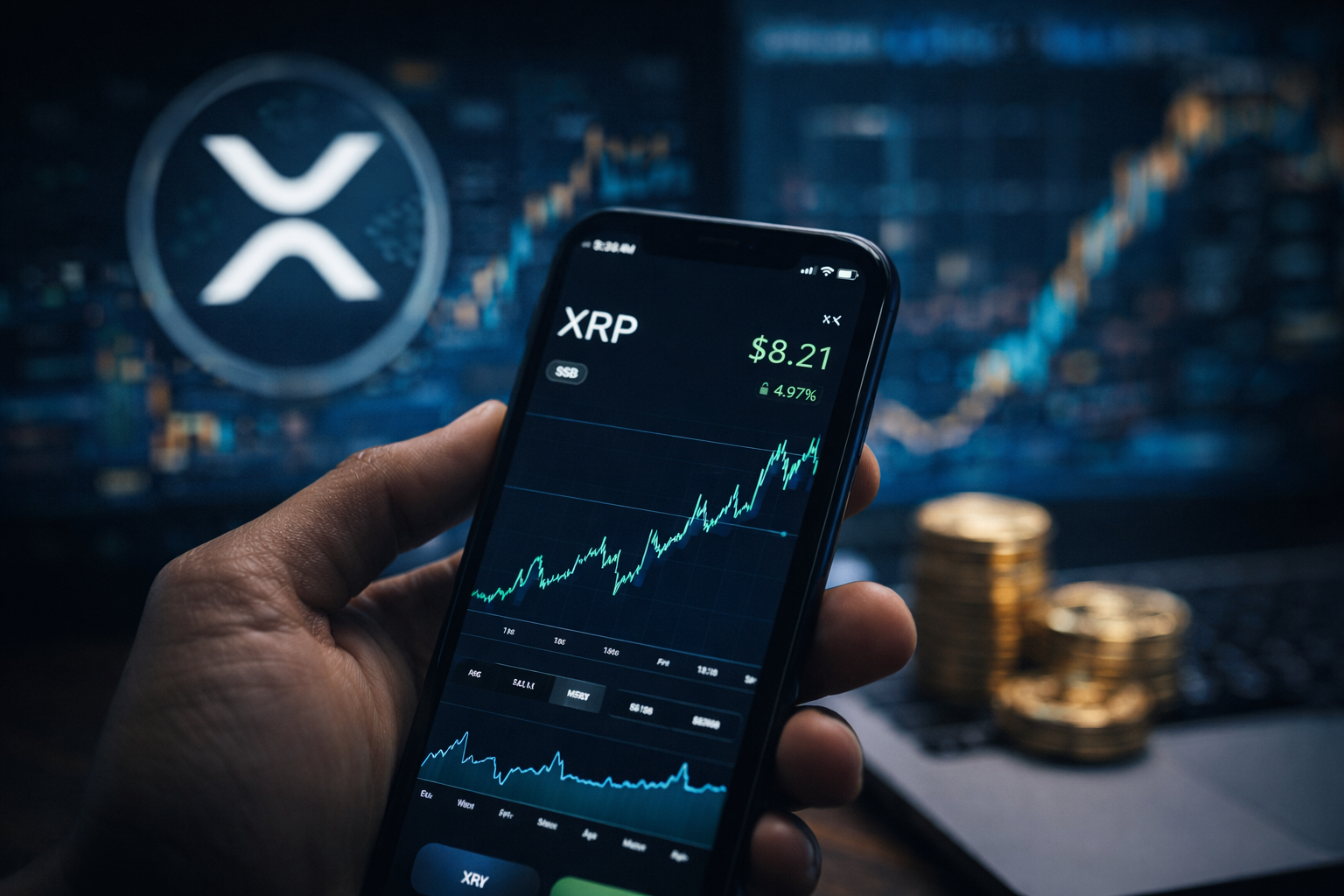
The current technical setup shows XRP consolidating around $8.10 after reaching highs near $8.50. Monthly charts suggest a breakout could mirror 2017’s explosive move. The $28 target represents a conservative 3x gain from current levels. The $70 projection would mean roughly 8.5x returns.
<tweet> CryptoBull (@CryptoBull2020) The last time #XRP printed 5 red monthly candles was from October 2016 to February 2017. It’s February 2026 and XRP is repeating history. Just look what happened in March, April and May of 2017. Time is ticking. </tweet>
Another analyst suggests XRP could hit $70 by July 2026. The pseudonymous “CryptoBull” believes Ripple’s XRP is “lined up” to reach that target by end of June. This prediction seems ambitious given it requires a 47x increase from current prices. That would push XRP’s market cap near $5 trillion.
BSCN (@BSCNews) MARKETS: ANALYST PREDICTS $XRP TO HIT $70 BY JULY
The pseudonymous and aptly-named ‘CryptoBull’ believes that @Ripple’s $XRP is “lined up” to reach $70 by the end of June.
The prediction is intuitively ridiculous and would mean a 47x increase from current prices and a market cap of nearly $5 trillion (which again seems impossible).
However, it does show that (potentially blind) optimism still exists in select pockets of the crypto ecosystem.
More measured analysis from Russian market experts projects $7-$8 short-term targets. Long-term projections range from $50-$100 if XRP maintains momentum. The key thesis centers on XRP surpassing Bitcoin in real-world utility applications.
Xaif Crypto (@Xaif_Crypto) A Russian market analyst projects $XRP could reach $7-$8 short-term, with a long-term target of $50-$100 on sustained momentum.
Key thesis: XRP to surpass Bitcoin in real-world utility.
These varied predictions reflect genuine uncertainty about XRP’s path forward. Conservative targets around $28 align with previous cycle performance. Extreme targets like $70 assume unprecedented adoption and utility growth.
Why Are Institutions Choosing XRP Over Other Cryptos?
Several factors drive institutional preference for XRP products right now. Regulatory clarity stands as the primary catalyst. Ripple’s 2025 legal resolution with the SEC removed years of uncertainty. Courts ruled XRP sales on secondary markets don’t constitute securities transactions.
This clarity allows traditional financial institutions to engage with XRP confidently. Banks and payment processors can integrate XRP technology without regulatory fears. Mastercard recently referenced XRP as a potential bridge currency in published documentation.
JackTheRippler (@RippleXrple) A RECENTLY PUBLISHED DOCUMENT FROM Mastercard REFERENCES #XRP AS A POTENTIAL BRIDGE CURRENCY.
FEB 28TH: GLOBAL XRPL TOKEN LISTING CONFIRMED. TRILLIONS IN INSTITUTIONAL CAPITAL ARE RUMORED TO BE POSITIONING TOWARD THE XRP LEDGER — WITH REAL TOKEN AIMED AT TOKENIZING THE MASSIVE GLOBAL REAL ESTATE MARKET. DYOR/NFA
Real-world utility applications separate XRP from purely speculative crypto assets. The XRP Ledger processes cross-border payments faster and cheaper than traditional systems. Transaction settlement happens in 3-5 seconds versus days for wire transfers. Costs run fractions of pennies compared to percentage-based fees.
Global XRPL token listings are confirmed for February 28th according to community sources. Trillions in institutional capital reportedly position toward the XRP Ledger. Real estate tokenization projects aim to use XRP infrastructure for massive markets.
Payment corridors using XRP already operate across multiple continents. Ripple’s On-Demand Liquidity service connects financial institutions in various countries. These working applications give XRP tangible value beyond speculation.
ETF structures provide tax-advantaged exposure for retirement accounts. Investors can hold XRP through IRAs and 401(k)s now. This access opens XRP to capital that couldn’t previously participate. Learning about cryptocurrency portfolio management helps investors balance XRP positions properly.
Institutional buyers prefer regulated ETF vehicles over direct crypto holdings. Custodial requirements, insurance, and compliance become simpler through ETF structures. Fund managers can allocate to XRP without building separate crypto infrastructure.
The steady ETF inflows during Bitcoin and Ethereum outflows suggest rotation rather than new capital. Institutions are rebalancing portfolios toward assets with clearer regulatory paths. XRP benefits from this shift as one of few major cryptos with explicit legal clarity.
What Could Derail Bullish XRP Price Predictions?
Market realities could easily dash optimistic price targets. Several factors might prevent XRP from reaching $28, $70, or higher projections. Broader crypto market conditions remain the primary risk.
Bitcoin dominance still drives overall crypto sentiment. If Bitcoin enters sustained bear market, altcoins typically suffer worse. XRP wouldn’t escape that correlation despite improving fundamentals. Previous cycles showed XRP dropping 90%+ during crypto winters.
Regulatory changes outside the US could create headwinds. European crypto regulations continue evolving. Asian markets maintain various restrictions on crypto trading. New rules limiting XRP access in major markets would constrain price appreciation.
Competition from central bank digital currencies poses long-term threats. CBDCs aim to solve similar problems as XRP in cross-border payments. Government-backed solutions might capture market share from private alternatives. Countries launching CBDCs could reduce XRP utility in those regions.
Technical adoption hasn’t reached predicted levels yet. While Ripple partnerships exist, XRP usage in actual payment volumes remains relatively small. Mass adoption needs to materialize for extreme price targets. Current transaction volumes don’t support multi-trillion dollar valuations.
Supply dynamics work against massive price increases. XRP has large circulating supply of around 58 billion tokens. Another 42 billion sits in escrow releasing gradually. This supply structure makes $70 XRP mathematically challenging. Total crypto market cap would need unprecedented growth.
Learning about crypto market cycles helps set realistic expectations. Previous patterns don’t guarantee future performance. Past XRP pumps came from different market structures and conditions.
ETF inflows could reverse quickly if sentiment shifts. The $39 million weekly inflow seems strong but remains tiny versus broader markets. Bitcoin ETFs pull billions in good weeks. XRP needs sustained institutional interest to maintain momentum.
Frequently Asked Questions
What does 1.17% market cap mean for XRP ETFs?
XRP ETFs holding 1.17% of market cap means they control roughly 793 million XRP tokens worth $1.06 billion. This represents significant institutional ownership considering the products only launched in November 2024, showing rapid adoption among traditional finance investors.
Can XRP really reach $70 based on historical patterns?
Technical analysts point to 2016-2017 patterns repeating in 2025-2026 when XRP rallied from pennies to $3.40. However, $70 requires a 47x gain creating nearly $5 trillion market cap, which most analysts consider unrealistic without unprecedented adoption and utility expansion.
Why are XRP ETFs getting inflows while Bitcoin ETFs see outflows?
Institutional investors are rotating capital toward XRP following Ripple’s 2025 regulatory clarity. XRP offers different utility than Bitcoin focused on cross-border payments, and some funds view it as undervalued relative to its potential real-world applications.
How do I invest in XRP through ETFs?
You can buy XRP ETFs through standard brokerage accounts like any stock. Major products include Franklin XRPZ, Bitwise XRP, and Grayscale funds. These provide regulated exposure without needing crypto wallets, though direct XRP purchases through exchanges like Coinbase or Kraken offer more control.
What’s the most realistic XRP price target for 2026?
Conservative analysts project $7-$8 short-term based on current momentum. More bullish targets around $28 align with previous cycle performance patterns. Extreme predictions of $70+ require unprecedented adoption that most market observers consider unlikely within 2026 timeframes.