Key Takeaways
- The CFTC has filed a lawsuit against New York, claiming exclusive authority over federally regulated prediction markets.
- The CFTC argues that event contracts are “swaps” and should not be governed by traditional state gambling laws.
- 37 states have joined an amicus brief supporting state oversight, arguing that federal rules lack necessary consumer protections for betting.
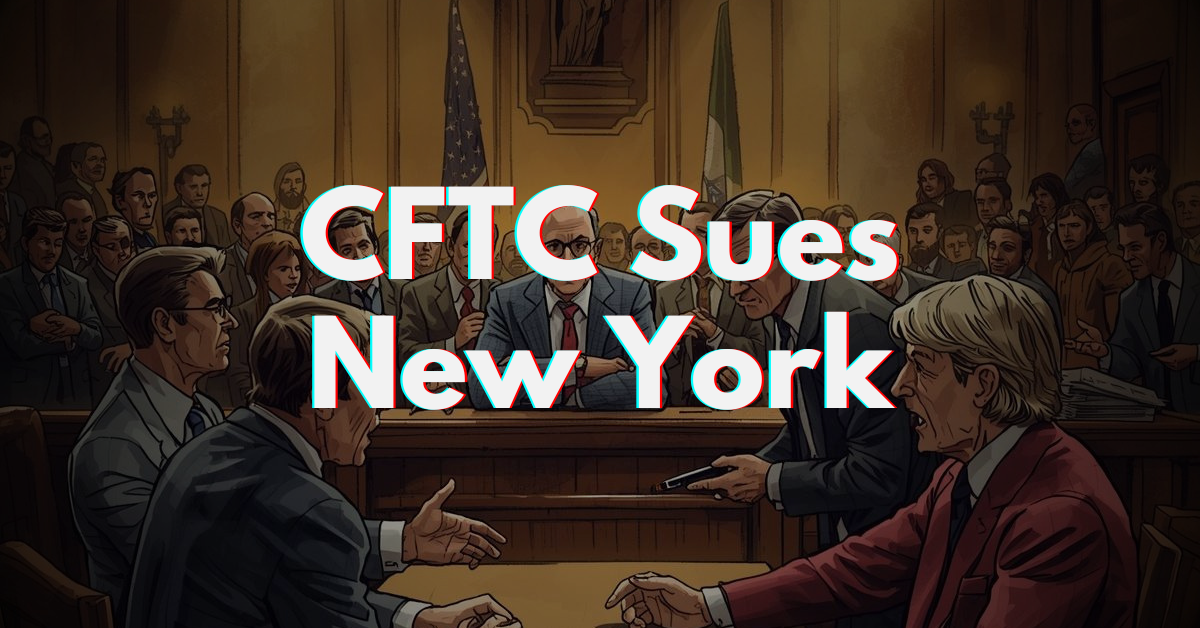
The battle for the future of prediction markets has moved into the federal courtroom as the Commodity Futures Trading Commission (CFTC) takes aim at the State of New York. The lawsuit seeks to block New York from applying its local gambling laws to platforms that are already registered and regulated at the federal level.
CFTC Chair Michael Selig argues that an “onslaught” of state-level litigation is threatening to fragment the market and undermine the commission’s statutory authority to oversee event contracts as financial instruments.
Federal law doesn’t legalize sports betting
New York officials recently ramped up pressure by suing major exchanges like Coinbase and Gemini, alleging that their prediction offerings constitute illegal gambling. Naturally, this didn’t sit well with state regulators. A massive group of 37 states—with Massachusetts leading the charge—is pushing back, arguing that the 2010 laws the CFTC is using were never meant to open the door for national sports betting.
For these states, it’s about control. They believe local experts should be the ones handling things like ID checks and fraud prevention, rather than relying on a complex federal system that wasn’t built for this.
Crackdown on prediction markets
This jurisdictional “tug-of-war” is manifesting in real-time restrictions for users. In Nevada, a judge recently extended a ban on Kalshi, siding with state regulators who view the platform as an unlicensed sportsbook. Similar cease-and-desist actions have appeared in Illinois, Connecticut, and Arizona.
At the heart of this legal battle is a simple question: is an ‘event contract’ (like betting on a policy change or a game) a legitimate financial tool for hedging risk, or is it just gambling? If the CFTC loses its bid for a permanent ban, prediction markets could end up in a regulatory nightmare. We’re talking about a patchwork of 50 different state laws that would make it almost impossible for any platform to run a nationwide business.
Final Thoughts
The outcome of the CFTC vs. New York case will decide if prediction markets are treated like Wall Street or Las Vegas. For now, the legal uncertainty is leaving both platforms and users in a state of regulatory limbo.
Frequently Asked Questions
Why does the CFTC want control?
They view these contracts as financial tools (swaps) used to manage economic risk, falling under their specific federal mandate.
Can I still use Kalshi in New York?
Currently, state-level lawsuits have disrupted many sports and event-related contracts for New York residents.
What is an “event contract”?
It is a financial agreement where the payout depends on the outcome of a future event, such as an election or a sports result.