Key Takeaways
- Stablecoins are gaining wider adoption than Bitcoin in many countries because they offer digital payments and savings without extreme price volatility.
- Faster settlements, lower fees, and predictable value make stablecoins a practical solution for remittances and cross-border payments.
- Bitcoin and stablecoins serve different roles: Bitcoin focuses on long-term value storage, while stablecoins support everyday financial activity.
Bitcoin introduced the world to decentralized digital money, but in many parts of the globe, it is no longer the cryptocurrency people use most often. Instead, stablecoins have emerged as the preferred digital asset for millions of individuals, businesses, and even institutions.
While Bitcoin remains the largest and most recognized cryptocurrency, its volatility makes it less suitable for daily spending, savings, and commercial transactions. Stablecoins, on the other hand, offer many of the benefits of blockchain technology without the dramatic price swings that can turn a paycheck or business payment into a financial gamble.
As global crypto adoption matures, the question is no longer whether digital assets will play a role in financial systems. The more important question is why stablecoins are gaining traction faster than Bitcoin in many regions worldwide.
What Are Stablecoins?
Stablecoins are cryptocurrencies designed to maintain a stable value, most commonly by pegging to a fiat currency like the U.S. dollar. This peg is typically backed by cash reserves, short-term securities, or algorithmic mechanisms depending on the stablecoin’s design. Popular examples include Tether (USDT), USD Coin (USDC), DAI, and USDe.
Unlike Bitcoin, which can gain or lose significant value within hours, stablecoins are built for consistency. For the growing number of users who want digital dollars rather than speculative investments, that stability is the primary draw.
The Volatility Problem With Bitcoin
Bitcoin’s price can swing dramatically within days or even hours, making it unreliable for everyday financial use. Supporters see this as a natural trait of an emerging asset still finding its place in global markets. For consumers and businesses, it is a practical problem.
A worker paid in Bitcoin could find their salary worth far less just a week later. A merchant accepting it never knows exactly what an incoming payment will be worth by the time it is used. When people need money to reliably hold its value, unpredictable prices become a real barrier.
Investors can profit from that unpredictability. Everyday users, however, need stability more than upside. That difference helps explain why many countries with growing crypto adoption are turning to stablecoins over Bitcoin for daily transactions.
Stablecoins Act Like Digital Dollars
One of the strongest drivers of stablecoin adoption is simple: they give people access to the U.S. dollar without a U.S. bank account.
In countries where local currencies regularly lose value, getting dollars has traditionally meant navigating restrictions, high fees, or limited availability. Stablecoins cut through that. Users can hold dollar-pegged assets directly in a crypto wallet, from anywhere in the world, with nothing more than a smartphone and an internet connection.
For many people in these regions, stablecoins are not considered crypto at all. They are digital cash, a practical way to protect savings and conduct transactions in a currency that holds its value.
Inflation Drives Stablecoin Demand
Countries with persistent inflation tend to become natural markets for stablecoin adoption. When a local currency steadily loses purchasing power, people look for ways to protect what they have, and stablecoins offer a practical solution that traditional banking often cannot match.
Compared to opening a foreign bank account or converting cash through official channels, stablecoins offer:
- Faster access with fewer barriers to entry
- Round-the-clock availability with no banking hours or holidays
- Global liquidity that is not tied to local financial infrastructure
- A straightforward way to reduce exposure to local currency depreciation
In these environments, most users are not chasing investment returns. They simply want a reliable unit of account that holds its value. Stablecoins fill that role in a way Bitcoin, with all its volatility, cannot.
Cross-Border Payments Favor Stablecoins
International money transfers remain slow and expensive for much of the world. Traditional remittance systems often involve:
- Multiple intermediaries driving up costs
- Currency conversion fees at both ends
- Settlement times stretching across several days
- Limited access for those without formal banking
Stablecoins offer a faster and cheaper alternative. A blockchain-based transfer settles in minutes, bypasses intermediaries, and arrives at a predictable value. That last point is key: with Bitcoin, a payment can lose significant value between the moment it is sent and the moment it is received. With a dollar-pegged stablecoin, what is sent is what is received.
For the millions who rely on remittances, that combination of speed, low cost, and price certainty makes stablecoins the more practical choice.
Businesses Prefer Predictable Pricing
Businesses operate on predictable margins, which makes Bitcoin a poor fit for commercial use. A company accepting payment for goods or services needs confidence that the value received today will still be worth roughly the same tomorrow.
Stablecoins provide that confidence, along with several practical advantages:
- Easier accounting — stable values simplify bookkeeping, invoicing, and financial reporting.
- Reduced currency risk — no exposure to sudden price swings between payment and settlement.
- Faster settlement — transactions complete globally without depending on banking hours.
- Better cash management — companies stay liquid while operating within digital asset ecosystems.
For businesses weighing crypto as a payment option, these factors often make stablecoins the more logical choice over Bitcoin.
Governments Often View Stablecoins Differently
Regulators tend to draw a clear line between Bitcoin and stablecoins. Bitcoin is widely regarded as a speculative investment, while stablecoins are more often seen as payment tools. Many policymakers see real potential in stablecoins to support faster settlements, financial inclusion, digital commerce, and the broader shift toward tokenized financial systems.
That does not mean stablecoins avoid scrutiny. Many countries are actively building rules around reserves, transparency, and issuance. But because stablecoins serve a clear practical purpose, they tend to fit more naturally into existing financial systems than assets with no clear use beyond price speculation.
Bitcoin and Stablecoins Serve Different Purposes
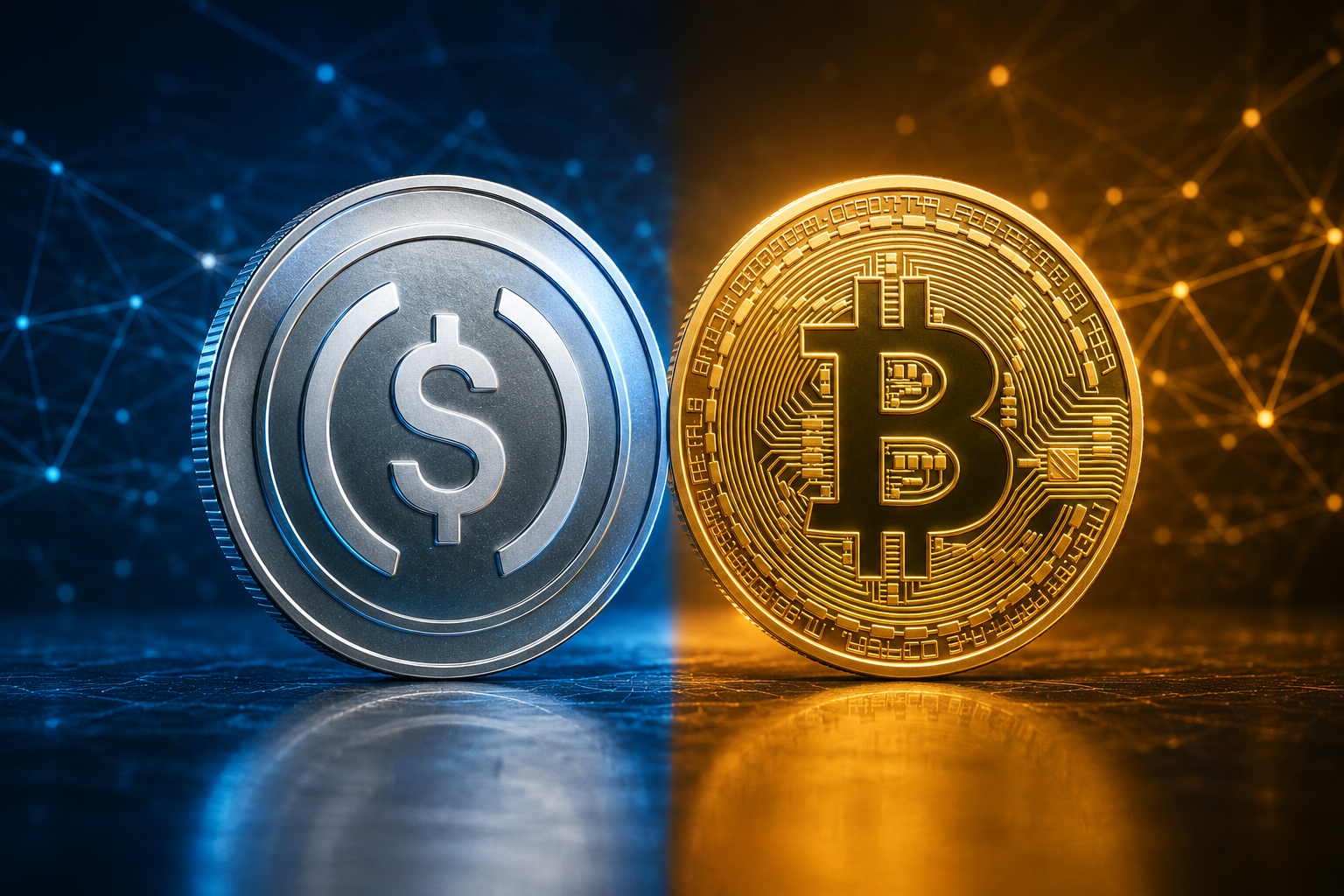
Comparing Bitcoin and stablecoins as competitors often misses the point. They are designed to solve different problems, and understanding that distinction explains a lot about how each is actually used.
Bitcoin: Digital Scarcity
Bitcoin is primarily a long-term store of value. People hold it as a hedge against inflation, monetary expansion, and currency debasement, much like digital gold. Common uses include:
- Long-term wealth preservation
- A hedge against monetary expansion
- A decentralized reserve asset
- Speculative investment
Stablecoins: Digital Utility
Stablecoins are built for everyday financial activity rather than long-term holding. Common uses include:
- Payments and business settlements
- Savings and cash management
- Remittances and cross-border commerce
- Trading and liquidity
In practice, many users rely on both. They hold Bitcoin to preserve wealth over time while using stablecoins for day-to-day transactions. Rather than one replacing the other, they tend to occupy different roles in the same financial toolkit.
Final Thoughts
Bitcoin and stablecoins are both products of the same blockchain revolution, but they serve different needs. Bitcoin opened the door to decentralized finance. Stablecoins are what most people are actually using to walk through it. For billions navigating currency instability, limited banking, and costly transfers, stablecoins offer something Bitcoin cannot: reliability as an everyday financial tool, not just an investment. As adoption grows, the story of crypto may be less about Bitcoin’s price and more about how many people quietly use a digital dollar to pay a bill, send money home, or protect their savings from inflation.
You Might Also Like: