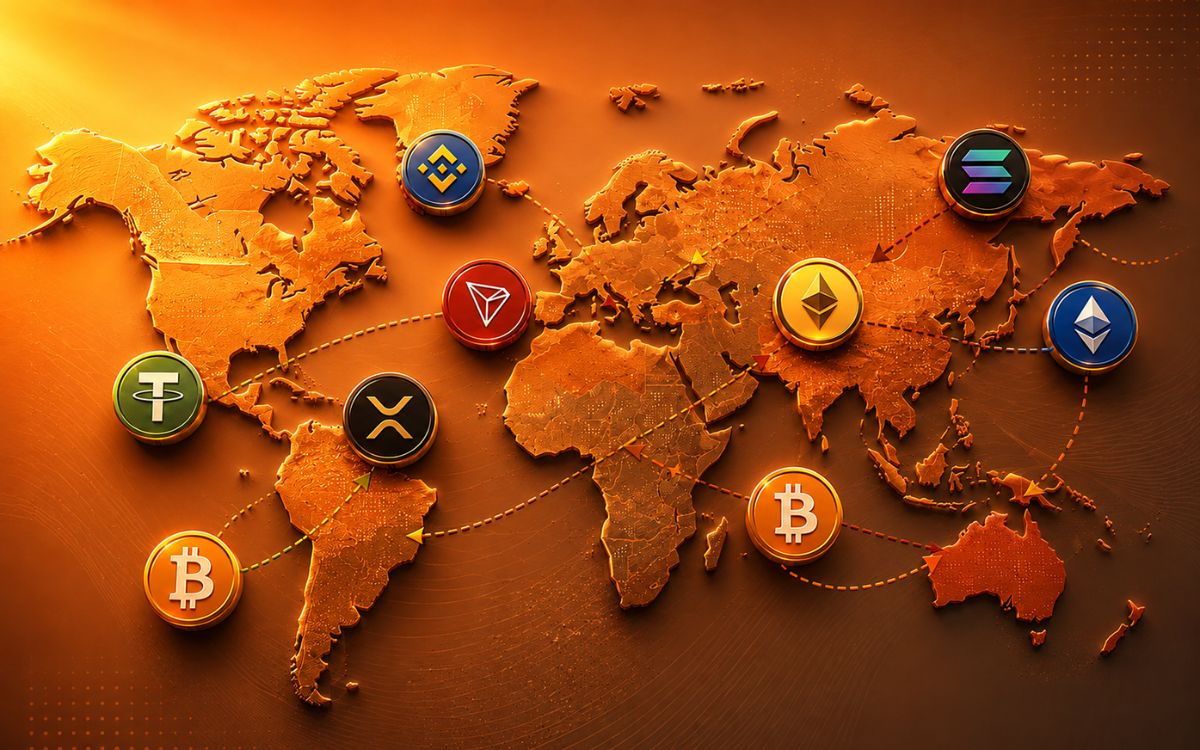
A $50 transfer of USDT can cost less than a cent on one network and more than five dollars on another, and the amount sent has nothing to do with it. It comes down to which blockchain carries the transaction, which platform you send it from, and how many times your money gets converted along the way.
Picking the wrong combination of network, wallet, and timing is the biggest reason crypto transfers cost more than they should.
This guide walks through the cheapest ways to send crypto internationally right now, what drives the fee on each option, and where the real costs tend to hide. You’ll also find the mistakes that quietly inflate transfer costs and the safety checks worth running before you hit send.
What Drives the Cost of a Crypto Transfer
Three things determine what you pay: the blockchain network fee, any charge your wallet or exchange adds on top, and the cost of converting between currencies or assets. Network fees, sometimes called gas, go to the validators who process and confirm your transaction.
Ethereum’s fee can swing from under a dollar to well over ten dollars depending on network activity, while newer, high-throughput chains keep costs low and predictable even under heavy use.
Exchange fees are separate from network fees and easy to miss. Some platforms charge a flat withdrawal fee regardless of which blockchain you use, so a transfer that’s nearly free on-chain can still cost several dollars once the platform’s own charge is added.
Conversion fees show up when you swap one asset for another, such as moving bitcoin into a dollar-pegged stablecoin before sending, and can include both a trading fee and slippage on larger amounts.
The 7 Cheapest Ways to Send Crypto Internationally
These seven approaches can be combined, and most senders end up stacking two or three, such as choosing a low-fee network and comparing exchange withdrawal fees before picking where to send from.
1. Pick a Low-Fee Network Instead of Defaulting to Ethereum
Sending the same asset over a different blockchain can be the biggest lever on cost. Standard Chartered’s head of crypto research, Geoffrey Kendrick, told CoinDesk in a Feb. 3, 2026 note that Solana’s fees now run at “often less than a cent,” a key reason he expects Solana to play a bigger role in stablecoin payments.
TRON took the same approach from the other direction: its Super Representative community approved a 60% cut to base transaction fees in August 2025, pushing total daily fee spend from $1.9 million to $1.2 million by the end of September, per CoinDesk Research’s Q3 2025 report on the network.
Tip: If your funds sit on Ethereum, bridge to a lower-fee network such as Solana, Polygon, or BNB Smart Chain before sending, rather than paying Ethereum’s mainnet fee for the transfer itself.
2. Send a Stablecoin Rather Than a Volatile Asset
Stablecoins such as USDT and USDC remove one entire layer of risk: price movement between sending and cash-out. CoinDesk Research’s Q1 2026 report on TRON found that the network’s USDT market cap passed $85 billion during the quarter, pushing TRON’s share of the global USDT market above 46%, largely because its resource model keeps everyday transfers cheap and predictable for retail users.
Sending a stablecoin also means the recipient isn’t exposed to a price drop while the transaction confirms.
3. Compare Withdrawal Fees Before Choosing a Platform, Not After
The exchange you send from matters as much as the network you choose. Platforms including Binance and KuCoin waive withdrawal fees on select assets, or offer free internal transfers between accounts on the same platform. Checking a platform’s withdrawal fee schedule before funding an account, rather than after, avoids paying twice: once to get funds on, and again to move them off.
Availability varies sharply by region, so confirm access before assuming either platform works for you. Binance suspended services for EU and EEA customers on July 1, 2026 after missing the bloc’s MiCA licensing deadline, and it does not appear on ESMA’s authorized list as of mid-August 2026.
US residents can’t use Binance’s global platform at all. Binance.US is a separate, more limited product for that market. Our guide to the best cryptocurrency exchanges available to US users breaks down which platforms are licensed for Americans.
KuCoin has been permanently barred from serving US customers since a March 2026 CFTC consent order, and also restricts users in Dubai, Singapore, China, Canada, France, the Netherlands, and Ukraine. Neither exclusion is temporary or under appeal, so a reader in one of these regions needs a different platform entirely, not a workaround.
4. Use Peer-to-Peer Transfers for Off-Chain Speed and Savings
P2P platforms settle a transfer through an internal ledger instead of broadcasting it to the public blockchain, usually meaning a smaller fee and faster settlement.
The tradeoff is counterparty risk, so this route only works well with escrow protection or a platform with an established reputation. Sending directly to an unknown counterparty without safeguards removes the fee savings if the transfer never completes.
5. Time Transfers Around Network Congestion
Network fees rise and fall with demand, and sending during a quiet window, typically nights or weekends, can meaningfully cut costs on fee-market chains like Ethereum. A mempool tracker or blockchain explorer shows real-time congestion before you confirm a transaction, which matters most on networks where fees spike rather than stay flat.
6. Batch Multiple Payments Into One Transaction
For businesses sending to several recipients at once, a batch payment tool bundles multiple transfers into a single transaction instead of paying the network fee for each one separately.
Most major wallets and exchanges support this for bulk payroll, affiliate payouts, or recurring remittances, cutting down on the transaction-hash tracking that piles up without one. Our Resources hub lists portfolio trackers built for exactly that kind of volume.
7. Account for the Full Journey, Not Just the Network Fee
The cheapest blockchain fee doesn’t guarantee the cheapest transfer once fiat currency gets involved. A Bank of Italy mystery-shopping study covered by CoinDesk on Aug. 1, 2026 sent real USDC transfers across 10 corridors linking Italy with Argentina, Brazil, South Africa, the UAE, and Japan, and found total costs, from funding an exchange account to cashing out locally, ranged from 0.3% to nearly 9% of the amount sent.
The on-chain leg was consistently the cheapest part of the journey. The expensive parts were converting fiat into crypto, converting back into local currency, and the exchange rate spread at each end. If your recipient needs local cash rather than crypto to hold, the network fee is only one piece of what you’ll pay.
Common Mistakes That Increase Crypto Transfer Costs
Most of the money lost to a crypto transfer disappears through habit rather than any single bad decision. The mistakes below show up across almost every corridor and platform combination.
Defaulting to Ethereum Out of Habit
Many senders stick with the network they know instead of checking whether a cheaper chain supports the same asset. A quick check of which networks the recipient’s wallet accepts often reveals a far cheaper route than the one used last time.
Ignoring the Receiving Side’s Supported Network
Sending USDT-ERC20 to a wallet that only accepts TRC-20 can strand funds entirely, not just cost extra. Confirming network compatibility with the recipient before sending costs nothing and prevents an unrecoverable mistake.
Converting at the Wrong Moment
Swapping assets when exchange rates are unfavorable, or right before a volatile market move, can cost more than any network fee. Timing a conversion around a stablecoin’s stable value, rather than a volatile asset’s price swing, removes this risk entirely.
Skipping the Withdrawal Fee Schedule
A platform with a near-zero network fee can still charge several dollars in flat withdrawal fees on top. Checking the fee schedule before funding an account avoids a surprise charge once the transfer is already underway.
Buying Crypto With a Credit Card to Fund the Transfer
Card issuers frequently treat crypto purchases as cash advances, adding fees that dwarf whatever you save on the transfer itself. A bank transfer or debit purchase avoids that surcharge entirely.
Assuming the Blockchain Fee Is the Whole Cost
As the Bank of Italy’s research shows, the on-chain leg is rarely where the real expense sits once fiat conversion enters the picture. Tracking the full cost from funding to cash-out, not just the network fee, gives a more accurate picture before you commit to a route.
Staying Safe While Keeping Costs Down
Cutting fees should never come at the cost of losing the funds outright, since crypto transactions can’t be reversed once confirmed. The checks below take a few extra minutes and prevent the kind of mistake no fee comparison can undo.
Verify the Recipient Address Character by Character
Typing a wallet address by hand invites transcription errors that send funds to an address nobody controls and nobody can recover. Scanning a QR code instead of typing the address removes most of that risk.
Confirm the Network Matches on Both Ends
Sending on the wrong chain, such as ERC-20 to a wallet that only accepts TRC-20, can strand funds permanently rather than simply delaying them. Confirm which network the receiving wallet supports before broadcasting the transaction, not after.
Run a Small Test Transaction First
For any transfer above a few hundred dollars, sending a small amount first confirms the address and network are correct before the full balance is on the line. The extra network fee for a test transfer is minor compared to what a mistake on the full amount would cost.
Avoid Public Wi-Fi When Sending Funds
Accessing a wallet or exchange account over public Wi-Fi exposes login credentials and session data to anyone else on the same network. A mobile data connection or a trusted private network closes that gap.
Frequently Asked Questions
Sending crypto across borders raises a few questions almost every first-time sender asks. Here are straight answers to the most common ones.
What is the cheapest network for sending crypto internationally?
There’s no single answer for every asset and corridor, but high-throughput chains such as Solana and TRON consistently post lower fees than Ethereum’s mainnet. Standard Chartered’s Geoffrey Kendrick noted in a Feb. 3, 2026 CoinDesk report that Solana fees often run under a cent, while TRON’s fee structure was cut 60% in August 2025 per CoinDesk Research.
Is sending a stablecoin cheaper than sending Bitcoin or Ethereum?
It’s usually cheaper in effect, if not always in raw network fee, because the recipient avoids price swings while the transaction confirms and doesn’t need to immediately convert to protect the value received.
Do exchanges add fees on top of network fees?
Yes. Withdrawal fees, spreads, and conversion charges are separate from the blockchain’s network fee and vary by platform, so the cheapest network doesn’t automatically mean the cheapest total transfer.
Are crypto transfers always cheaper than services like Wise or Western Union?
Not necessarily. A Bank of Italy study reported by CoinDesk on Aug. 1, 2026 found stablecoin remittances beat traditional providers on some corridors and cost more on others, with total costs ranging from 0.3% to nearly 9% depending on the route and conversion method.
What’s the safest way to send crypto across borders without losing money to fees or mistakes?
Confirm the network on both ends, send a small test transaction for larger amounts, and compare the receiving platform’s withdrawal fees before choosing where to send from, not after funds land.
Before your next transfer, pull up the fee schedule for both the sending and receiving platform, not just the network fee calculator, since the Bank of Italy’s research shows the on-and-off ramps are usually where the real cost sits.