Bitcoin’s 30-day mean hash rate has fallen 19% since November 2025, dropping from 1,108 EH/s to 898 EH/s over nine months, the longest sustained decline in the network’s history, according to Glassnode data, as major mining companies redirect power and capital toward long-term AI hosting contracts.
A Decline Unlike the Last Two Downturns
Bitcoin has only seen two comparable hash rate drawdowns before this one, and both resolved quickly.
| Period | Hash rate move | Depth | Duration | Driver |
| May – July 2021 | 165 to 95 EH/s | -42% | ~10 weeks | China mining ban |
| April – July 2024 | 626 to 578 EH/s | -8% | ~3 months | Post-halving purge |
| November 2025 – August 2026 | 1,108 to 898 EH/s | -19% | ~9 months, ongoing | Margin squeeze and AI pivot |
The May-to-July 2021 collapse, triggered by China’s mining ban, cut the hash rate by 42%, from 165 to 95 EH/s over about 10 weeks, but reversed within 6 months as relocated Chinese hardware came back online in the US and Central Asia.
The April-to-July 2024 dip, a routine purge of inefficient rigs after that year’s halving, cut the hash rate by 8%, from 626 to 578 EH/s over roughly three months, with new, more efficient machines replacing the lost capacity within a single quarter.
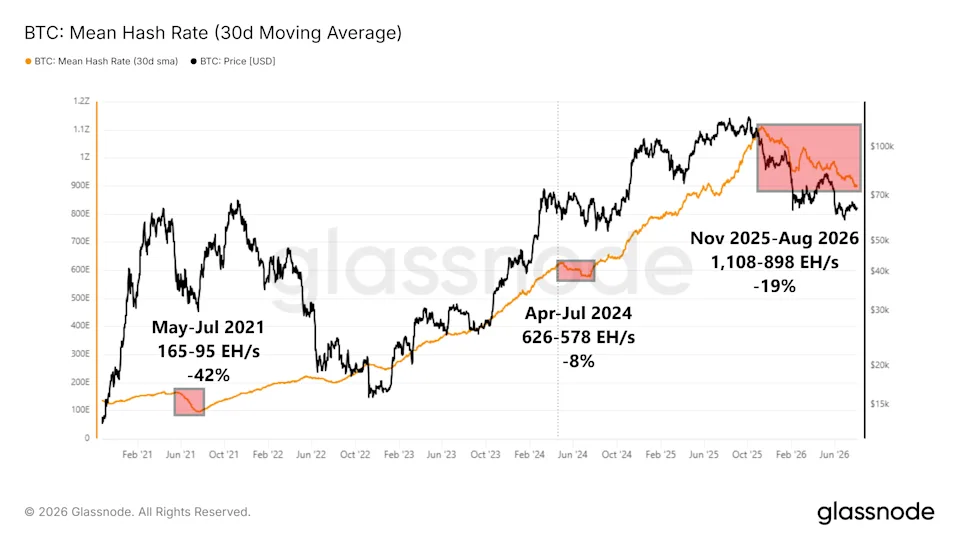
The current decline breaks that pattern on two fronts. In absolute terms, the network has shed roughly 210 EH/s, more hashpower than the entire network possessed in early 2021, and as of early August, the 30-day average still shows no sign of bottoming out.
The mechanism driving it looks structural rather than cyclical. Miners are signing 12- to 20-year AI hosting leases on the same power capacity that used to run Bitcoin-specific hardware.
Mining Difficulty Just Turned Negative for Only the Second Time
Network difficulty now sits 1.1% below where it stood a year ago, marking the first negative year-over-year reading since August 2021, when China’s ban pushed the same metric to -21.2 %.
Bitcoin’s difficulty has recorded a negative annual reading only twice in its entire history, and both times mark a genuine mass departure of mining capacity rather than routine turnover.
Difficulty has contracted 19.9% from its November 2025 peak near 156 trillion down to 126.23 trillion, among the deepest sustained contractions of the ASIC mining era.
BitcoinArchive estimated Bitcoin’s current production cost near $54,939 per coin, based on an assumed electricity cost of $0.06 per kilowatt-hour, and noted that Bitcoin has spent only 10 days trading below its estimated production cost since 2017.
That figure is a third-party estimate contingent on the stated electricity assumption, not a confirmed cost figure, though each successive negative difficulty adjustment does mechanically lower production costs for the miners who remain active.
The AI Contracts Explain Why This Capacity Isn’t Coming Back
Bitcoin traded near $65,000 at the time of this writing, up modestly over the prior 24 hours but still roughly 49% below its October 2025 peak. The hash price is sitting near $30 to $32 per petahash per day, below breakeven for older mining fleets, with industry estimates suggesting 15% to 20% of active machines are currently running at a loss. Public mining companies sold more than 32,000 BTC in the first quarter alone to help fund their transition into AI infrastructure.
That transition is well underway. Hut 8 reports $26.6 billion in contracted AI portfolio value. Core Scientific leases roughly 1.1 gigawatts of capacity to CoreWeave. TeraWulf signed a 20-year hosting lease with Anthropic worth approximately $19 billion. IREN and Cipher Mining have separately signed deals with Microsoft and AWS worth $9.7 billion and $5.5 billion, respectively.
Combined, public mining firms now hold more than $70 billion in AI-related contracts. The reason this capacity is unlikely to return to Bitcoin mining comes down to simple economics, as AI hosting reportedly pays 3 to 25 times as much per megawatt as Bitcoin mining does. Our ranking of top Bitcoin mining companies by hashrate breaks down where several of these same companies stand in the broader industry.
The squeeze has already produced casualties beyond capacity shifts. Poolin, once the world’s largest mining pool, filed for Chapter 11 bankruptcy protection in late July, joining other mining-adjacent Chapter 11 filings that month.
Not Everyone Agrees on What This Means
Opinions on how much this matters for Bitcoin itself are split among those closely watching the space.
Coinbase CEO Brian Armstrong has dismissed concerns that the shift toward AI hosting will meaningfully hurt Bitcoin’s price.
Chamath Palihapitiya takes a more cautious view, describing the shift as structural for miners rather than a temporary rotation.
Bitwise Europe’s head of research, André Dragosch, has offered a middle position, suggesting miners could come to regret converting capacity away from Bitcoin if mining profitability eventually recovers.
What Comes Next
The clearest signal to watch from here is whether the difficulty chart’s year-over-year reading stays negative through autumn. If it does, the network will confirm its first sustained contraction in its security budget in Bitcoin’s history.
What this means for you: either fresh mining capacity replaces the departing AI-focused miners by 2027, or Bitcoin heads into its next rally with a meaningfully thinner hashpower cushion than it’s had before, a dynamic worth tracking alongside price regardless of which side of this debate you find more convincing.
Disclosure: The writer holds Bitcoin.