This article contains affiliate links. If you sign up or buy through them, UseTheBitcoin may earn a commission at no extra cost to you. It does not change what we write. Disclosure Policy
Key Takeaways:
- Bitcoin Miners in 2026: Marathon Digital Holdings, CleanSpark, Riot Platforms, and Core Scientific lead the US public mining sector by hashrate in 2026.
- The April 2024 halving cut block rewards to 3.125 BTC, forcing miners to operate more efficiently or find supplemental revenue.
- Next-generation ASIC hardware from Bitmain and MicroBT has reshaped which miners can compete profitably at scale.
Disclaimer: This content is for educational purposes only and does not constitute financial advice. Cryptocurrency investments carry significant risk. Always conduct your own research before making any investment decisions.
Bitcoin mining in 2026 is a different business than it was even two years ago. The April 2024 halving cut block rewards in half, energy costs remain the primary variable in every miner’s profitability calculation, and the race to deploy the most efficient hardware has intensified. Public mining companies now compete not just on hashrate but on cost per coin produced, energy sourcing strategy, and increasingly, revenue diversification into AI compute.
Here’s a look at the top Bitcoin mining companies by hashrate in 2026 and what separates the leaders from the rest of the field.
Who Are the Top Bitcoin Miners by Hashrate in 2026?
As of April 2026, the top Bitcoin miners by hashrate are Marathon Digital Holdings (MARA), the largest among US public miners, followed by CleanSpark, Riot Platforms and Core Scientific. Public miners report their operational hashrate to investors, and while rankings shift as companies expand or upgrade, the top tier stayed stable through 2025 and early 2026.
Here’s how the leading public miners compare:
- Marathon Digital Holdings (MARA): Marathon consistently holds the largest hashrate among US public miners. The company has aggressively expanded its owned and hosted capacity through direct infrastructure buildouts and acquisitions. Marathon also holds significant Bitcoin on its balance sheet as a reserve asset.
- CleanSpark (CLSK): CleanSpark has grown rapidly through self-mining expansion in the US, focusing on low-cost power deals in states including Georgia and Wyoming. The company emphasizes sustainable energy sourcing as part of its operational strategy.
- Riot Platforms (RIOT): Riot operates one of the largest single-site Bitcoin mining facilities in the world at its Rockdale, Texas location. The company benefits from power curtailment agreements with the Texas grid, earning revenue by reducing consumption during peak demand periods.
- Core Scientific (CORZ): Core Scientific exited bankruptcy in early 2024 and has since rebuilt its operational scale. The company operates both self-mining and hosting services for third-party miners, and it has moved aggressively into AI compute hosting as a revenue supplement.
- Bitdeer Technologies (BTDR): Bitdeer operates mining facilities across multiple countries and has invested heavily in developing its own ASIC hardware. Its international diversification reduces regulatory and energy risk compared to single-country operators.
What Separates the Best Bitcoin Miners From the Rest?
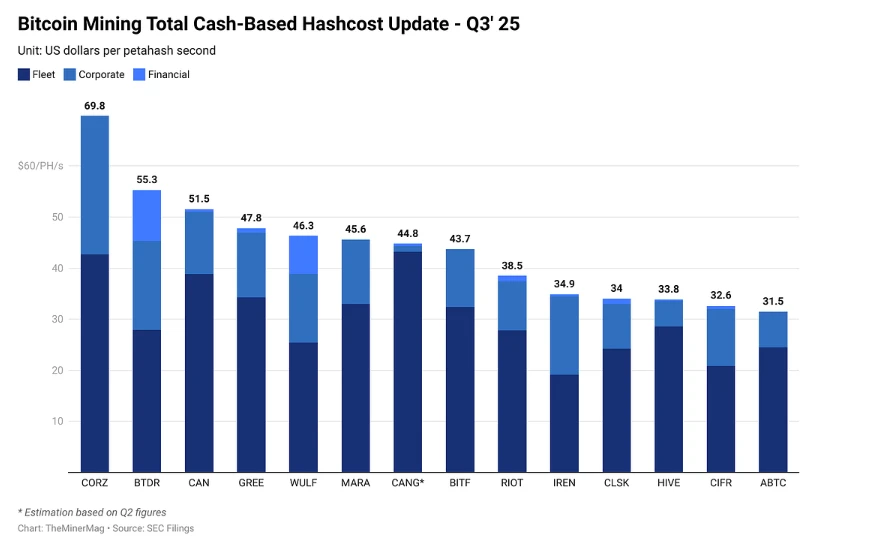
The best Bitcoin miners combine cheap power, efficient hardware and extra revenue: they secure electricity below $0.04 per kilowatt-hour through long-term power purchase agreements, run current-generation ASICs from Bitmain and MicroBT, and earn from AI compute hosting or grid curtailment. Hashrate alone doesn’t decide who succeeds after the 2024 halving.
How Does Energy Cost Affect Profitability?
Electricity is the dominant cost in Bitcoin mining. A miner running equipment at $0.04 per kilowatt-hour operates profitably at a much wider range of Bitcoin prices than one paying $0.08 per kilowatt-hour. The best miners have secured long-term power purchase agreements at rates below $0.04, often with renewable energy providers.
Texas has become a major hub for US mining partly because of its deregulated energy market, which allows miners to negotiate directly with generators. The state’s power curtailment programs also allow miners to earn supplemental income by voluntarily reducing consumption during grid stress events.
How Has Hardware Efficiency Changed the Economics?
The latest ASIC models from Bitmain and MicroBT deliver significantly more terahashes per watt than machines from two or three generations ago. Miners running current-generation hardware produce more Bitcoin at the same electricity cost as older machines.
This creates pressure on operators running older equipment. As hashrate grows network-wide and difficulty increases, older machines become progressively less profitable. The 2024 halving accelerated that dynamic by cutting revenue per block in half while difficulty continued rising.
What Is AI Compute Hosting and Why Are Miners Doing It?
AI compute hosting means renting mining data center capacity, with its reliable power and cooling, to technology firms that run AI workloads. Miners such as Core Scientific do it because AI hosting can earn more stable revenue per megawatt than Bitcoin mining when BTC prices are low or difficulty is high, and they can switch capacity between the two.
How Do You Follow Bitcoin Mining Developments?
Staying current on mining news requires tracking hashrate data, difficulty adjustments, company earnings reports, and hardware releases. Live hashrate and difficulty data is available through crypto analytics and on-chain data platforms, which aggregate network-level statistics in real time.
For investors who want Bitcoin exposure without dealing with mining economics, buying BTC on platforms like Coinbase, Kraken, and Binance is the most straightforward path. For long-term storage, Ledger and Trezor remain the standard for hardware wallet security. Check out this guide on how to choose the best Bitcoin wallet for a full breakdown of your storage options.
Frequently Asked Questions
Who Is the Largest Bitcoin Miner in 2026?
Marathon Digital Holdings consistently ranks as the largest US public Bitcoin miner by hashrate in 2026, followed closely by CleanSpark, Riot Platforms, and Core Scientific.
How Do Bitcoin Miners Make Money After the Halving?
Miners earn revenue from block rewards, currently 3.125 BTC per block, plus transaction fees from each block they mine. Some companies supplement mining revenue with AI compute hosting, power curtailment income, and Bitcoin treasury strategies.
What Hardware Do the Top Bitcoin Miners Use?
Leading miners deploy Bitmain Antminer S21 series and MicroBT Whatsminer M60 series machines, which represent the current generation of high-efficiency ASICs. These units deliver more hashrate per watt than previous-generation equipment.
Is Bitcoin Mining Still Profitable in 2026?
Profitability depends on electricity cost, hardware efficiency, and BTC price. Miners with access to sub-$0.04 per kilowatt-hour power and current-generation hardware remain profitable across a wide range of Bitcoin price levels. Operators with older equipment and higher energy costs face tighter margins.
More on Bitcoin: Bitcoin hub · Bitcoin price today · Bitcoin price prediction · How to buy Bitcoin safely