Robinhood Chain, the layer-2 blockchain Robinhood launched on July 1, 2026, has surpassed Coinbase’s Base and even Ethereum itself in daily transaction fees within its first two months, driven by rapid growth in tokenized real-world assets (RWA) and a breakout token launchpad called Pons.
Why Robinhood Is Pushing Into This So Hard
Robinhood’s crypto business has been under pressure as the company reported $100 million in crypto transaction revenue for the second quarter of 2026, down 38% year over year, and CEO Vlad Tenev has responded by leaning heavily into tokenization and Robinhood Chain, aiming to replicate what Coinbase built with Base over several years.
The company is trying to migrate its roughly 28 million funded accounts toward on-chain services, and rapid early growth in fee generation is the clearest signal so far that the strategy is gaining traction.
How Much Robinhood Chain Collected at August Month-End
Robinhood Chain collected $1.07 million in chain fees against Base’s roughly $93,215, more than eleven times as much, while processing nearly 12.7 million transactions on August 30 compared to Base’s 8.17 million.
Over a longer 30-day window, Robinhood Chain generated $3.13 million in chain revenue, ranking third among all tracked blockchains behind Canton at $49 million and Tron at $26 million, ahead of Base at $2.89 million and Ethereum at $2.47 million.
However, in terms of app revenue, Ethereum still leads at $45.84 million versus Robinhood Chain’s $21.05 million.
Since its mainnet launch, Robinhood Chain has already processed more than 453 million total transactions.
The Rest of the Chain’s Growth Looks Broad, Not Narrow
Total value locked on Robinhood Chain reached $729.97 million, with $2.386 billion bridged into the network overall and a stablecoin supply of $796.7 million that grew 7.8% over the week, according to DeFiLlama data.
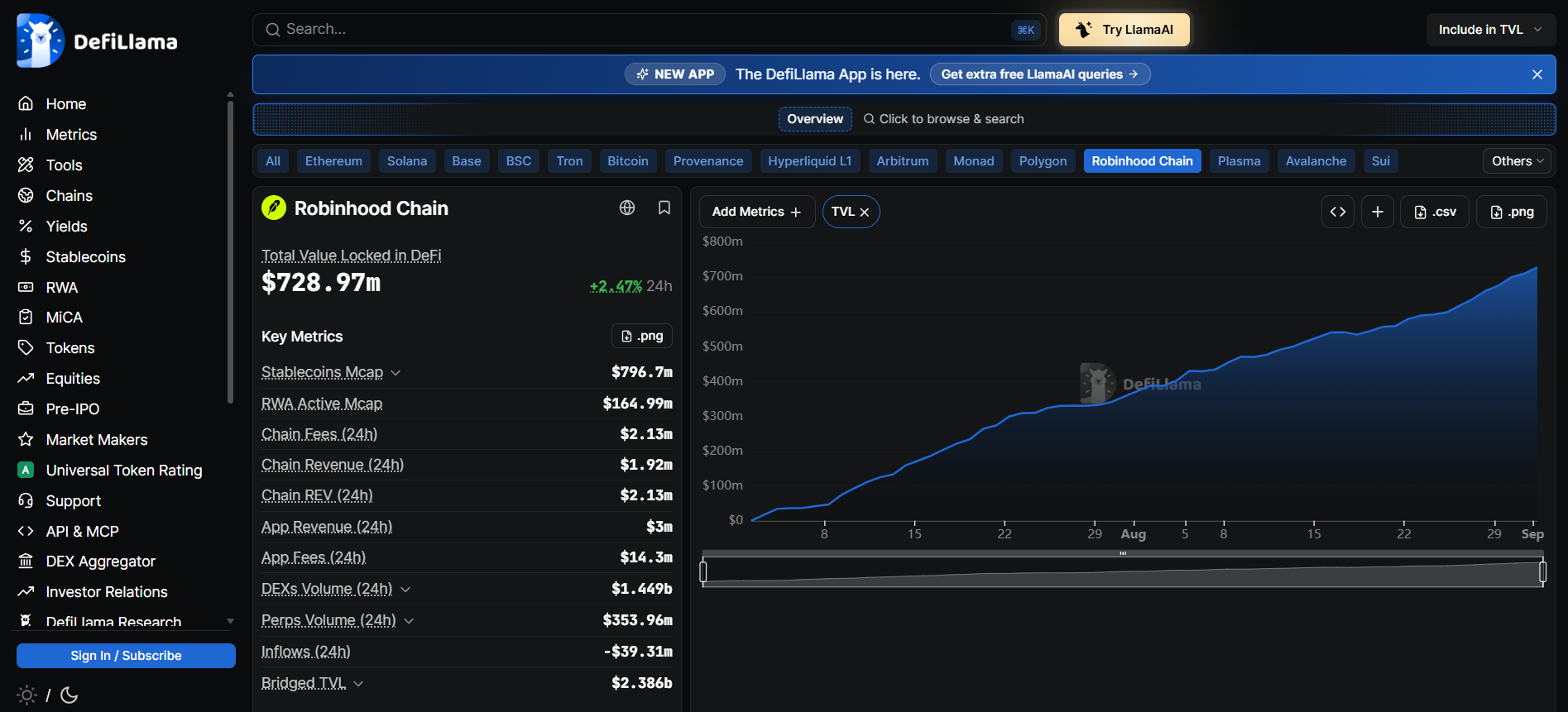
DEX volume ran to $1.449 billion over 24 hours, with an additional $353.96 million in perpetual futures volume.
Onchain real-world asset volume has also set records for four consecutive days, with each session clearing roughly $115 million against a prior July peak near $60 million, pushing RWA market cap on the chain to $149.22 million.
Pons Has Been the Standout Individual Driver
Much of the recent excitement traces back to Pons, a token launchpad built on Robinhood Chain.
Pons generated roughly $208.82 million in 30-day DEX volume and booked a record $690,000 in revenue on a single Saturday.
Its native token has moved sharply alongside that growth, trading at $0.3591 after gaining 46% in a single day and 499% over the week, up from $0.1333 just days earlier, with a market capitalization of $254.89 million on $79.58 million in trading volume.
Around 80% of Pons’s revenue goes toward buying back and burning its token, which explains why the token’s price and the protocol’s revenue have moved together.
What Comes Next
Whether this pace holds depends largely on whether Robinhood can sustain elevated transaction volume and fee generation while continuing to migrate more of its existing user base toward on-chain services.
If current trends continue, Tenev’s stated ambition for 24/7 tokenized trading could position Robinhood Chain as a leading settlement layer for RWAs, though the day-to-day volatility already visible in these fee figures suggests the current numbers should be read as an early, fast-moving snapshot.
What this means for you: Robinhood Chain’s growth over its first two months has been real and broad-based across multiple metrics, not confined to one narrow number, but a young chain’s daily figures can swing sharply, as the differing snapshots here already show, so any single day’s fee comparison is best treated as a data point in an ongoing trend rather than a final verdict on which network is winning.