Basic Attention Token (BAT) is the token behind the Brave browser’s rewards system, which pays users who opt in to privacy-respecting ads and lets them send contributions to creators. BAT was sold in 2017, and as of October 2026 it is still used in Brave.
Brave was co-founded in 2015 by Brendan Eich, the creator of JavaScript and a co-founder of Mozilla, and Brian Bondy. Brave’s About page lists Eich as founder and CEO and Bondy as founder and CTO. The BAT token sale took place in 2017.

What is Basic Attention Token?
To put it as simple as possible, Basic Attention Token is the native token that powers the Brave ecosystem. BAT launched as an ERC-20 token on the Ethereum blockchain and is also available as bridged tokens on other networks, including Solana and Polygon, according to CoinGecko’s contract listing. Brave Rewards can pay BAT out to a Solana address. The tokens can be used freely on the Brave ecosystem meaning that they can be exchanged between advertisers, publishers, and typical Internet users.
The main goal of the San Francisco-based Basic Attention Token (BAT) project is to provide its users with a powerful digital advertising exchange based on blockchain technologies. It was designed to address and improve the somewhat unfair digital advertising system where many Internet users are required to sacrifice time, privacy and attention in order to use it for free.
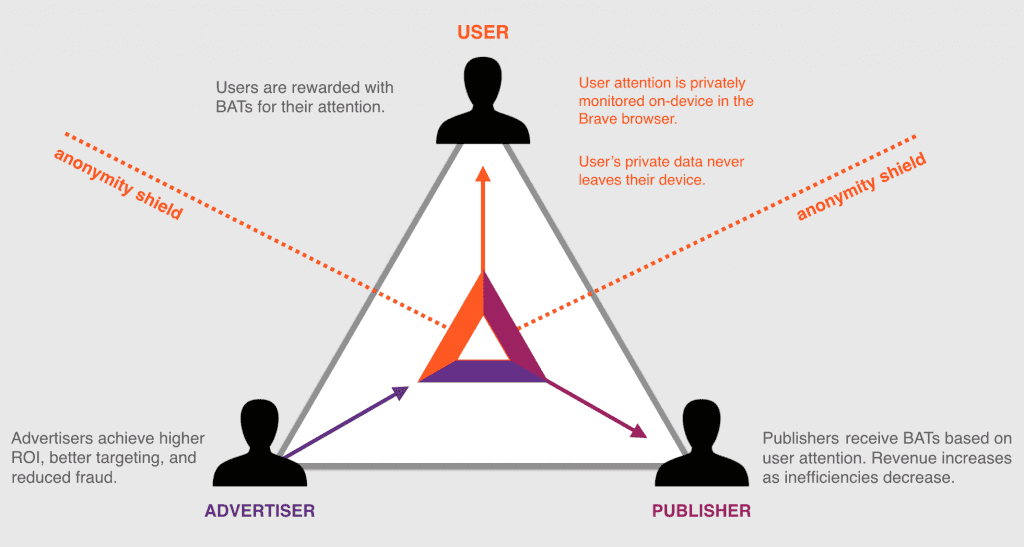
The project’s structure, how BAT works
If the name of Brave sounds familiar, it’s because the browser is widely used. Brave said it passed 100 million monthly active users on September 30, 2025, with more than 42 million daily active users, and its About page lists more than 120 million monthly and 51 million daily active users as of October 2026. Brave is a Chromium-based web browser that’s all about offering its users a grander online experience by blocking trackers and ads, thus improving both privacy and webpage loading speeds.
The Brave browser is an instrumental part of the Basic Attention Token project, but Brave works without BAT and Brave Rewards is opt-in. Users who turn it on see privacy-respecting Brave Ads, and those who connect a payout account earn BAT. They can also send BAT contributions to websites and creators registered with Brave Creators. Brave’s BAT Roadmap 4.0 post of July 9, 2026 says tens of millions of people use Brave Rewards and that more than 2 million verified websites and creators are registered.

BAT’s advertising model competes with large ad platforms such as Google, Meta and YouTube. The model is meant to cut out middlemen: advertisers pay for Brave Ads, and users who view the ads receive a share of the revenue in BAT. Brave launched self-serve ads in April 2023, and as of March 2026 advertisers can pay with BAT on Ethereum or Solana, SOL, USDT, USDC or a card, with a minimum of $500 a month.
According to the Basic Attention Token whitepaper, Brave was to measure the attention of users, based on the time spent on specific content, and send that score to a ledger that paid publishers and users. Brave now says its ads are private and never profile the user.
Earnings are paid out through a payout account. It can be with a custodial partner (Brave named Gemini, Uphold and bitFlyer, in Japan only, in January 2023) or, in eligible countries, a self-custody Solana address (announced August 14, 2025).
Market performance
The BAT token has been launched via a typical ICO. What’s most impressive about this particular ICO is the fact that the company managed to raise $35 million in just under 30 seconds. The sale took place in 2017, according to Brave’s timeline. As of October 29, 2026, BAT was trading about 93% below its CoinGecko all-time high of $1.90, set on November 27, 2021.
As of October 29, 2026, CoinGecko ranks BAT 170th by market capitalization, with about 1.496 billion BAT in circulation out of a maximum supply of 1.5 billion. Rankings change daily, so see BAT’s page on CoinMarketCap for the latest. BAT trades on many of the most popular cryptocurrency exchanges, and CoinGecko lists markets on Binance, Coinbase Exchange, Kraken, OKX, Bybit and Upbit. For the full list, refer to CoinMarketCap’s Markets section.

Storing BAT
Brave includes its own self-custody wallet, Brave Wallet, and other wallets hold BAT as well. BAT began as an ERC-20 token, so Ethereum-compatible wallets can store it, and some of the best wallets for storing BAT are Ledger hardware wallets, MyEtherWallet and Exodus, which lists BAT on Ethereum. For Brave Rewards payouts on Solana, desktop users can verify an address from Brave Wallet or a third-party Solana wallet such as Phantom, while Android supports Brave Wallet only and iOS is not supported, according to Brave (updated July 16, 2026). Payouts are not available in countries where Brave Rewards is unavailable.
Risks and outlook
BAT’s outlook depends on whether Brave’s rewards and payments products grow. Brave published BAT Roadmap 4.0 on July 9, 2026. It plans a unified Brave Wallet, a stablecoin payments layer called BravePay, a Brave Rewards Card, and a Creator Contribution Protocol that would pay creators when AI products use their content. Brave also says part of its net revenue from these sources will fund BAT buybacks, and that its Brave Ads notification unit will start a gradual sunset by the end of 2026. Brave presents these items as plans, and some are still in research. The original BAT Roadmap 1.0 remains online.
BAT faces competition from large ad platforms such as Google and Meta and from other blockchain advertising projects such as Papyrus and Adshares. BAT is volatile, and on October 29, 2026 it traded about 93% below its 2021 high. This guide is not investment advice, so research the project and the risks before buying any token.
Social media
For more information about the project, users are advised to visit the project’s official website. Other useful resources include the blog section, the project’s Medium section, its Reddit, as well as its X and Telegram channels.
Conclusion
According to the project’s whitepaper, besides all the involved costs in data charges for loading ads, the device’s performances can be affected as well. It’s believed that advertisements can decrease the battery life of your phone or laptop by as much as 21%. However, the most valuable resource users lose because of ads is their free time.
BAT and Brave are both active in October 2026. Brave has grown to more than 120 million monthly users, and BAT’s role is moving toward wallet, payments and creator features. Many items in Brave’s BAT Roadmap 4.0 are still plans, and BAT’s market value is far below its 2021 high.