Bitcoin and precious metals like gold and silver have rallied together in late August as global bond yields surged to multi-decade highs, reviving what traders call the debasement trade, a rotation into scarce assets that dominated markets for much of 2025 before a hawkish Federal Reserve pivot unwound it earlier this year.
What the Debasement Trade Means
The term nods back to Henry VIII, who mixed cheaper metals into gold and silver coins so he could stretch the crown’s money further.
The modern version works the same way in spirit. When investors worry that a government is spending more than it takes in, and printing or borrowing to cover the gap, they start looking for places to put their money that a government cannot simply create more of.
Some assets a government can create at will, like a currency itself or the debt backing it, so their value depends entirely on policy choices.
Other assets have a supply nobody can just decide to increase. Gold and silver only grow through slow, expensive mining. Moreover, Bitcoin is capped at 21 million coins by its own code, with no exceptions.
When people get nervous about a currency losing value, they move toward assets that cannot be diluted, and that shift in demand pushes gold, silver, and Bitcoin higher together.
Why It Is Back Now
The renewed momentum traces to a broad bond sell-off. The 30-year US Treasury yield surged above 5.3% last month, its highest level since 2007, on persistent inflation concerns, growing government debt, and competition from a wave of corporate AI-related bond issuance crowding out demand for Treasuries.
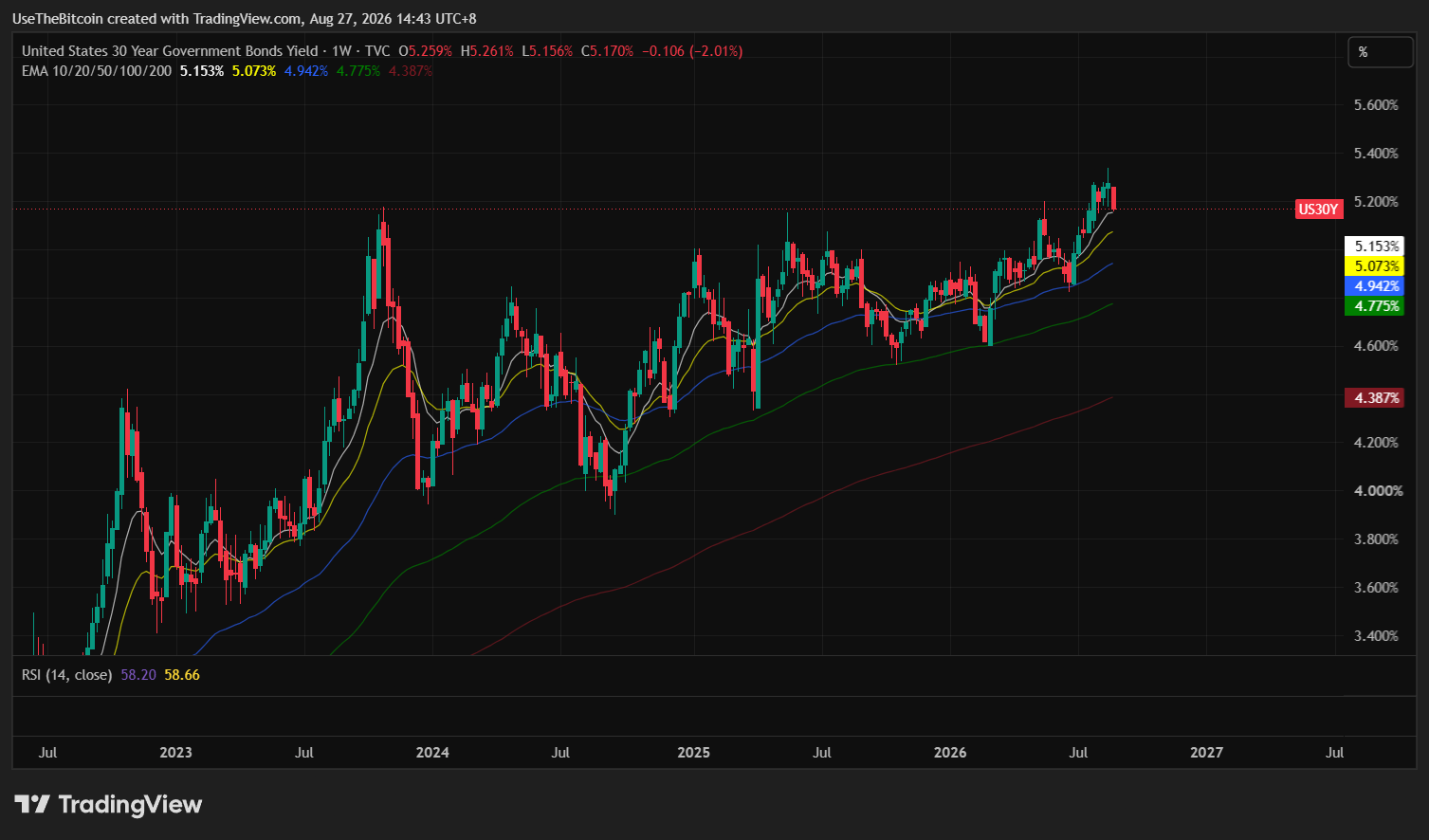
The move was not confined to the United States. Japan’s 30-year yield hit a record high, France’s 30-year touched a post-2008 peak, and the United Kingdom’s 30-year gilt reached its highest level since 1998.
The 30-year yield has since eased somewhat, sitting around 5.17% as of this week, down roughly 13 basis points from its recent high, though that relief did not come immediately.
US Treasury Secretary Scott Bessent first announced a plan to double the size of the department’s long-bond buyback operations to at least $4 billion per operation.
Officials then floated tapping the roughly $1 trillion Treasury General Account to buy long bonds outright, and that appeared to finally ease pressure on the market. Our earlier coverage of Arthur Hayes’s Bitcoin bull market thesis covers this same Treasury General Account dynamic in more depth.
The next buyback operation at the enlarged size takes place on September 9.
Bitcoin’s Rally Has Its Own Political Backdrop
Bitcoin surged to a three-month high, briefly trading above $80,000, though it remains roughly 38% below its October peak.
The rally coincided with regulatory developments. The Senate left for its August recess without voting on the CLARITY Act after Democrats withheld consent over unresolved ethics language, pushing a procedural cloture vote to September 15.
The more immediate driver was political signaling. President Trump hosted crypto executives at the White House on August 19 and urged Congress to pass what he called a fair version of the bill.
Gold and Bitcoin Are Moving More in Sync Than Usual
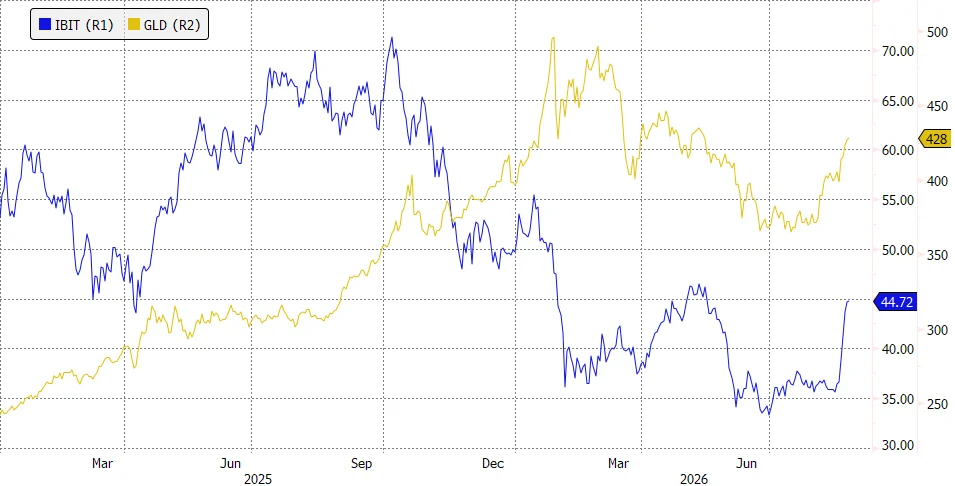
For context, Bitcoin’s correlation with the debasement narrative has been historically inconsistent. In January 2026, when the debasement trade moved into high gear, Bitcoin’s price fell even as gold and silver rallied.
However, the correlation between the two asset classes has jumped in recent weeks. The only period it ran higher was 2020, during waves of stimulus and ultra-low interest rates.
Over the longer term, the relationship looks nothing like this. Since 2010, the correlation between gold and Bitcoin has hovered near zero.
Last year offered a clear example of that usual divergence as both assets hit records in October 2025, but Bitcoin then collapsed while gold continued rallying. Gold went on to peak in January before tumbling as well. Only now have both assets rallied together off their recent lows.
Record ETF Flows Are Backing Up the Narrative
Bloomberg senior ETF analyst Eric Balchunas has tracked this shift closely through two separate observations.
Earlier this week, he noted that SPDR Gold Shares and BlackRock’s iShares Bitcoin Trust had returned to the top 10 most-traded US ETFs by volume, pushing out semiconductor funds that had dominated the rankings through the summer.
According to Bloomberg’s terminal data, GLD ranked third by value traded at $4.02 billion and IBIT seventh at $2.24 billion, behind Invesco QQQ Trust at $11.19 billion and SPDR S&P 500 ETF Trust at $10.75 billion.
Separately, and more recently, Balchunas cited a different figure entirely. Gold and Bitcoin ETFs combined for more than $7 billion in flows over the past week, which he called a record for a five-day period.
He also noted that IBIT’s year-to-date flows had turned positive after recovering from earlier outflows. Farside Investors data showed US spot Bitcoin ETFs alone brought in $314.3 million on August 25, extending a run of positive daily flows.
Balchunas has been careful to frame this as a rotation rather than an AI collapse. Capital has poured into semiconductor makers, hyperscalers, and data center infrastructure over the past year, with Big Tech data center spending expected to exceed $730 billion in 2026.
His point is that record gold and Bitcoin ETF flows suggest investors are increasingly allocating additional capital toward hard assets as debasement concerns return to focus, not that the AI trade has disappeared.
Wall Street Is Also Making It Easier to Move Bitcoin Into ETFs
Separate from the flow data, BlackRock has been actively lowering the barrier for large Bitcoin holders to convert directly into ETF shares.
The firm cut the minimum size for a Bitcoin-to-ETF swap to $1 million in July, down from $25 million when the process first became available.
Robbie Mitchnick, BlackRock’s Head of Digital Asset Management, told Bloomberg that IBIT has now facilitated more than $5 billion of these conversions, up from more than $3 billion when the trend was first reported last October. “It is going to keep growing because we keep expanding the access,” Mitchnick said.
“People see things happen in the outside world, whether it is kidnappings, ransom, custody failures, that motivate them to make this switch for all or some of their holdings.”
What Comes Next
Whether this rally holds depends on several threads converging at once, the September 9 buyback operation at its enlarged size, the September 15 CLARITY Act cloture vote, and whether gold and Bitcoin ETF flows continue at their current record pace or prove to be a short-term reaction to a specific news cycle.
Both assets remain well below their prior all-time highs, gold by roughly 14% and Bitcoin by roughly 38%, leaving real room for the current momentum to continue or fade.
What this means for you: the unusually tight correlation between gold and Bitcoin right now is a genuine departure from their typical relationship rather than a permanent shift, so treat the current alignment as a reflection of a specific macro moment, rising yields and debasement concerns, rather than a new, dependable pattern going forward.
More on Bitcoin: Bitcoin hub · Bitcoin price today · Bitcoin price prediction · How to buy Bitcoin safely