Key Takeaways:
- Extreme oversold on Bitcoin typically means RSI below 20, not the standard 30 used for stocks.
- Multiple indicators together give a stronger signal than any single tool alone.
- Oversold doesn’t always mean an immediate bounce, especially during a clear downtrend.
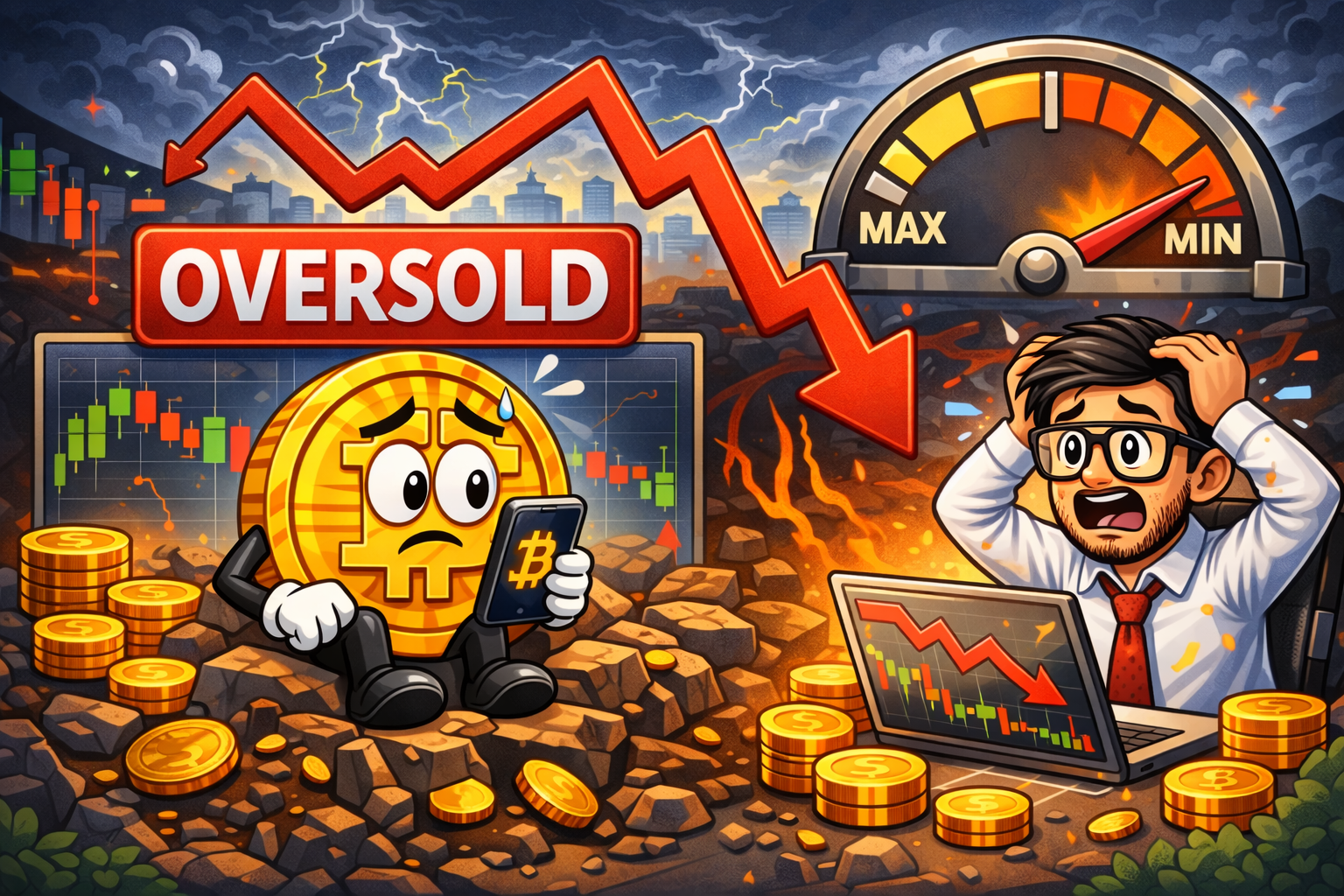
Bitcoin doesn’t move in straight lines. It swings hard, drops fast, and sometimes pushes indicators deep into oversold territory. These extreme readings often mark turning points in Bitcoin’s price history, and knowing how to read them gives traders a real edge in timing their moves.
What Does “Extreme Oversold” Actually Mean for Bitcoin?
An oversold condition happens when an asset drops sharply and quickly, pushing the price far below what historical averages consider normal. For Bitcoin, extreme oversold readings go well beyond the standard thresholds used in traditional markets, which makes them worth understanding on their own terms.
How Does RSI Measure Oversold Conditions?
The RSI is one of the most widely used tools for spotting oversold territory. For most assets, oversold starts below 30, but for Bitcoin, extreme oversold typically falls below 20 or even 15. These readings don’t appear often, and when they do, they tend to carry real weight.
RSI measures the speed and size of recent price changes over a set period. A reading below 20 means selling pressure has been both intense and sustained, which signals the market has basically been in full panic mode.
Why Are Bitcoin’s Oversold Zones Different from Stocks?
Bitcoin trades 24/7 with no circuit breakers in place. Stocks have built-in pauses during extreme moves, but Bitcoin has no such safety net. This means sell-offs can accelerate faster and go much deeper before any stabilization kicks in. Oversold readings in crypto reflect a higher degree of emotional selling than you’d typically see in equity markets, which is exactly why standard stock-market thresholds don’t translate directly to Bitcoin.
Which Indicators Flag Extreme Oversold Conditions?
Relying on just one indicator gives you a narrow view of what’s happening. Traders who track multiple tools at once get a much fuller picture of where the market actually stands. Here are the key indicators worth watching when Bitcoin looks extremely oversold:
- RSI below 20: Signals intense and sustained selling pressure over recent sessions.
- Stochastic RSI at or near zero: Confirms that momentum has completely stalled out.
- MACD histogram deeply negative: Shows bearish momentum is still running strong with no sign of slowing.
- Bollinger Bands break below the lower band: Suggests price deviation has gone to an extreme level.
- Fear and Greed Index below 10: Reflects full panic mode across overall market sentiment.
No single signal works as a buy trigger on its own. When several of these line up at the same time, though, the setup becomes far more meaningful. Confluence between indicators is what separates a real signal from just background noise.
What Happens After Bitcoin Hits Extreme Oversold?
History offers some useful reference points here. Bitcoin has entered extreme oversold territory several times across different market cycles, and while the aftermath isn’t always the same, patterns do tend to emerge over time.
What Do Historical Recovery Patterns Show?
In late 2018, Bitcoin’s RSI dropped to historic lows while the price bottomed near $3,100. Within 12 months, it had surged past $13,000. In March 2020, Bitcoin fell nearly 50% in a single day during the COVID crash, with RSI hitting extreme lows once again. Recovery started within weeks, and by year’s end, Bitcoin reached all-time highs.
These examples don’t guarantee the same result every time, but they do show that extreme oversold levels have frequently come before strong medium to long-term recoveries.
When Does Oversold Not Signal a Bounce?
Extreme oversold readings can linger much longer than most traders expect. In a bear market, Bitcoin can stay oversold for weeks while prices continue grinding lower, which is exactly what happened through most of 2022. RSI stayed depressed even as prices kept falling with no clear bottom in sight.
The key difference always comes down to market structure. In a confirmed downtrend with weak fundamentals, oversold signals act more like warnings than buying opportunities. Context always matters more than the indicator reading alone.
How Do Traders Actually Use Oversold Levels?
Spotting an oversold reading is only part of the process. Acting on it without a solid plan leads to early entries and avoidable losses. Experienced traders pair oversold signals with other confirmation tools before committing to any position.
Here are practical approaches traders commonly rely on:
- Wait for RSI to cross back above 20 or 30 before entering. A crossback up suggests momentum may be starting to shift.
- Check volume alongside price action. A spike in volume after the low can add meaningful confirmation of a potential reversal.
- Look at higher timeframes for context. A weekly RSI in extreme oversold territory carries far more weight than the same reading on a 1-hour chart.
- Use dollar-cost averaging instead of a single entry. Spreading entries across a wide zone significantly reduces timing risk.
- Always set defined stop-losses. Even high-probability setups fail sometimes, and protecting capital stays non-negotiable regardless of the signal.
Bitcoin’s extreme oversold levels aren’t magic buy signals. They’re data points that, when combined with volume analysis, market structure, and broader sentiment, give traders much stronger context for making decisions.
Why Do These Levels Draw Long-Term Investors?
Long-term Bitcoin holders pay close attention to extreme oversold readings because these moments often align with periods of maximum fear across the market. Historically, fear-driven sell-offs have created some of the best long-term entry points for Bitcoin, and seasoned holders know this well.
Platforms like Coinbase and Kraken typically see strong buying activity during these windows, especially from institutional accounts looking to accumulate at lower prices. Retail investors often sell at the worst possible time, while long-term holders treat that panic as an opening. Extreme oversold levels mark the exact moments when that contrast becomes most visible.
Bitcoin’s price swings are part of what makes it a unique asset class. Extreme oversold readings don’t show up every week, and when they do appear, they deserve serious attention. Reading the data clearly, without reacting emotionally, is what separates informed traders from everyone else.
Frequently Asked Questions
What RSI level is considered extreme oversold for Bitcoin? For Bitcoin, an RSI reading below 20 is widely considered extreme oversold territory. Some traders treat anything below 15 as an especially significant signal. Standard oversold for most assets sits below 30, but Bitcoin’s volatility means levels need adjusting to reflect its behavior.
Does extreme oversold always mean Bitcoin will recover quickly? Not always. Bitcoin can stay in oversold territory for extended periods during prolonged bear markets. The 2022 bear market was a clear example where RSI stayed depressed for months. Recovery timing depends heavily on broader market structure and macroeconomic conditions at the time.
Can beginners use oversold signals to trade Bitcoin? Oversold signals are useful for building market awareness, but beginners should avoid using them as direct trade triggers. Pairing RSI with volume data, higher timeframe analysis, and clear stop-loss levels gives a much safer and more reliable approach, especially for those still learning how Bitcoin trading works.
Which timeframe works best for spotting extreme oversold conditions? Higher timeframes like the daily and weekly charts give the most reliable oversold signals for Bitcoin. Short timeframes like 1-hour or 4-hour charts can show extreme readings far more frequently, which makes them less dependable. Weekly oversold readings are relatively rare and tend to carry the strongest historical significance.