Category Labs, the team building the Monad blockchain, introduced Cadence on July 7, 2026, a consensus protocol that lets multiple validators propose blocks at once instead of handing that power to a single leader.
The company announced it through its official X account, alongside a technical paper on arXiv authored by nine researchers, including Kushal Babel and Victor Shoup. In simulations across Monad mainnet’s 200 validators, Cadence finalized blocks in an average of 219 milliseconds, a speed Category Labs says matches the best case of older single-leader systems while allowing block intervals as short as 100 milliseconds.
What Cadence Changes for Monad
Most blockchains give one validator control over an entire block: it decides which transactions get in and can reorder them before anyone else sees the result. Category Labs’ X announcement points to that control as the root of most MEV extraction today. Cadence removes it by letting several proposers submit block contents in parallel, then merging the results deterministically so no single proposer sets the final order.
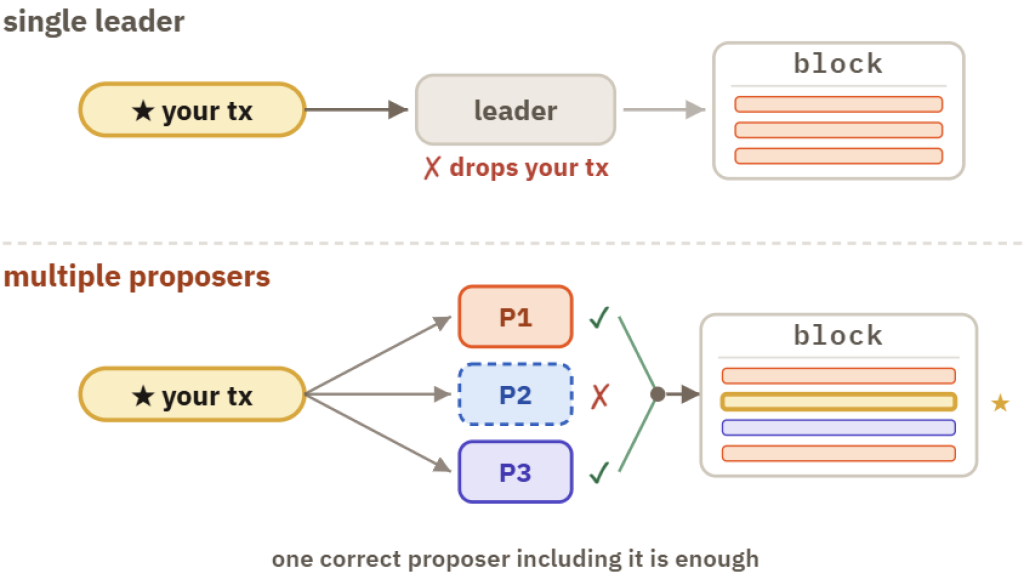
The arXiv paper describes Cadence’s fast path as finishing in three communication rounds, matching traditional single-leader consensus, with a faster two-round “speculative finality” borrowed from Category Labs’ existing MonadBFT design. Each block runs as an independent consensus instance under what the researchers call extreme pipelining, decoupling block interval from network delay.
Category Labs also linked Cadence to BTX, its parallel design for encrypted mempools, calling the pairing a step toward fixing MEV inside the protocol rather than patching it afterward.
What This Means for Monad Traders and Developers
Cadence targets the exact mechanic behind front-running and sandwich attacks: a proposer’s ability to see a transaction and act on it first. At its 100 millisecond target, oracle prices, liquidations, and on-chain auctions could update roughly ten times more often than today, a change that matters most to the DeFi protocols and traders who depend on that data staying current.
Builders face a version of the same question on the regulatory side: the Clarity Act’s proposed developer safe harbor turns on how much control over a transaction a protocol actually has, the same line Cadence is redrawing at the consensus layer.
Whether Cadence Hits Its 100ms Target on Mainnet
Cadence is currently a research proposal backed by simulation results, not a live mainnet feature. The arXiv paper, last revised July 7, 2026, sets an initial target block interval of 100 milliseconds, about ten times faster than Monad’s current one-second block time.
Category Labs hasn’t published a mainnet date for Cadence itself, though its own blog shows RaptorCast, one of the protocol’s supporting components, already shipping in production, suggesting further pieces could roll out on a similar schedule.
What This Means for You
If you hold or trade MON, Cadence would make front-running harder, since no single proposer sees your order before it lands in a block. It won’t erase MEV, but it closes off the simplest version: one proposer seeing every pending transaction first, and faster blocks would narrow the window where a stale price triggers a bad liquidation. None of this is live yet, so treat Cadence as a design to track, not to plan around today.