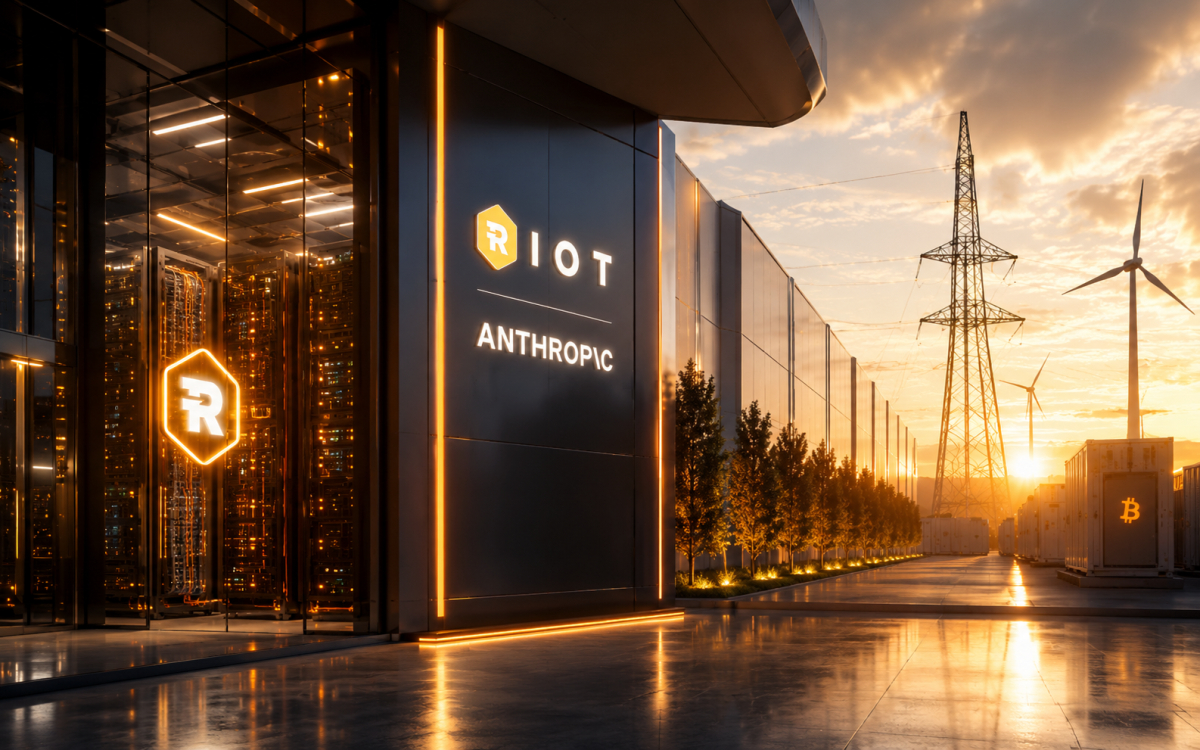
Riot Platforms disclosed a 20-year data center lease agreement on August 10, 2026 Monday with an initially unnamed “leading frontier AI” company, later reported by Bloomberg to be Anthropic, expected to generate roughly $9.1 billion in total contract revenue.
Inside the Deal
The agreement covers 191 megawatts of IT capacity at Riot’s Rockdale campus in Texas, enough to power roughly 143,000 homes at any given moment, and runs through June 2048.
Delivery is phased, with the first 96 megawatts targeted for December 2027 and the full 191 megawatts by June 2028.
The contract includes two five-year extension options that could raise its total potential value to $16.1 billion.
Riot said it secured a $573 million interim financing facility from Morgan Stanley to cover initial development costs while it finalizes a separate, investment-grade credit backstop for the buildout.
Riot’s regular Monday trading session closed down 5.46%, but shares surged roughly 25% in after-hours trading once the deal’s scale became clear, trading near $24.30 to $24.40.
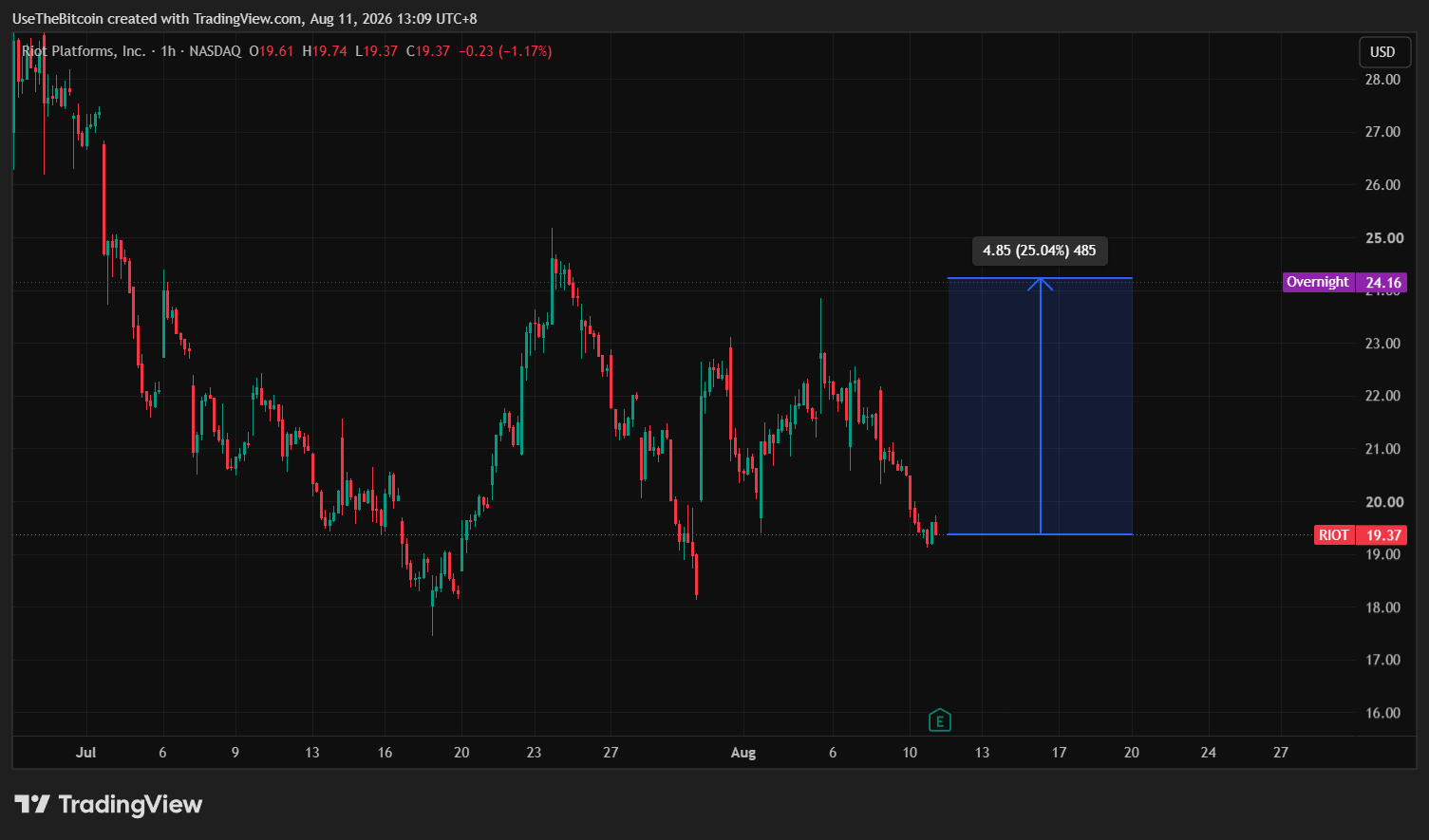
Riot declined to comment on Anthropic specifically as the counterparty, and Anthropic did not respond to a request for comment, though Bloomberg’s sourcing on the identification was described as coming from people familiar with the matter.
Riot itself only described its counterparty as a “leading frontier AI” company in its own disclosure, leaving the specific identification to Bloomberg’s separate reporting rather than confirming it directly.
Riot’s Second Major AI Deal This Year
This follows an earlier lease Riot signed with AMD in January 2026.
CEO Jason Les tied the two deals together directly in the company’s earnings statement. “In just over six months, Riot has now executed leases totaling 241 megawatts of capacity, representing approximately $9.8 billion of long-term, contracted revenue with two of the most important companies in the AI ecosystem,” Les said.
He added that Riot differentiates itself through fully approved, multi-gigawatt-scale power capacity already energized, in-house data center development expertise, and the ability to engineer custom infrastructure for demanding workloads.
Riot began shifting from Bitcoin mining toward AI data centers in 2025, formally launching a process to monetize its power and infrastructure for high-density computing before signing its first major lease with AMD that January.
Notably, this isn’t even the company’s first major pivot. Riot originally operated as a maker of diagnostic machinery for the biotech industry under the name Bioptix before shifting into Bitcoin mining years earlier.
Each pivot has followed the same underlying logic, redirecting the company’s existing assets, whether lab equipment, mining rigs, or now data center capacity, toward whichever market offers the strongest returns at the time.
Peers including Core Scientific, IREN, Applied Digital, TeraWulf, and Hut 8 are pursuing similar AI and high-performance computing strategies, a trend our earlier coverage of Bitcoin’s hash rate decline and the AI mining pivot explores in more depth across the broader mining industry.
Anthropic’s Broader Capacity Push
The deal fits into a wider pattern of Anthropic securing computing capacity across multiple providers to keep pace with customer demand.
The company already relies heavily on Amazon Web Services (AWS), Google Cloud, Microsoft Azure, and CoreWeave, and has separately signed a $10 billion deal with the infrastructure startup Volta Infra and agreed to buy nearly $45 billion in computing from Elon Musk’s xAI in May.
For comparison, rival OpenAI’s top cloud vendors are Microsoft Azure, Oracle Cloud, AWS, CoreWeave, and Google Cloud, a similar but not identical mix.
Riot’s Second-Quarter Results
The deal was announced alongside Riot’s second-quarter earnings, which showed mixed results.
Total revenue rose 14% to $174.2 million from $153 million a year earlier, with data center revenue contributing $23.2 million, reflecting the completion of the initial 25 megawatts delivered to AMD.
Bitcoin mining revenue came in at $113.7 million and engineering revenue rose to $37.3 million. The company produced 1,587 BTC during the quarter and ended the period holding more than $1.2 billion in liquid assets, including 11,380 BTC and $548.9 million in cash.
Riot posted a net loss of $237.2 million, or $0.68 per diluted share, compared with net income of roughly $219.4 million, or $0.58 per share, in the same quarter last year.
What Comes Next
Retail sentiment shifted to bullish following the news, with RIOT stock up 53% year-to-date as of its last close.
What this means for you: Riot’s balance sheet still shows meaningful Bitcoin exposure even as its revenue mix shifts toward AI hosting, so the stock increasingly functions as a hybrid bet on both Bitcoin’s price and the durability of long-term AI infrastructure contracts, a combination worth understanding clearly before treating RIOT as a pure proxy for either market on its own.