
Key Takeaways:
- Bitcoin fell 23% in the first 50 days of 2026, marking its worst start to any year on record.
- Six converging forces drove the decline: tariffs, tech correlation, record liquidations, institutional outflows, technical breakdown, and geopolitical risk.
- After hitting an all-time high of $126,272 in October 2025, Bitcoin dropped to a low near $61,000 before recovering into the $70,000 range by early March 2026.
Bitcoin entered 2026 already under pressure and never found its footing. By day 63 of the year, Coin Bureau confirmed that 2026 had become the worst-performing start in Bitcoin’s entire history when compared to the same period in all prior years. January closed down 10%. February fell another 15%. That back-to-back monthly loss had never happened before.
The total market cap dropped from roughly $4.4 trillion to approximately $2.3 trillion since Bitcoin’s October 2025 peak of $126,272. For anyone holding crypto through this period, the pain has been real. Six specific factors drove this selloff, and each one reinforced the others.
What Caused the BTC Price Crash in 2026
No single event triggered this decline. Six separate pressures built up over months and created a negative feedback loop. Understanding each one separately helps explain why recovery has been slow to arrive.
Tariffs Triggered the First Major Shock
President Trump announced a 15% global tariff rate in February 2026, expanding on the original tariff escalation that began in October 2025. Bitcoin fell more than 5% within hours of the announcement. The original “10/10 crash” on October 10, 2025, triggered by earlier tariff threats, produced over $19 billion in leveraged position liquidations in a single day. Bitcoin fell from roughly $122,000 to $105,000 in that session alone.
Tariffs raise inflation expectations. Higher inflation expectations reduce the likelihood of interest rate cuts. Higher rates keep yields elevated, pulling capital out of risk assets. Crypto, as the highest-beta asset class, gets sold first every time.
Tech Stocks Dragged Crypto Lower
Crypto’s correlation with U.S. tech stocks increased sharply throughout 2025 and 2026. When Microsoft reported disappointing quarterly earnings in late January and dropped roughly 10% in one session, Bitcoin followed. The AI trade unwinding added more pressure, as crypto miners with high-performance computing strategies sold Bitcoin to support their balance sheets.
Record Liquidations Amplified Every Drop
Leverage is what turns a correction into a crash. “Black Sunday II” on February 1 and 2 produced $2.56 billion in single-day liquidations. Days later on February 5, entity-adjusted realized losses hit $3.2 billion, an all-time record. Bitcoin briefly broke below $61,000 during that window.
Here is a quick breakdown of the key liquidation events:
- October 10, 2025: Over $19 billion wiped in 24 hours during the “10/10 crash.”
- February 1-2, 2026: $2.56 billion liquidated in a single day, Bitcoin breaks below $80,000.
- February 5, 2026: $3.2 billion in realized losses, an all-time record.
- February 23-24, 2026: $770 million liquidated after Trump’s 15% tariff announcement.
Institutional ETF Outflows Removed the Demand Floor
Throughout 2025, institutional buying through spot Bitcoin ETFs created a steady demand floor beneath the market. That floor disappeared in 2026. U.S. spot Bitcoin ETFs saw five consecutive weeks of net outflows totaling $3.8 billion through February 20. CoinShares reported that digital asset investment products turned negative year-to-date.
A brief reversal on February 25 brought $506.5 million back in, led by BlackRock’s IBIT at $297 million. However, by February 27, outflows resumed. That single positive day was a counter-trend bounce, not a trend reversal.
Bitcoin’s 365-Day Moving Average Broke Down
On the technical side, Bitcoin broke below its 365-day moving average for the first time since March 2022. That moving average had held as support throughout the entire 2023 to 2025 bull market. The break alarmed long-term analysts and triggered algorithmic selling. The weekly RSI also dipped below 30 for the first time since mid-2022, a level that historically marks either capitulation bottoms or the beginning of sustained bear markets.
Geopolitical Risk Pushed Capital to Safety
Growing U.S. military presence in the Middle East and escalating tensions with Iran pushed investors toward traditional safe havens. Cash and short-term Treasuries absorbed capital that previously flowed into crypto. Gold gained roughly 17% year-to-date while Bitcoin dropped, creating the widest divergence between the two assets in recent memory. That gap directly challenged the “digital gold” narrative that had supported Bitcoin’s valuation in prior cycles.
Where Does Bitcoin Stand Now
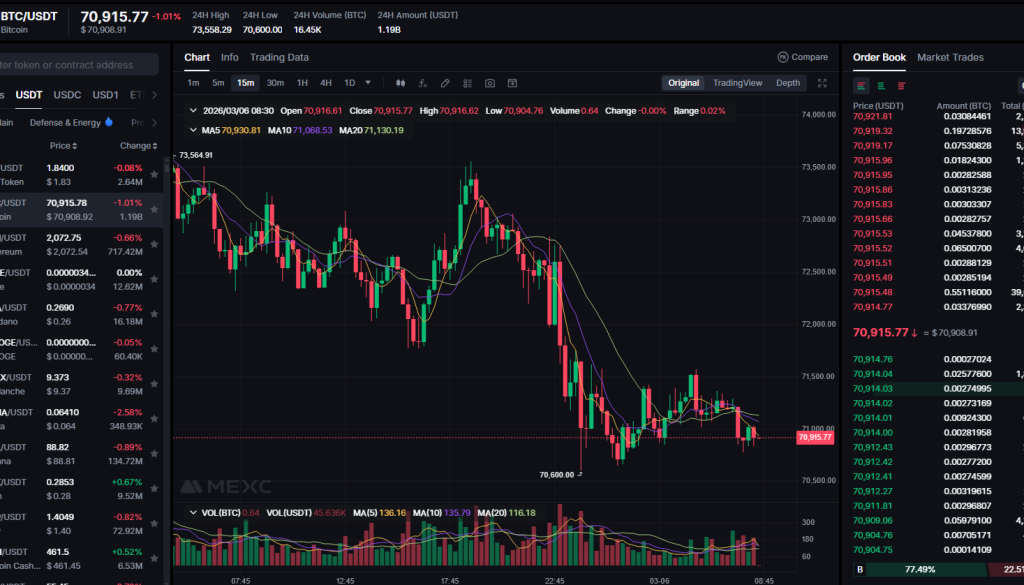
After bottoming near $61,000 in early February, Bitcoin recovered to the $70,000 to $73,000 range by early March 2026. The Crypto Fear and Greed Index, which hit 11 in late February, reflects the deepest sustained fear since mid-2022.
For where BTC trades today, see our live Bitcoin price page.
Despite the pain, Bitcoin’s current drawdown at roughly 48% from its all-time high is less severe than prior bear markets. For reference, here is how 2026 compares:
- 2014: Down 85% from peak, triggered by the Mt. Gox hack.
- 2018: Down 84% from peak, triggered by the ICO bubble burst.
- 2022: Down 78% from peak, triggered by Terra-Luna and FTX.
- 2026: Down approximately 48% from peak so far, driven by macro and structural factors.
That comparison cuts both ways. Recovery is historically possible. But further downside is also historically possible before a true bottom forms. Analyst forecasts currently range from a $38,000 worst-case scenario from Stifel Financial to a $60,000 bottom projection from Bernstein. Standard Chartered cut its 2026 year-end target to $100,000 from $150,000.
What Recovery Could Look Like
Analysts have identified specific signals that would indicate the worst is behind the market. None of them have fully triggered yet as of early March 2026.
Watch for these key recovery signals:
- Bitcoin reclaims $69,000: That former 2021 all-time high level would shift the technical outlook from bearish to neutral.
- ETF outflows reverse for two or more consecutive weeks: Sustained institutional inflows would signal that sentiment has bottomed.
- Fear and Greed Index rises above 25: Moving from extreme fear territory toward plain fear would suggest panic selling is exhausting itself.
- Tariff clarity: A softening or resolution of the 15% tariff rate would remove one of the main macro pressures weighing on risk assets.
For those holding Bitcoin on platforms like Binance, Coinbase, or Kraken, staying informed on macro developments is more important than ever during volatile periods. A good crypto portfolio tracker can help you monitor your exposure without making reactive decisions based on short-term price moves.
Bitcoin has survived Mt. Gox, the ICO collapse, Terra-Luna, and the FTX bankruptcy. Each time, the infrastructure emerged stronger and new all-time highs eventually followed. The current cycle’s institutional foundation, including ETFs holding roughly $165 billion in assets and a U.S. Strategic Bitcoin Reserve, provides a structural base that did not exist during prior crashes. Staying up to date on crypto news remains one of the best tools for navigating conditions like these.
Frequently Asked Questions
Why did Bitcoin crash so badly in early 2026?
Six forces hit simultaneously: Trump’s 15% global tariffs, tech stock correlation pulling crypto lower, record liquidations exceeding $3.2 billion in a single day, $3.8 billion in Bitcoin ETF outflows over five weeks, a technical breakdown below the 365-day moving average, and geopolitical tensions driving capital to cash.
How bad is the 2026 BTC price crash compared to prior bear markets?
Bitcoin is down roughly 48% from its October 2025 all-time high of $126,272. That is severe but still less extreme than the 78% to 85% drops seen in 2018 and 2022. Historical bear markets suggest further downside is possible before a confirmed bottom.
What is the lowest Bitcoin could go in 2026?
Analyst forecasts vary widely. Bernstein expects a bottom around $60,000. Standard Chartered warns of a possible drop to $50,000. Stifel Financial projects a worst-case decline to $38,000 based on a 15-year trendline. No consensus bottom has been confirmed.
Has Bitcoin ever had a worse start to a year?
No. Through the first 63 days of 2026, Bitcoin posted the worst same-day year-to-date performance in its entire history. It also recorded back-to-back losses in January and February for the first time ever.
What signals would confirm a Bitcoin recovery?
Key signals include Bitcoin reclaiming and holding $69,000, two or more consecutive weeks of net ETF inflows, the Fear and Greed Index rising above 25, and a clear softening of U.S. tariff policy.